Alaa Alkhatib
04/03/2026
Anatomy of Biological Dissonance
We exist in a moment of “Inertia before Collapse.” Biologist Edward Wilson argues that our existential tragedy is not a lack of resources, but this structural dissonance: we possess Paleolithic emotions, Medieval institutions, and God-like technology. This gap is not a fleeting flaw; it is the “Structural Necessity” that precedes great shifts. Our minds are still sociologically wired for gossip, revenge, and tribalism, while our technologies reflect sovereign capabilities that transcend borders and can erase the entire human race.
From “Safe Helplessness” to the “Precipice”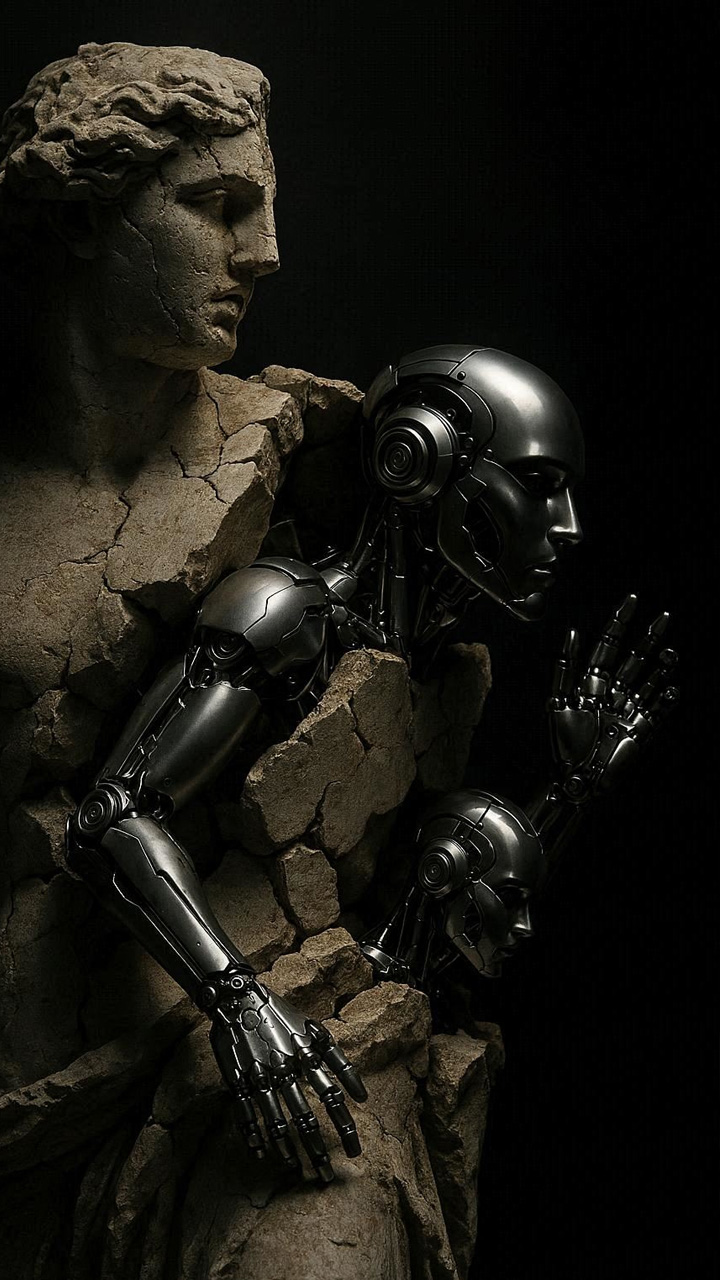
In his book The Precipice, Toby Ord confronts us with the “End of Political Innocence.” For 300,000 years, humanity was in a state of “Safe Helplessness.” Nature was harsh, and we killed each other repeatedly, but we lacked the tools for total extinction. Today, “Information,” the “Algorithm,” and “Synthetic Biology” have become sovereign tools and coercive forces. The problem is not that we are inherently evil, but that our “tools” have exceeded our “biological ceiling.” We use 21st-century physics, but manage it with a tribal mindset seeking dominance hierarchies.
Institutional Inertia and Bureaucracy
Here lies the danger: nation-states and slow bureaucracies are institutions designed for agrarian societies. These systems suffer from “Political Inertia,” making them unable to absorb the speed of existential threats. They attempt to govern a “De Facto” world with medieval legal tools. We face an international system emptied of its moral content, where society has turned into a market, and politics into mere technical management of primitive conflicts.
The Final Strategic Decision
Ord is not a pessimist; he seeks a “Sovereign Survival Strategy.” The solution lies in developing a “Collective Consciousness” and building institutions that match our lethal technologies in intelligence. But the forward-looking question remains: Does humanity have enough time to bridge this gap? Or will the “Intellectual Decision” come too late, after the wrong person, with the wrong primitive mindset, presses the red button?


