
Alaa Alkhatib
Originally published in Arabic on 11 October 2018 — edited English edition
1. Introduction
“Islam honored women” is a phrase frequently repeated in contemporary Muslim discourse. Yet the question itself—whether a religion “honored” women in the modern sense of equal rights and opportunities—is largely a product of modern social transformation. It was not framed in this way by earlier Muslim jurists and philosophers, just as comparable questions were rarely posed to other religions and societies before the modern age.
The more useful question requires a distinction between religion, the billions of people who believe in it, and the jurists and religious authorities who historically interpreted it and claimed authority over its meaning. This study therefore asks: to what extent did Muslim jurists, as a historically influential interpretive class, support or impede women’s movement toward rights and opportunities comparable to those of men within societies in which women had long been disadvantaged?
This distinction is essential. The study is not a judgment on Islam as revelation, nor does it attempt an exhaustive doctrinal debate over every legal ruling concerning women. Its approach is primarily historical and rational rather than confessional. It places the status of women within the broader evolution of human societies, where discrimination by class, race, lineage, religion, status, freedom, and sex has existed in many forms. It then examines how juristic interpretations interacted with inherited customs and patriarchal social structures.
For clarity, fiqh in this study means Islamic jurisprudence: the human scholarly process through which jurists interpreted the Qur’an, hadith, legal principles, precedent, custom, and other sources to formulate practical rulings. This is analytically distinct from revelation itself. Modern scholarship likewise emphasizes the importance of distinguishing Sharīʿa as a religious ideal from fiqh as historically developed human jurisprudence. [1] [2]
2. Why the Question Matters
Whenever questions of women’s rights are raised in societies suffering war, dictatorship, displacement, poverty, and political repression, an objection often appears: “Is this really the time to discuss women?” The objection is understandable, but its dismissive form reproduces a familiar authoritarian logic—the idea that rights, institutional reform, and social questions must be postponed until a supposedly greater battle has been won.
History suggests the opposite. Major political crises cannot be overcome simply by removing one ruler or defeating one enemy. Durable reform requires confronting the internal structures that reproduce injustice: political authoritarianism, sectarian and tribal privilege, religious monopoly, discrimination, and the unequal distribution of rights and opportunities.
Women constitute roughly half of every society. Their legal status, education, economic participation, bodily autonomy, and political citizenship are therefore not secondary questions to be addressed after “larger” problems are solved. They are part of the larger problem itself.
3. The Historical Position of Women
For most of recorded history, human societies were structured by multiple forms of hierarchy: rich and poor, ruler and ruled, master and slave, noble and commoner, dominant and subordinate ethnic or religious groups, and men and women. These hierarchies differed greatly across time and place, but patriarchal arrangements were widespread.
Several material conditions helped sustain them. Premodern economies depended heavily on physical labor; warfare was frequent and disproportionately mobilized men; pregnancy, childbirth, and infant care placed biological burdens on women that modern medicine and technology have only relatively recently reduced. Economic provision, military power, and political authority consequently became closely associated with men in many societies.
Over time, this division of labor could harden into a hierarchy of power. The man who earned, fought, owned, or inherited resources often acquired authority within the household, while the woman’s reproductive and domestic role was treated as dependence. This domestic hierarchy fitted easily into the broader authoritarian pyramid of premodern society: rulers and elites at the top, subordinate officials and social groups beneath them, and ordinary people near the bottom. Women were rarely represented in the upper layers of this pyramid and were frequently subject to men who were themselves subject to more powerful men.
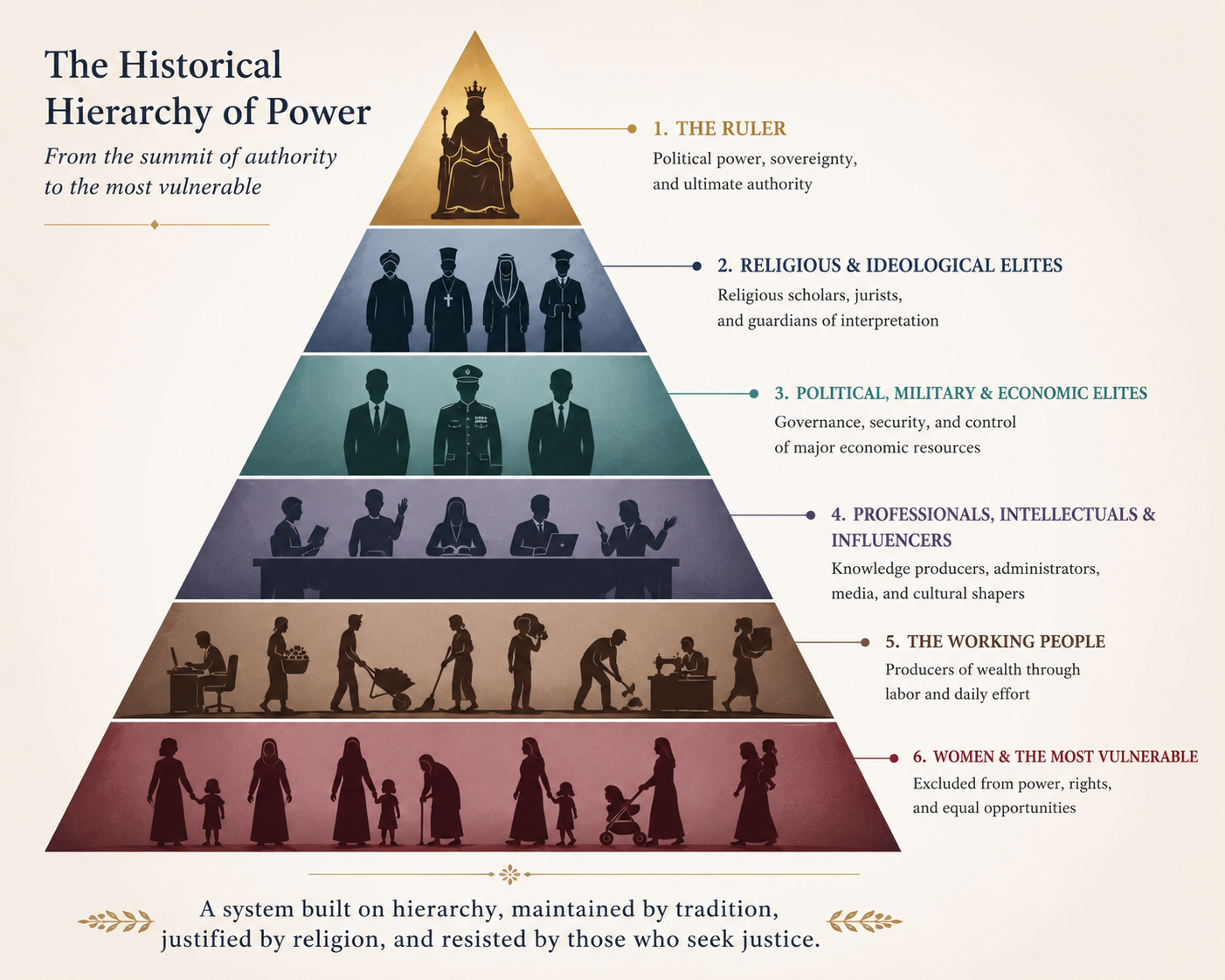
This pattern should not be overstated into the claim that women’s lives were identical in every civilization. Historical research documents significant differences in women’s property rights, access to courts, education, work, family bargaining power, and public roles. The defensible generalization is narrower: full legal and political equality between women and men, in the modern sense, was not the organizing norm of premodern civilizations. [3] [4]
4. Women in the Modern Age
Modernity transformed the material and legal foundations on which older gender arrangements had rested. Industrialization, mass education, modern medicine, contraception, new forms of work, representative politics, and the development of universal human-rights norms radically expanded the range of roles available to women.
Discrimination nevertheless persists everywhere, including in wealthy democracies. The difference is one of degree, law, institutions, and opportunity. Societies with stronger democratic institutions, broader education, more effective rule of law, and stronger commitments to equal citizenship have generally moved further toward gender parity than authoritarian, conflict-ridden, or highly traditional societies.
War and state collapse often magnify existing inequalities. In Afghanistan, Iraq, Syria, Yemen, Libya, and other conflict-affected societies, women have frequently borne distinctive burdens through displacement, insecurity, loss of education and work, coercive family arrangements, and restrictions imposed by armed or ideological authorities.
5. Why Full Rights Matter
The case for equal rights does not depend on proving that women and men are identical in every biological or psychological respect. Equal citizenship rests on a simpler principle: sex does not justify assigning one adult a lower legal status, fewer opportunities, or diminished human worth.
Modern science and technology have also removed many of the material arguments historically used to confine women to a narrow domestic role. Women participate fully in science, medicine, law, engineering, politics, business, education, and the arts. Preventing half of society from developing its capacities is not only unjust to women; it impoverishes society as a whole.
The strongest argument remains ethical: women are full human beings. Any legal or social system that diminishes their rights and opportunities merely because they are women requires justification against the modern principle of equal human dignity.
6. Religion and the Historical Status of Women
Religions have often introduced profound moral, spiritual, and communal changes, but they have rarely overturned every social hierarchy of the societies into which they emerged. Judaism, Christianity, and Islam all developed within worlds in which slavery, class hierarchy, patriarchal family structures, and political autocracy were normal features of social life.
Religious traditions could restrain abuses, create rights, or provide moral languages through which injustice was criticized. Yet religious institutions also absorbed prevailing social assumptions. Clerical and juristic classes were overwhelmingly male, and their interpretations often reflected societies in which male authority in family, economy, and politics was taken for granted.
In Islamic history, the relationship between law and women was more complex than a simple story of uninterrupted decline. Court records and legal studies show that women could own property, litigate, negotiate marriage conditions, seek divorce through various mechanisms, transmit religious knowledge, and exercise meaningful agency. At the same time, classical legal doctrine generally constructed differentiated rights and duties for men and women and embedded a gender hierarchy within family law. Both realities belong in an honest historical account. [1] [3] [4] [5]
7. Why Did Gender Become a Particularly Resistant Field?
Modern Muslim societies adapted—sometimes reluctantly—to many institutions that classical jurists had never known: the nation-state, modern banking, industrial technology, mass media, codified legislation, international law, and global economic systems. Many classical criminal and slavery-related rules also ceased to operate in most Muslim-majority states.
Gender relations, however, often became a field in which inherited juristic rulings and social customs retained exceptional symbolic power. Women’s clothing, mobility, marriage, divorce, sexuality, and family roles came to function not merely as private matters but as markers of religious authenticity and collective identity.
One reason may lie in the experience of defeat and dislocation that marked much of the modern Arab and Muslim world: colonialism, authoritarian government, military defeat, economic dependency, the Palestinian catastrophe, and repeated wars. Under such conditions, control over the family—and especially over women—could become a psychologically and politically accessible substitute for control that individuals lacked in public life.
This is an interpretive argument rather than a universal psychological law. It does not imply that every religious scholar, man, or family acts from the same motive. It suggests that gender regulation can acquire symbolic importance in societies where identity is perceived as threatened and where political power is concentrated elsewhere.
8. Islamic Jurisprudence and Historical Context
The rulings discussed here belong primarily to muʿāmalāt—the sphere of social and interpersonal relations—rather than to the core doctrines of faith or ritual worship. They were formulated by jurists living in particular times and places and working through historically developed methods of interpretation.
Recognizing this human and historical dimension does not require dismissing the Islamic legal tradition. It means distinguishing between revelation and jurisprudence, and between enduring ethical commitments and rules shaped by social conditions. Contemporary Muslim thinkers have taken very different positions on how far such rulings may be reinterpreted, but the debate itself demonstrates that fiqh is an interpretive tradition rather than a single timeless code.
The purpose here is therefore not to put the past on trial according to a simple scale of good and evil. It is to ask why interpretations formed under premodern conditions should exercise binding authority over societies whose knowledge, institutions, and conceptions of citizenship have fundamentally changed. [2] [6]
9. Forms of Gender Inequality Associated with Juristic Tradition Today
Contemporary debates concern a wide range of issues: women’s eligibility for high political or judicial office, qiwāma (male authority/responsibility within the family), polygyny, unilateral divorce, dress and seclusion, inheritance, blood money, testimony, and other differentiated rules. This study does not attempt to resolve each doctrinal dispute. It focuses instead on the image of women produced when particular rulings, hadith interpretations, and patriarchal customs reinforce one another.
9.1 The Claim that Women Are Less Intellectually Competent
One of the most widely repeated formulations is the hadith commonly rendered as describing women as “deficient in intellect and religion.” In the canonical Sunni collections, the report is situated in an address to women in which the Prophet is reported to connect “deficiency in intellect” to a rule concerning testimony and “deficiency in religion” to the suspension of prayer and fasting during menstruation. Classical and modern scholars have interpreted the report in different ways, and some modern Muslim writers have attempted to restrict its meaning to the specific legal and ritual context rather than treating it as a statement of women’s general intellectual inferiority.
The distinction is crucial. A report embedded in a particular rhetorical and legal context should not automatically be converted into a universal psychological proposition about half of humanity. The modern scientific literature does not support a simple hierarchy in which one sex possesses generally superior intellectual capacity. Meta-analyses find small or negligible differences in overall measures in many populations, alongside domain-specific differences that may favor males or females depending on the task, age, sample, and test. Such findings cannot sustain the popular claim that women are inherently less rational or intellectually competent.
The theological question is separate from the scientific one. Muslims who regard the hadith as authentic may interpret its language contextually, rhetorically, legally, or literally. The argument of this study is that using it as a generalized social doctrine of female intellectual deficiency is neither required by the scientific evidence nor intellectually defensible.
The familiar contrast between the “emotional woman” and the “rational man” is equally weak as a basis for political or familial authority. Human history—overwhelmingly governed by men—contains war, tyranny, cruelty, and catastrophic miscalculation alongside extraordinary creativity and achievement. Male dominance in historical leadership is not evidence of superior rationality; nor would female leadership prove the reverse. [7] [8] [9]
9.2 Menstruation, Ritual Purity, and the Female Body
The female body has also been burdened by ideas of purity, danger, shame, and sexual control across many cultures and religions. Menstruation is a particularly revealing example. The Hebrew Bible’s Leviticus 15 contains ritual-impurity rules associated with menstrual bleeding, and menstrual taboos have appeared in many societies in very different forms.
Islamic jurisprudence likewise developed extensive rules concerning menstruation (ḥayḍ), including the suspension of prayer and fasting and restrictions on certain ritual acts. Jurists disagreed on many details, but menstrual blood was commonly discussed within legal categories of impurity (najāsa) and ritual state. It is important, however, not to collapse ritual impurity into a modern medical claim that menstruation is filthy, toxic, or evidence of bodily inferiority. Ritual categories operate within a religious legal system; biological cleanliness and microbial status are different questions.
Modern medicine describes menstrual fluid as a complex physiological mixture of blood, endometrial tissue and cells, cervical mucus, vaginal secretions, immune cells, proteins, and other components. It is not medically accurate to describe menstrual fluid as sterile: contemporary microbiome research detects bacterial communities in menstrual and reproductive-tract samples. The older claim that menstrual fluid is “more sterile than all other bodily fluids” should therefore be abandoned. The stronger and scientifically defensible point is that menstruation is a normal physiological process and provides no basis for treating women as physically degraded or morally contaminated.
This distinction also allows a more serious religious discussion. Exemption from prayer or fasting during menstruation can be understood within the logic of ritual law without turning a temporary ritual status into a theory of female inferiority. The problem begins when legal terminology is absorbed into popular culture as contempt for the female body. [10] [11] [12]
9.3 Childhood Marriage and the Question of Consent
Classical jurists also discussed the marriage of minors within social worlds in which childhood, adulthood, consent, and family authority were conceptualized differently from today. Major Sunni schools permitted guardians to contract certain marriages for minors, while jurists debated the conditions governing consummation and harm. Classical texts therefore need to be described accurately rather than sanitized or sensationalized.
From a modern rights-based perspective, the decisive issue is the child as a person with developing autonomy, physical vulnerability, and a right to education and meaningful consent. Historical context can explain why jurists formulated rules in a particular way; it does not require modern societies to reproduce those rules after radically different understandings of childhood, medicine, education, and human rights have emerged.
The same methodological principle applies when evaluating highly disturbing passages attributed to individual jurists in later legal works: the text should be cited precisely, its school and context identified, and it should not be presented as if it represented every Muslim jurist or Muslim community. [13] [14]
9.4 Dress, Seclusion, and the Regulation of Women’s Bodies
Debates over hijab, niqab, ʿawra, seclusion, and women’s mobility contain enormous diversity within Islamic thought. They also illustrate the degree to which the female body has become a site on which communities negotiate sexuality, honor, piety, identity, and fear of social change.
The criticism advanced here is not directed at women who freely choose religious dress. Freedom must include the freedom to wear religious clothing as well as the freedom not to be coerced into it. The problem is a legal or social structure that treats women’s bodies primarily as sources of sexual temptation requiring confinement while granting men a much wider presumption of mobility and bodily autonomy.
When rules developed in patriarchal societies are presented as the only possible expression of Islam, historical interpretation is transformed into sacred necessity. That is precisely the distinction this study seeks to reopen.
10. Conclusion
Reconsidering inherited juristic rulings about women is not an act of hostility toward Islam. It follows from a simple historical fact: contemporary societies possess scientific knowledge, educational systems, political concepts, and human-rights norms unavailable to premodern jurists.
The jurists of the past were products of their worlds, just as modern interpreters are products of theirs. Some mitigated the harshness of prevailing norms; others reproduced them. The mistake is not that medieval scholars failed to think like twenty-first-century citizens. The mistake is to transform every historically conditioned interpretation into an untouchable rule for the future.
A serious renewal of Islamic thought therefore requires separating revelation from the accumulated authority of interpretation. It requires preserving the right to examine hadith, jurisprudence, custom, and inherited social assumptions with the tools of language, history, reason, ethics, and contemporary knowledge.
Women’s equality is not a peripheral concession to modernity. It is part of the larger struggle against inherited hierarchies that rank human beings by sex, class, race, lineage, sect, or power. A society cannot credibly demand freedom from political domination while reproducing domination inside the family and the social order.
Glossary of Key Terms
Fiqh: Islamic jurisprudence: the historically developed human scholarly interpretation of practical religious and legal norms.
Sharīʿa: Literally “the path”; often used for the divine normative ideal of Islam. Modern scholarship frequently distinguishes it from fiqh, the human juristic elaboration of that ideal.
Hadith: A transmitted report concerning words, actions, approvals, or characteristics attributed to the Prophet Muhammad.
Qiwāma: A Qur’anic and juristic concept concerning men’s responsibility/authority within the family; its scope and modern interpretation are intensely debated.
Muʿāmalāt: The sphere of social, contractual, economic, and interpersonal legal relations, conventionally distinguished from ritual worship.
ʿIbādāt: Acts of ritual worship, such as prayer and fasting.
Najāsa: Legal or ritual impurity in Islamic jurisprudence; not necessarily equivalent to a modern medical concept of contamination.
Ḥayḍ: Menstruation; a detailed subject of Islamic ritual jurisprudence.
ʿAwra: Parts of the body that jurisprudence requires to be covered in specified contexts; definitions vary by school, sex, and circumstance.
Taklīf: Religious-legal accountability or obligation.
Editorial Note on the English Edition
This is an edited translation rather than a literal rendering of the 2018 Arabic text. The author’s central argument and critical voice have been preserved, while several categorical historical claims have been qualified, technical Islamic terms have been explained, and distinctions have been added between scripture, hadith, jurisprudential interpretation, social custom, and the author’s own critique. The discussion of menstruation has also been updated: contemporary research does not support describing menstrual fluid as sterile; the text therefore retains the intended argument—that menstruation is a normal physiological process and not evidence of female degradation—without repeating the older scientific claim.
References and Further Reading
Bracketed citations in the text link to the corresponding reference below. The English edition retains key sources from the Arabic original and adds modern academic sources where historical or scientific context required strengthening.
- Saadia Yacoob, “Islamic Law and Gender,” in The Oxford Handbook of Islamic Law (Oxford University Press, 2018). Source
- Natana J. DeLong-Bas, “Women’s Rights and Duties in Classical Legal Texts: Modern Rereadings,” in The Oxford Handbook of Islam and Women (Oxford University Press, 2023). Source
- Leila Ahmed, Women and Gender in Islam: Historical Roots of a Modern Debate (Yale University Press, 1992). Source
- Judith E. Tucker, In the House of the Law: Gender and Islamic Law in Ottoman Syria and Palestine (University of California Press, 1998). Source
- Amira El-Azhary Sonbol, “Women in Shari‘ah Courts: A Historical and Methodological Discussion,” Fordham International Law Journal 27 (2003). Source
- ʿAbd al-Karīm al-Namlah, Al-Muhadhdhab fī ʿIlm Uṣūl al-Fiqh al-Muqāran (Riyadh: Maktabat al-Rushd, 1999), source cited in the Arabic original.
- Khaled Abou El Fadl, “Modern Rereadings of the Ḥadīth through a Gendered Lens,” in The Oxford Handbook of Islam and Women (Oxford University Press, 2023). Source
- Meta-analysis: “The Impasse on Gender Differences in Intelligence: a Meta-Analysis on WISC Batteries,” Educational Psychology Review 34 (2022). Source
- ʿAbd al-Ḥalīm Abū Shuqqa, Taḥrīr al-Marʾa fī ʿAṣr al-Risāla (Dar al-Qalam, 1990), source cited in the Arabic original.
- I. S. Fraser et al., “Blood and total fluid content of menstrual discharge,” Obstetrics & Gynecology 65, no. 2 (1985): 194–198. Source
- “Proteomic Analysis of Menstrual Blood,” Molecular & Cellular Proteomics (2012). Source
- “Microbiological and Cytokine Profiling of Menstrual Blood for the Assessment of Endometrial Receptivity,” Biomedicines 11 (2023). Source
- Ibn Rushd, Bidāyat al-Mujtahid wa Nihāyat al-Muqtaṣid, Book of Purification, source cited in the Arabic original.
- Al-Nawawī, Sharḥ Ṣaḥīḥ Muslim, vol. 9, chapter on the marriage of a young virgin by her guardian, source cited in the Arabic original.
- ʿAbd al-Raḥmān al-Jazīrī, Al-Fiqh ʿalā al-Madhāhib al-Arbaʿa (Dar al-Kutub al-ʿIlmiyya, 2003), source cited in the Arabic original.
- Leviticus 15:19–30, source cited in the Arabic original. Source
- Original Arabic article on InfoSalam, first published 11 October 2018. Source


