
State-Building, National Cohesion and the Search for a Sustainable Governance Model
Alaa Alkhatib
30 August 2025
Download / Read the Full Study (PDF)
English edition adapted from the original Arabic study
Contents
- Governance in the Modern State
- Centralized Government
- Federal Government
- Confederation
- Political Decentralization
- Administrative Decentralization
- Comparing Governance Models
- Real-World Applications
- Decentralization and Federalism in Post-Conflict States: Opportunities and Risks
- What Governance Model Is Best Suited to Syria in 2025?
Choosing a form of government is not merely a technical question of public administration. It expresses a social contract: where legitimacy originates, how authority and resources are distributed, and which mechanisms are used to resolve conflicts within society. Every model of governance – centralized, federal, politically or administratively decentralized, or confederal – represents a practical balance among competing considerations: state unity versus internal diversity, efficiency and speed versus representation and participation, and coherence in national decision-making versus responsiveness to regional particularities.
The success of any model does not depend on an ingenious constitutional text alone. It also requires a political culture capable of coexistence and managing disagreement, institutions that separate powers and uphold the rule of law, and safeguards for human rights and equal citizenship. The form of government should therefore be a means to achieve higher objectives – stability, justice, development and freedom – rather than an end in itself.
Because these terms are sometimes used interchangeably, it is useful to distinguish among the state as the overarching sovereign entity, the political system as the constitutional and legal framework through which authority is distributed, and the government as the changing executive authority. This distinction helps identify where dysfunction lies and how institutional gaps may be addressed.
Debate over Syria’s future form of government has continued for more than a decade, particularly since the establishment of the Autonomous Administration in northeastern Syria and the emergence of the Syrian Democratic Forces (SDF). The debate returned with greater intensity after the fall of Bashar al-Assad’s regime and Ahmed al-Sharaa’s rise to power, especially as deep disagreements emerged between the SDF and the interim Syrian authorities. It intensified further after the massacres on the coast and in Suwayda, the rejection of the interim authorities by actors in both areas, and the emergence of voices calling even for separation from Syria.
Against this background, this paper reviews the principal forms of government in the modern state and the ways in which they distribute authority. It then compares them through historical and contemporary cases before applying the analysis to Syria. The practical question is: what institutional mix is most likely to preserve the unity and sustainability of the state while providing fair representation and a balanced distribution of power and wealth?
1. Governance in the Modern State
Governance is the framework through which a society manages its internal affairs and the state manages its relations with other states, through a system of public authorities and sovereign functions.
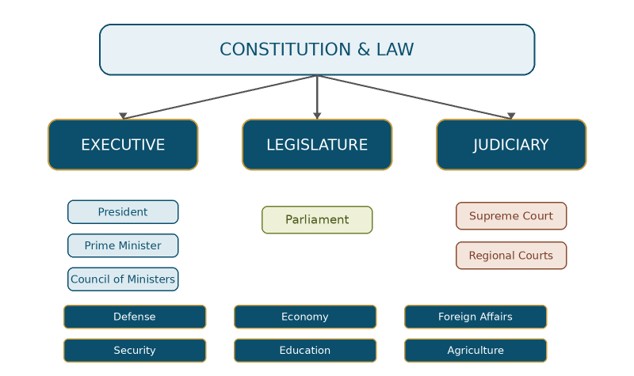
The constitution and legal order define and regulate the operation of state authority. Traditionally, this system includes three independent branches:
- Legislative authority: makes laws and enacts legislation. It is usually exercised through elected bodies that, in principle, represent the people, such as a parliament, national assembly or senate.
- Executive authority: implements public policy and manages the activities required to preserve the stability, safety and security of the state and society. It is also responsible for enforcing the law and implementing legislative and judicial decisions. It includes the presidency, government, armed forces, security services and public institutions.
- Judicial authority: resolves disputes and oversees the application of law through the judicial system, principally the courts and their supporting institutions.
Alongside these traditional branches are core sovereign functions that determine the independence and sovereignty of the state: managing economic policy; commanding the armed forces, police and security services; conducting foreign relations and international treaties; and controlling natural and subsoil resources. How these powers and responsibilities are distributed between the center and regions or local units determines the form of government.
2. Centralized Government
2.1 Definition
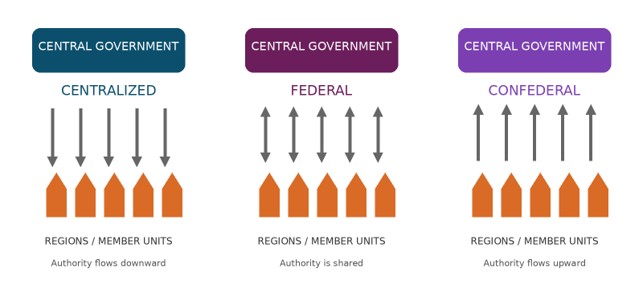
A system in which the powers of government are concentrated at the center under a single central government. Local governments or administrations operate primarily as executive arms under close central supervision and possess very limited autonomous powers.
2.2 Characteristics and Distribution of Powers
- Legislation and public policy: uniform laws are established by the central authority and apply throughout the country.
- Executive administration: ministries and central agencies lead the main sectors and delegate only limited administrative tasks to local units.
- Judiciary: a unified judicial hierarchy operates under a central supreme authority.
- Security, defense and foreign relations: managed centrally through the armed forces, security institutions, foreign policy and treaty-making.
- Economy and resources: the center sets economic strategies and controls national resources, subsoil wealth and their distribution.
- Advantages and limitations: rapid decision-making and uniform standards, but potentially slower responses to local needs, greater bureaucracy, and a higher risk of authoritarian concentration if democratic safeguards are absent.
2.3 Examples
France (traditionally), Egypt and China; historically, Syria also followed a centralized model before the current debate over redistribution of authority.
3. Federal Government
3.1 Definition
A constitutional system in which powers are divided between a central or federal government and regional governments – states, provinces or other constituent units – with each level possessing constitutionally defined areas of autonomous authority.
3.2 Characteristics and Distribution of Powers
- Federal center: generally responsible for defense, national security, foreign policy, currency and international treaties.
- Regions: legislate in designated local fields such as education, taxation and parts of health policy and policing.
- Advantages and limitations: provides flexibility and accommodates diversity, and is compatible with democratic government, but requires a precise constitutional settlement to prevent conflicts of jurisdiction.
3.3 Examples
The United States, Germany, Canada and, with its distinctive characteristics, the United Arab Emirates.
4. Confederation
4.1 Definition
A union of independent sovereign states that delegate selected powers to a common body while retaining their fundamental sovereignty.
4.2 Characteristics and Distribution of Powers
- Common center: comparatively weak and often limited to trade or agreed aspects of common foreign policy.
- Member states: retain their own armed forces, economies, legislation and sovereign authority.
- Advantages and limitations: offers maximum flexibility but is vulnerable to fragmentation and weak collective effectiveness.
4.3 Examples
The Swiss Confederation before 1848; the European Union as a partially confederal arrangement; the Confederate States of America (1861-1865); and the pre-1971 arrangements among the emirates that later formed the UAE.
5. Political Decentralization
5.1 Definition
Political decentralization grants regions legislative and executive powers while remaining within a single unified state. It goes beyond administrative delegation by providing subnational governments with genuine political autonomy, including the authority to enact laws, levy taxes and elect their leadership independently.
5.2 Characteristics and Distribution of Powers
- Center: retains defense, foreign policy and the national armed forces.
- Regions: possess elected parliaments and local governments with relatively autonomous legislative and executive powers in areas such as taxation and local policy.
- Advantages and limitations: strengthens representation and responsiveness to diversity, balancing unity and difference. If constructed primarily on ethnic or sectarian foundations, however, it may also create pathways for separatist demands.
5.3 Examples
Spain (Catalonia and the Basque Country), India, Indonesia after 1999, and the Kurdistan Region of Iraq.
6. Administrative Decentralization
6.1 Definition
Under administrative decentralization, the central government delegates administrative and local responsibilities to local authorities while retaining political and legislative control at the center.
6.2 Characteristics and Distribution of Powers
- Center: establishes national legislation and national policy.
- Governorates and municipalities: manage everyday services such as education, health, municipal affairs and sanitation under central oversight.
- Advantages and limitations: can improve local service delivery and reduce bureaucracy, but does not fundamentally alter the balance of political power.
6.3 Examples
Morocco through local-government reforms, Japan through prefectural governments, and Tunisia following the 2014 Constitution.
7. Comparing Governance Models
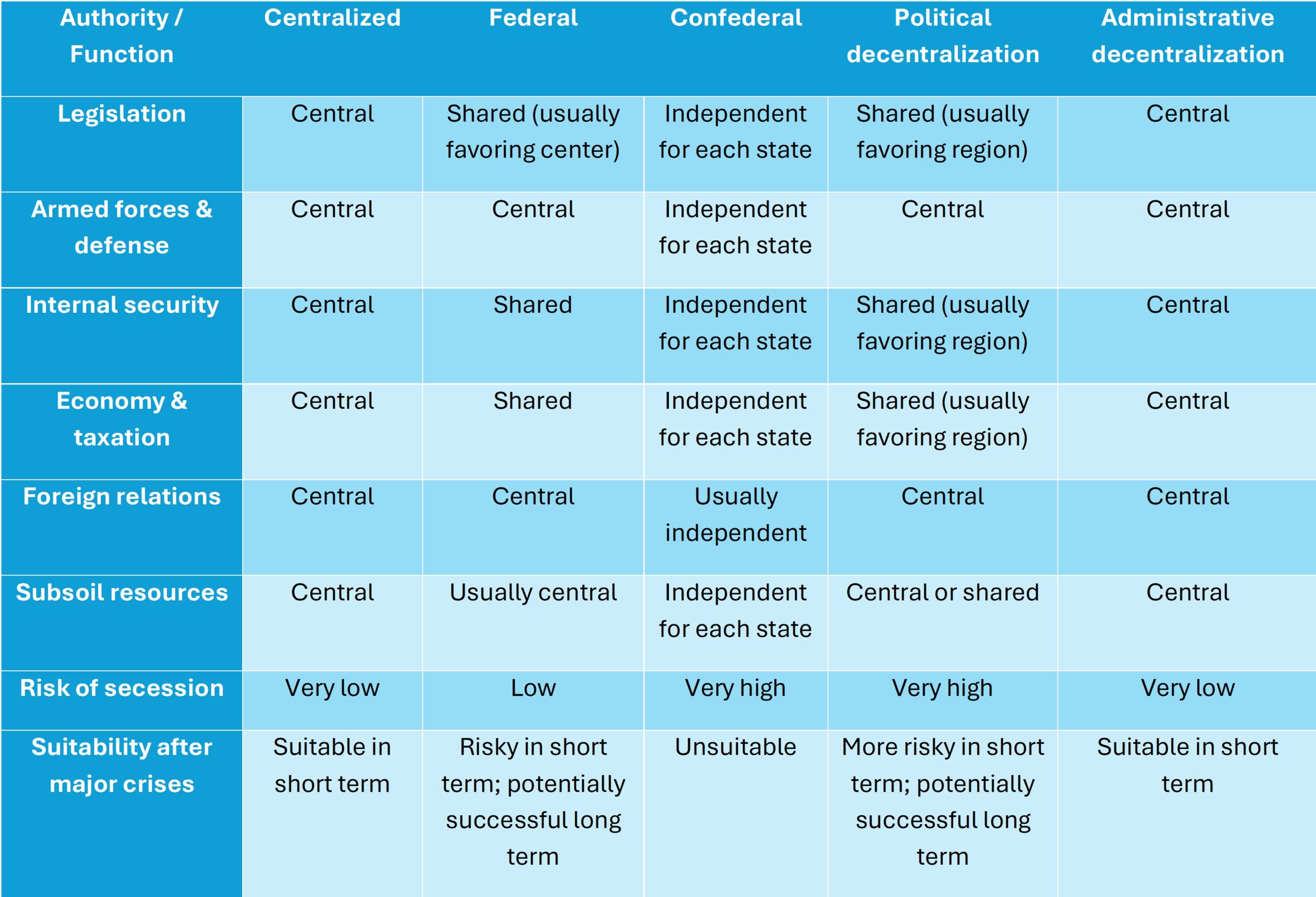
These definitions should not be treated as rigid boundaries between the systems that exist today. A formally centralized state may contain features commonly associated with federalism. France, for example, remains a centralized state while granting substantial powers to territorial authorities, particularly in fields such as education and transport. Labels such as “federal” or “politically decentralized” therefore do not by themselves reveal the actual distribution of authority; the institutional details vary from one country to another.
Centralized systems can provide the strongest formal guarantee of national unity, but they may also be less effective in ensuring equitable distribution among regions and more distant from the everyday concerns of citizens.
8. Real-World Applications
The comparison suggests that advanced states often employ federal arrangements, developing states more frequently retain centralized structures, while states emerging from conflict are often pushed toward fragile forms of decentralization. The following cases illustrate how different countries have responded to major political or social crises.
8.1 Germany after the Second World War
After the collapse of the Nazi regime, Germany was rebuilt as a federal state in 1949, distributing authority between the federal government and 16 Länder. The aim was to prevent a return to extreme central authoritarianism and to strengthen local democracy. The German experience is widely regarded as one of the most successful federal models in modern history.
8.2 Belgium
Following linguistic and cultural crises between Flemish and French-speaking communities, Belgium gradually transformed into a federal system beginning in the 1980s. It now contains three regions and three language communities with extensive powers, making it a prominent example of cultural federalism in Europe.
8.3 Spain
After the end of Francisco Franco’s rule in 1975, the 1978 Constitution granted broad political powers to autonomous communities. Although Spain is not formally a federation, its system is sometimes described as a form of de facto or quasi-federalism. Catalonia and the Basque Country possess extensive autonomy, although political tensions remain.
8.4 United Arab Emirates (1971)
Although the UAE did not emerge from a civil war, the federation was established after a period marked by tribal divisions and separate emirate structures. The model has proved durable, supported by political consensus, resource distribution and constitutional flexibility.
8.5 Iraq after the Fall of Saddam Hussein (2003)
Iraq’s 2005 Constitution established a federal system. The Kurdistan Region received broad autonomy, with its own parliament and security forces. Implementation outside Kurdistan remained limited amid sectarian conflict, foreign intervention and weak trust among communities. The result has often functioned as an incomplete federal arrangement: administratively significant but politically contested.
8.6 Ethiopia after the Fall of Mengistu (1991)
After the fall of Mengistu Haile Mariam in 1991, Ethiopia adopted a system of ethnic federalism in which regions were largely defined by ethnolinguistic identity and constitutionally granted a theoretical right to secession. Subsequent internal conflicts, including the Tigray war, illustrate the risks that can arise when federal structures become closely tied to closed identity categories.
8.7 Bosnia and Herzegovina after the Balkan War (1992-1995)
The 1995 Dayton Agreement created a highly complex federal arrangement divided principally between Republika Srpska and the Federation of Bosnia and Herzegovina. Although the agreement ended the war, the political system has remained fragile and deeply affected by ethnic and political divisions. Federalism in this case functioned primarily as an instrument of conflict settlement rather than as a pre-existing project of national unity.
8.8 Sudan (Comprehensive Peace Agreement, 2005)
The peace agreement granted southern Sudan autonomous federal status for six years together with a right to hold a referendum. The 2011 referendum ultimately resulted in the independence of South Sudan.
8.9 Lebanon
Lebanon did not formally adopt federalism, but it institutionalized sectarian power-sharing at the center: the presidency is reserved for a Maronite Christian, the premiership for a Sunni Muslim, and the speakership of parliament for a Shia Muslim. The arrangement was intended to reassure different communities, yet it also contributed to institutional paralysis and entrenched sectarian identity within the political system. Lebanon demonstrates that sectarian power-sharing may prevent domination by one group without necessarily producing a strong or stable state.
8.10 Rwanda after 1994
After the 1994 genocide, Rwanda did not move toward federalism or political decentralization. The new government led by the Rwandan Patriotic Front instead emphasized strong central authority to restore security and prevent renewed territorial or ethnic division. Administrative decentralization was introduced gradually through reforms between 2000 and 2006, giving local authorities greater roles in services and development while sovereign decisions remained centralized. The underlying logic was to avoid institutionalizing ethnic divisions through territorial political structures.
8.11 Turkey
Turkey is an example of a strongly centralized state that nevertheless permits substantial administrative decentralization. Major municipalities such as Istanbul and Ankara possess important administrative and financial responsibilities while remaining under central-state supervision. Despite enduring national tensions, particularly around the Kurdish question, the model illustrates how centralization can coexist with expanded local administration when institutions are sufficiently capable of managing the balance.
9. Decentralization and Federalism in Post-Conflict States: Opportunities and Risks
When states experience severe internal crises or civil wars, federalism or political decentralization is often proposed as a means of sharing power and reassuring communities that have been in conflict. A central objective is to prevent the return of authoritarian centralization, which in many cases contributed to the original conflict.
9.1 Opportunities and Advantages
- Power- and wealth-sharing: broadens the participation of regions and communities in decision-making and reduces perceptions of marginalization.
- Reducing security tensions: when regions manage their daily affairs, direct friction with the center may decrease.
- Flexibility in managing diversity: gives regions with distinct ethnic or cultural characteristics space to express their identities within a single state.
- Distribution of development: reduces the concentration of economic resources in the capital.
9.2 Risks and Challenges
- State fragility: in the absence of strong institutions, federalism may become a pathway toward secession.
- Dual or overlapping sovereignty: conflicts of jurisdiction between the center and regions can produce political paralysis.
- Weak national loyalty: local, ethnic or sectarian identities may overshadow a shared national identity.
- Disputes over resources: conflicts over the distribution of natural resources may reignite political or armed confrontation.
9.3 Conditions for Successful Federalism or Political Decentralization
For federal or politically decentralized arrangements to succeed in post-conflict contexts, several conditions are essential:
- A clear constitution precisely defining the powers of the center and the regions.
- An independent judiciary capable of resolving constitutional disputes.
- Fair distribution of national wealth through transparent mechanisms.
- A consensual political culture in which federalism is used as a framework for coexistence rather than a transitional stage toward separation.
- Unified national armed forces and security institutions under central-state authority, while allowing for local policing where appropriate.
- A structured roadmap to address the accumulated effects of deep social cleavages and rebuild trust among communities – a prerequisite for durable institutions and political stability.
9.4 Comparison with a Centralized System
In Rwanda, strong central authority helped prevent the territorial institutionalization of ethnic division and supported the construction of comparatively strong institutions intended to prevent a return to large-scale violence.
Developing states emerging from major crises have not consistently demonstrated strong federal outcomes when federalism is introduced during the immediate recovery period.
The successful federal or highly decentralized experiences of Germany, Belgium and Spain developed in states that possessed relatively advanced political, educational and economic foundations. Their crises also differed from civil wars structured primarily around sectarian or religious divisions, and external powers generally had an interest in their stabilization. The UAE likewise did not move into its federal arrangement immediately after a devastating internal civil war, and influential external actors broadly supported the new union.
At the same time, centralization after a major crisis carries its own danger: the reproduction of dictatorship. Many authoritarian systems have relied on extreme concentrations of central power, including Nazi Germany, the Soviet Union, Saddam Hussein’s Iraq, North Korea, and Syria under Baath Party rule and the presidencies of Hafez and Bashar al-Assad.
10. What Governance Model Is Best Suited to Syria in 2025?
10.1 The Major Challenges Facing Syria
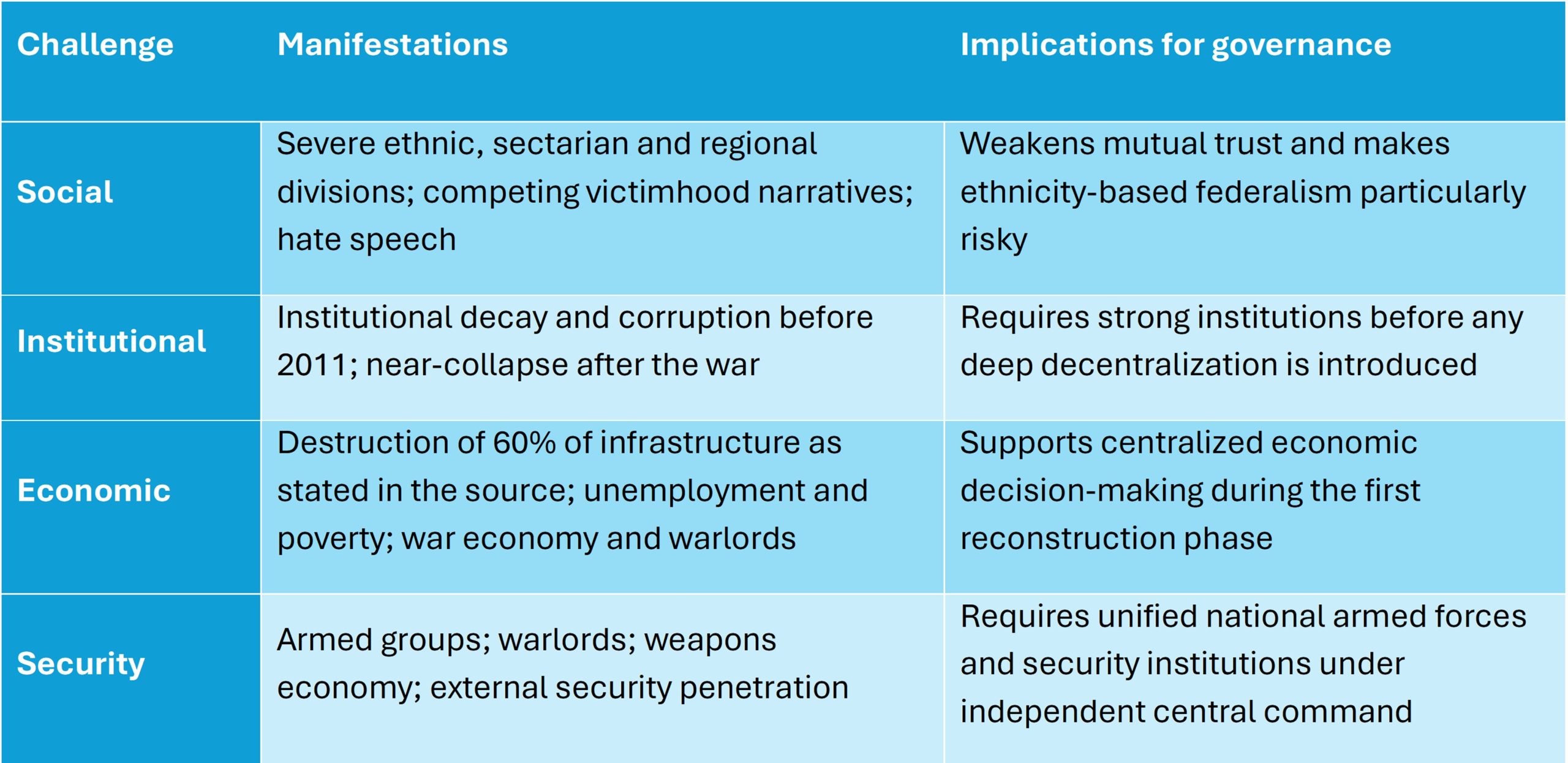
After the fall of the Assad regime, Syria faces several major challenges. In order of their severity in the argument of this paper, they can be summarized as follows.
10.1.1 The Social Challenge
After decades of authoritarian rule and fourteen years of internal and internationalized armed conflict, Syrian society emerged deeply divided along sectarian, ethnic, political and even regional lines. Each community carries its own experience of victimization, producing competing narratives of grievance that deepen the country’s vertical social cleavages.
Addressing this social fragmentation is foundational to any reconstruction of the Syrian state. Without wise and capable political authority, transitional justice, and short- and long-term educational and media strategies capable of confronting stereotypes associated with sectarian and ethnic division, institutional reconstruction alone will remain fragile.
10.1.2 The Institutional Challenge
Before the 2011 uprising, Syria already suffered from institutional weakness, bureaucratic decay and corruption. After fourteen years of conflict, the country urgently requires institutional reconstruction based on modern standards and methods tested in other states.
10.1.3 The Economic Challenge
With more than 60 percent of Syria’s economic infrastructure described in the source paper as destroyed, and with the enormous economic crises generated by the conflict, reconstruction requires a modern, carefully designed and evidence-based economic roadmap. Economic recovery is also a necessary condition for confronting the country’s other challenges.
Modern experience also shows the economic advantages that can arise when geographically neighboring states cooperate through unions or economic agreements. For a relatively small country such as Syria, located in a strategically important and highly unstable region, the reconstruction of the economic system should at minimum be organized at the national level before broader regional coordination is pursued where possible.
10.1.4 The Security Challenge
The prolonged war created warlord networks, armed groups whose principal experience is military, and economic actors who accumulated wealth through the war economy. Addressing this legacy requires a comprehensive security approach capable of preventing any Syrian territory from becoming a point of penetration or destabilization.
10.2 The Safest Governance Path for Syria
It is impossible to state with certainty that one form of government is inherently best for Syria. Yet comparison with countries that have faced similar conditions, together with the scale and nature of Syria’s challenges, leads this paper to advocate a flexible path whose long-term objective is a federal system capable of supporting the sustainability and prosperity of the state and society. The starting point, however, should be a democratically constrained centralized government that guarantees the independence of the legislative, judicial and executive branches. At the same time, it should operate through clear and transparent strategies beginning with transitional justice, confronting incitement and hate speech, and rebuilding trust among Syrian communities and between society and political institutions.
The economic challenge provides the clearest illustration. Syria requires major national economic decisions concerning infrastructure that serves the entire country and must meet standards of reliability, efficiency and economic return. In practical terms, economic reconstruction therefore requires a significant degree of centralized economic decision-making during the first phase. Similar logic applies to the other challenges described above.
10.2.1 Safeguards for Centralized Government as a Starting Point
Because of Syria’s complexity, centralization also carries a serious risk of renewed dictatorship, a concern the paper associates with policies of the current interim government. If a centralized starting point is to prepare Syria for a later federal stage, the following safeguards are necessary:
- A clear constitution guaranteeing the rights of all components of Syrian society under the umbrella of international human-rights principles as higher constitutional standards, while protecting democracy and secularism as safeguards for the functioning of state and society.
- Elections held as soon as reasonably possible, using available capacities, to establish a representative parliament as the highest institution of democratic oversight.
- Judicial independence from the executive authority.
- Clear limits on presidential tenure and clear accountability of the presidency and government before parliament.
- The launch of a transitional-justice process.
- Freedom of the media and political activity.
- A national doctrine for the Syrian armed forces and security institutions based on inclusive national principles, with safeguards against sectarian, religious or ethnic alignment.
- A media and education roadmap that opens serious discussion of Syria’s sectarian, ethnic and political composition and addresses the legacy of five decades of deepening vertical divisions within society.
- Strict laws against incitement and sectarian or ethnic hate speech.
10.2.2 The Risks of a Rapid Transition to Federalism in Syria
Under present conditions, proposed federal arrangements in Syria tend toward defining regions in ethnic or sectarian terms. Such divisions are developing amid substantial mistrust and fear of the other, as well as feelings of revenge and hostility among minorities within the territories that might form these regions.
In this context, federalism or political decentralization is not impossible, but it is fraught with risk. It would need to be constructed on administrative-geographic rather than sectarian or ethnic foundations; accompanied by sustained trust-building among Syrian communities and between citizens and the state; supported by independent institutions; and designed to protect regions from becoming arenas of international polarization.
10.2.3 Conclusion
Federalism is not merely an administrative option. It is a political and social project that requires trust to be built first. In Syria, any debate over the form of the state must begin with the country’s actual conditions rather than with ready-made institutional models. Build trust, then conduct dialogue, then decide – not the other way around.
A federal system requires a deeper level of political and social trust than a centralized system. In the Syrian case, rebuilding such trust will require years of organized and carefully planned work; federal structures by themselves cannot create it.
Accordingly, this paper concludes that the most appropriate model for Syria under present conditions is a centralized system grounded in democracy, secularism and human rights, and guided by clear and transparent roadmaps for rebuilding institutions, reconstructing economic infrastructure and consolidating security under parliamentary, judicial and media oversight.
Once the foundations required to confront Syria’s major challenges have been established, the country could begin a transition toward a federal system intended to sustain development, democracy and the rights of Syrian citizens in accordance with international human-rights standards.
The debate over Syria’s form of government must therefore be built first on the restoration of national trust. No constitution, however sophisticated, can succeed without an inclusive social contract that protects all citizens.


