
Alaa Alkhatib
Originally published in Arabic on 3 July 2019.
English edition: translated from the original Arabic study and linguistically edited for an international readership. The argument, historical context, and cited source material remain those of the original 2019 publication.
Download the study as PDF file
1. Abstract
This study examines a question that has become increasingly prominent in media, political, and public discourse: “Who represents Islam?” Its prominence is closely connected to debates that place the relationship between Islam and terrorism at the center of public discussion—not only in academic research, but also in political conflicts within and beyond Arab and Muslim-majority societies.
The study begins by distinguishing between defining Islam and identifying who or what may be said to represent it. It then examines the principal actors who have attempted to answer the question, the range of answers they have offered, and, ultimately, whether the question is methodologically sound in the first place. In contemporary public discourse, “Who represents Islam?” is rarely a neutral question. It is often drawn into political and ideological struggles that intensify polarization between Muslims and non-Muslims and obstruct meaningful cross-cultural and inter-civilizational dialogue.
1. Introduction
The question “Who represents Islam?” could have remained confined to specialized academic and theological domains, much like similar inquiries faced by other major world religions regarding representative authority. However, developments over recent decades—particularly following the traumatic events of September 11, 2001—catapulted this question into the public sphere across media, political, and populist arenas.
Consequently, the inquiry no longer exists in isolation from its socio-political conditions. It directly feeds into a broader discourse regarding the role of Islam in the modern era. On an internal level, it intersects with political, intellectual, and identity struggles within Muslim-majority societies and states. Internationally, it shapes the discourse surrounding Islam’s association with what is frequently termed “Islamic terrorism”—a dominant label in geopolitical, media, and social media landscapes. Increasingly, this narrative bleeds into domestic political debates within non-Muslim Western nations, especially with the proliferation of conspiracy theories alleging an “Islamic plot” against Western civilization.
This study focuses primarily on the question within the framework of terrorism and radicalism, as this represents its most prevalent context. To maximize accessibility, the analysis deliberately tempers overly dense academic jargon; addressing this inquiry has become a matter of broad public concern, often deliberated in sensationalized media or populist political settings rather than dispassionate scholarly forums. What ought to have been a constructive debate has degraded into a circular, unproductive polemic. This stagnation stems from the question’s deep entanglement with international politics, intra-Islamic political-intellectual rivalries, and competing factions within political Islam (al-Islam al-Siyasi) and missionary movements (da‘wah). Furthermore, the chaotic nature of contemporary digital media and social networks has magnified the danger of this issue: the contradictory responses flooding the public domain obscure the realities of international conflicts and compound the structural challenges faced by Muslim communities worldwide.
2. Conceptualizing Representation and Definition
For an English-language reader, the key distinction is conceptual rather than linguistic. “What is Islam?” asks for a definition: an account of the religion’s essential characteristics, beliefs, and practices. “Who represents Islam?” asks a different kind of question: which person, community, institution, text, movement, or state may legitimately be treated as speaking for, embodying, or exemplifying Islam.
Classical Arabic and Islamic works on logic treated definition (al-ta‘rif) as a technical intellectual operation. Muhammad ‘Ali al-Thanawi, for example, discusses several forms of definition in Kashshaf Istilahat al-Funun wa al-‘Ulum [Dictionary of the Technical Terms of the Arts and Sciences].¹
“Definition (al-ta‘rif) is used for more than one meaning, including the essential definition (al-ta‘rif al-haqiqi), by which a conception not previously possessed is acquired…” [author’s translation from the Arabic source].¹
To simplify this for contemporary research, a definition can be understood as: A comprehensive statement of an object’s essential attributes and distinguishing features, formulated within the temporal and situational context of both the definer and the object defined.
For instance, if one were to define “Arabs” today, answers might vary:
- A linguistic definition: Those who speak Arabic.
- A genealogical definition: Those whose lineage traces back to the tribes of the Arabian Peninsula and the Syrian Desert.
- A civic definition: Citizens of contemporary Arab states.
A person might combine all three definitions, or propose something entirely different. These contemporary definitions may or may not align with historical classification—such as Ibn Khaldun’s classical categorization of Arabs into “pure/original” (‘Ariba), “Arabized” (Musta’riba), “descendant” (Tabi’a), and “foreign-assimilated” (Musta’jima).
In contrast, the term “representative” (al-Mumaththil / Yumaththil) as used in this study reflects its modern political and sociological sense (equivalent to the English representative), which differs significantly from classical Arabic linguistic usage of Tamthil (which historically denoted allegory, analogy, or resemblance).
For the purposes of this study, a representative may therefore be understood as an individual, group, institution, text, or other identifiable entity that is treated as speaking for, embodying, or expressing a broader subject. The representative is necessarily narrower than the reality it is said to represent.
For example:
- An ambassador represents a state.
- A parliament represents a population.
- A government represents the state structure.
- A constitution represents the foundational principles of a nation.
In religious contexts, a faith might claim to represent the Divine—the religion functions as a tangible representative through its texts and adherents. However, one cannot logically say that the Divine “represents” the religion, as the Divine transcends the limited human construct of the religion itself.
Furthermore, representation is inherently relative, contested, and subject to temporal limitations:
- Contested Scope: One person may argue that a specific party represents Communism; another might point to a philosopher; a third might point to socialist states.
- Temporal Scope: A government represents a state temporarily (for its term in power), whereas foundational texts—such as the Qur’an for Islam, or the Old and New Testaments for Christianity—are viewed by believers as enduring representatives across all times and places.
Why the Question Becomes Problematic
When the general public asks “Who represents Islam?”, it is not seeking a theoretical definition or an abstract theological framework. It seeks a tangible, concrete entity—a physical object, person, or group that can be seen, heard, touched, and directly interacted with.
The average audience demands a clear target: Is it a book, a person, a religious authority, a movement, a government, a state, a political party, or a specific set of actions and moral stances?
Here lies the primary danger: when presented with a tangible “representative,” the lay public puts the cart before the horse. Rather than measuring an individual or group against the foundational principles of Islam, people inversely construct their definition of Islam based on the behaviors and attributes of whoever claims—or is labeled—to represent it.
3. Who Answers the Question, and for Whom?
Responses to “Who represents Islam?” vary widely, often contradicting one another depending on who provides the answer. The entities attempting to resolve this inquiry can be categorized into four primary currents:
1. Internal Theological Currents Led by Clerics and Religious Authorities
The majority of Islamic sects and theological schools claim—through their scholars (ulama), jurists (fuqaha), and preachers—that their specific doctrinal (‘‘aqidah), jurisprudential (Fiqh), and legal methodologies represent authentic Islam. Consequently, they deny total or partial legitimacy to other traditions.
For instance, mainstream Salafism often asserts that Ash’arism, Sufism, and Shi‘ism do not represent true Islam—either in whole or in part. Conversely, these traditions often hold symmetrical attitudes toward Salafism and other groups. Even in the most tolerant frameworks, certain sects accord others only partial representation, reserving ultimate representational authority for themselves.
These rivalries exist not only among major branches (e.g., Sunni and Shia), but also cascade down into internal sub-factions within each broad tradition. The 1,400-year history of intra-Islamic theological discourse—and its modern iterations—is fundamentally a contest over the monopoly of representational authority.
As the classical philosopher and theologian Abu Hamid al-Ghazali noted in his critique of sectarian exclusivity:
“Know that what we have mentioned, despite its apparent simplicity, contains profound depth; for every sect charges its opponents with disbelief (Takfir) and accuses them of denying the Messenger of God (peace be upon him).”
Because of these deep-seated factional fractures, responses originating from within internal religious currents remain fragmented and often mutually exclusive.
2. State-Sponsored Institutional Currents
Led by political authorities, official state religious bodies (such as ministries of religious affairs), and state-aligned media outlets across Muslim-majority countries, this current appears relatively more tolerant on the surface compared to strict theological factions. State institutions tend to show greater pragmatism regarding internal sectarian rivalries and focus primarily on defending Islam’s image against external accusations—particularly following the surge of extremist violence and the rise of hate speech targeting both non-Muslims and minority Muslim sects.
However, responses from state-aligned bodies vary according to the political alignment and geopolitical interests of each ruling regime. Positioned within states locked in regional rivalries—even when bound by a shared Arab or Islamic identity—these institutional currents fail to offer a unified, universal consensus.
3. Human Rights, International, and Non-Governmental Currents
Comprising political figures, international journalists, intergovernmental organizations, and non-governmental human rights bodies, this current explicitly rejects attributing collective blame for terrorism to any specific national, religious, or ethnic group. This stance aligns with universal principles against discrimination based on creed, ethnicity, race, or gender.
While some political factions adopt these positions diplomatically, others hold them as core ideological principles. Rather than defining who or what specifically does represent Islam, these entities firmly reject equating the religion as a whole with terrorism or violent extremism.
4. Anti-Islamic Political and Populist Currents
Operating both within and outside Muslim-majority contexts, these politicians, media outlets, and commentators view Islam as an inherent threat to global peace and security. While some draw a line between Islam as an ideology and individual Muslims, they generally converge on the claim that extremist and jihadist movements are the truest or most authentic representatives of Islamic doctrine. (Notably, these currents rarely label jihadists as “extremists”; instead, they describe them as devout adherents faithfully applying Islamic texts.)
The Spectrum of Responses
The arguments produced by these currents generally fall along a continuum anchored by two opposing poles:
- The Apologetic/Defensive Pole: Asserts that every act of physical or moral violence, sectarian hatred, anti-intellectualism, or repression carried out in the name of Islam has no connection to the faith. Proponents argue that violent manifestations stem from political co-optation or external conspiracies against Islam, citing selections from sacred texts, classical heritage, and history to support their defense.
- The Essentialist/Hostile Pole: Asserts the exact opposite, attributing violence, intolerance, and social repression directly to foundational Islamic texts and doctrines. Proponents rely on opposing selections from the same historical and theological sources, frequently endorsing counter-conspiracy theories alleging an “Islamic takeover” of Western societies.
Public Perception and Audience Categorization
While comprehensive empirical polling on how lay populations internalize this debate remains limited, public engagement with the question is heavily conditioned by identity, political context, media exposure, and collective emotional reflexes. Audiences can be classified into three broad groups:
- Muslim Publics
Muslim populations hold varied views on who represents their faith. The vast majority live under non-democratic regimes with limited freedom of expression or open public debate. Like populations globally, they are influenced by media narratives, political conflicts, and prevalent conspiracy theories.
Generally, lay Muslim publics reject the legitimacy of violent fringe groups (such as ISIS or al-Qaeda) as representatives of Islam. However, when faced with historical sectarian divisions or state-driven propaganda, public consensus fractures, leading to ambiguity regarding who holds legitimate authority.
- Non-Muslim Minorities in Muslim-Majority States
Determining the exact distribution of views among non-Muslim minorities in the region is complex. However, the escalation of regional conflicts, sectarian polarization, and the rise of Islamophobia over recent decades have deeply impacted their perceptions of religious authority and societal security.
- Western Publics in Non-Muslim Majority Nations
Historically, large segments of Western populations had limited exposure to Islamic theology and relied primarily on post-WWII principles of tolerance and human rights. However, as media coverage increasingly linked Islam with terrorism—and as Western far-right political movements gained traction—the query “Who represents Islam?” became an urgent public concern.
Studies show that the “Jihadist-Salafi model” (associated with groups like al-Qaeda) has significantly shaped Western perceptions, sustaining widespread anxiety regarding Islam. Concurrently, other research indicates shifts toward greater empathy and nuanced understanding among specific demographics, highlighting a dynamic and evolving public discourse that warrants continued study.
4. Defining Islam: Scriptural, Theological, and Western Perspectives
A logical starting point in evaluating who represents Islam is to examine how the faith itself is defined. A rigorous inquiry begins with the primary foundational texts—the Qur’an and the Prophetic Traditions (hadith)—followed by the interpretations of major Muslim scholars across different schools of thought, and concludes with definitions formulated by Western academic institutions.
Scriptural Foundations: The Qur’an and hadith
The word Islam appears in the Qur’an in several passages in the sense of the divinely ordained religion or submission to God. One of the most frequently cited verses states:
QUR’AN — 3:19
“Indeed, the religion in the sight of God is Islam.” (Qur’an 3:19)
Textually, the Qur’an does not offer a single, rigid, formalistic definition of Islam or din (religion/way of life); rather, it explicitly distinguishes between Islam (outward submission/compliance) and Iman (inner faith/conviction):
QUR’AN — 49:14
“The bedouins say, ‘We have believed.’ Say, ‘You have not believed; but say [instead], “We have submitted,” for faith has not yet entered your hearts. And if you obey God and His Messenger, He will not deprive you at all of your deeds. Indeed, God is Forgiving and Merciful.'” (Qur’an 49:14)
While classical exegesis (tafsir) encompasses vast methodological diversity, mainstream Sunni and Shia exegetes generally agree that Islam linguistically and idiomatically denotes complete submission, obedience, and surrender to the commands of God and His Messenger. For instance, the classical commentator Ibn Kathir (d. 1373 CE) defined Islam in his commentary on Surah Ali ‘Imran (3:19) as:
“Following the Messengers in what God sent them with at every epoch, culminating in Muhammad (peace be upon him), who sealed all paths to God except through his revelation. Whosoever meets God after the sending of Muhammad following a law other than his Sharia, it shall not be accepted.”
The prophetic traditions (hadith) further articulate the practical pillars of Islam. The canonical collection of Sahih al-Bukhari and Sahih Muslim records the famous narration attributed to ‘Abdullah ibn ‘Umar:
PROPHETIC HADITH
“Islam is built upon five pillars: Testifying that there is no god but God and that Muhammad is His servant and Messenger, establishing prayer, paying the obligatory charity (Zakat), performing the pilgrimage to the House (Hajj), and fasting Ramadan.”
In another foundational narration highlighting ethical conduct alongside ritual duty, the Prophet was asked to define Islam and replied:
PROPHETIC HADITH
“That you surrender your heart to God, and that fellow Muslims remain safe from your tongue and hand.”
Theological Interpretations Across Major Traditions
Classical and contemporary Muslim scholars (ulama and fuqaha) have offered structurally concise yet conceptually layered definitions of Islam. The core divergences among these definitions lie in theological nuances (‘‘aqidah): the precise relationship between Islam (outward physical actions / A’mal al-Jawarih) and Iman (internal conviction of the heart / A’mal al-Qulub).
1. The Modern Sunni-Islamist Paradigm (e.g., Yusuf al-Qaradawi)
In his work Religion and Politics (Al-Din wa al-Siyasa), the influential Sunni jurist Yusuf al-Qaradawi defined religion (din) as:
“The framework that governs the relationship between God and His accountable creation—in terms of recognizing His oneness (tawhid), affirming true belief free from idolatry (shirk) or popular superstitions, and singling Him out alone for worship and seeking ultimate aid…”
Al-Qaradawi’s definition explicitly frames religion through a monotheistic Abrahamic lens. He further expands the scope of Islam beyond strictly ritualistic boundaries, asserting:
“Islam is both religion and world, creed and law (Sharia), worship and social transactions (mu‘amalat), a call (da‘wah) and a state, morality and power.”
2. The Contemporary Shia Paradigm (e.g., Center for Shiite Studies)
Contemporary Shi‘i scholars often emphasize the primordial, human-nature dimension (Fitrah) of Islam, framing it as an unbroken chain of monotheistic continuity. A formulation published by the Center for Shiite Studies defines Islam as:
“Islam signifies peace, compassion, and love. It is the final divine revelation concluding all prior Abrahamic dispensations. To be a Muslim means to obey God and His Messenger… It is built upon tawhid (the oneness of God) and is the religion of primordial human nature (Din al-Fitrah), founded upon justice, benevolence, and virtue. In this universal sense, Islam is the original religion of humanity since Abraham, as the Qur’an states: ‘Abraham was neither a Jew nor a Christian, but he was one inclined toward truth, a Muslim’ (Qur’an 3:67)—meaning one who surrenders himself to his Lord and lives peacefully with His creation.”
3. A Mainstream Sunni Formulation
A widely accepted synthesis among traditional Sunni authorities frames Islam within three ascending spiritual tiers: Islam (outward submission), Iman (internal faith), and Ihsan (spiritual excellence/mindfulness). When used in isolation, the term Islam encompasses both outward ritual obligations and inward spiritual beliefs.
A Western Reference-Work Definition
From an external, academic perspective, reference frameworks like the Encyclopædia Britannica define Islam through historical and phenomenological lenses:
“Islam is a major world religion promulgated by the Prophet Muhammad in Arabia in the 7th century CE. The Arabic term ‘Islam’ literally means ‘surrender’ or ‘submission’ to the will of God. God is viewed as the sole Creator, Sustainer, and Restorer of the world. The divine will, to which human beings must submit, was revealed through the sacred text, the Qur’an, which God revealed to His Messenger Muhammad. In Islam, Muhammad is considered the last in a series of prophets, and his message completed and perfected earlier divine revelations.”
5. Evaluating Responses Derived from Definitions of Islam
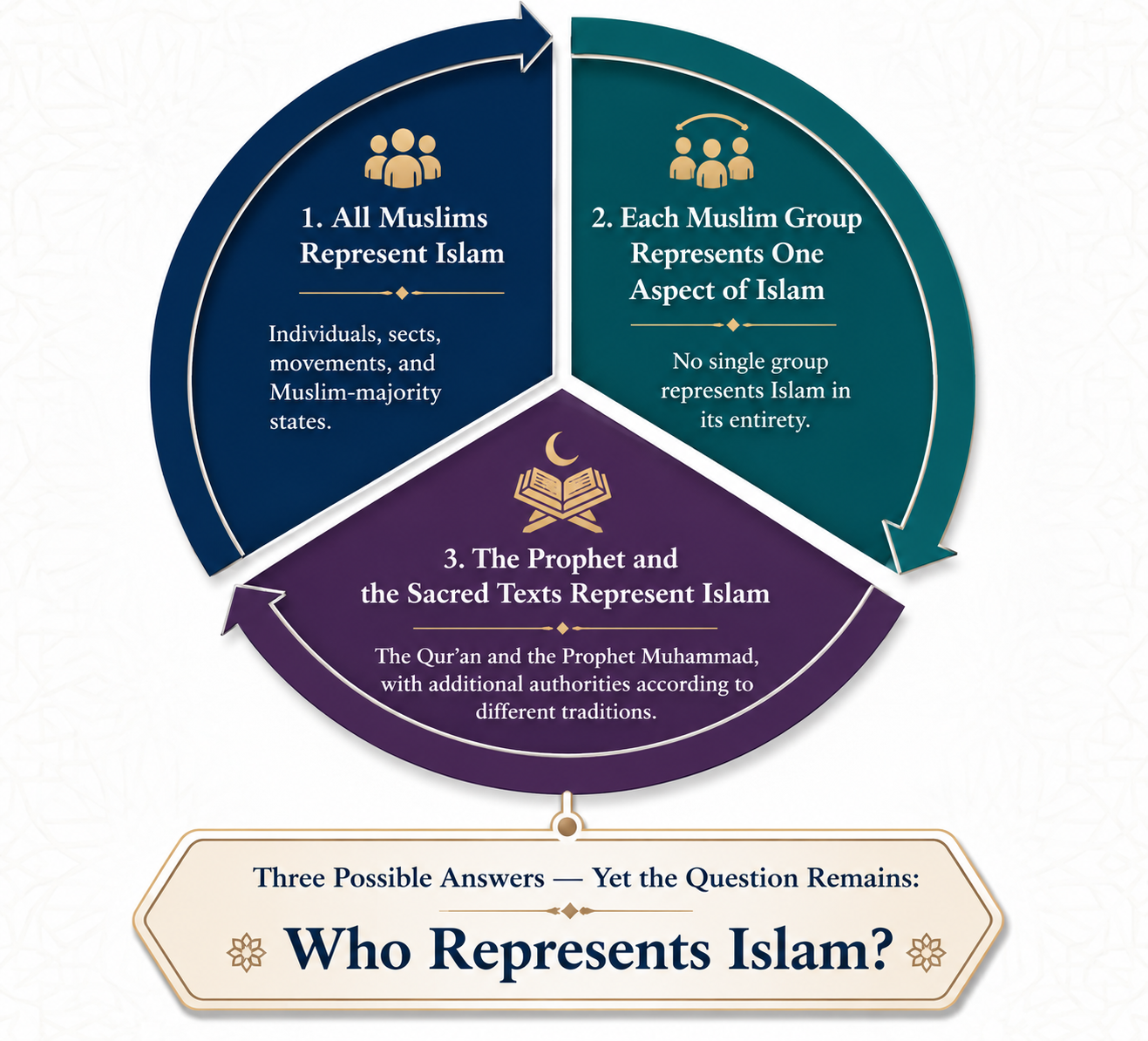
When assessing the definition of Islam against the primary question—“Who represents Islam?”—three distinct logical deductions emerge. Each deduction purports to offer a resolution, yet each faces significant theological, sociological, and analytical objections when contextualized within contemporary discourse.
5.1 First Deduction: “All Muslims Represent Islam”
This proposition asserts that every Muslim individual, state, political party, theological sect, missionary movement (da‘wah), and militant faction collectively represents Islam.
In a broad sociological sense, adherents of any faith naturally serve as its visible representatives. However, as an answer to the core inquiry, this statement creates more confusion than clarity. The question does not exist in a vacuum; it is explicitly tied to contemporary geopolitics, state conflicts, and the global debate surrounding Islam, extremism, and political violence. Formulated this way, the answer fails to offer a definitive or actionable resolution.
This assertion faces two major theological and conceptual objections from Muslim scholars (ulama) and the general public following traditional religious authority:
- Human Imperfection and Fallibility: Human beings are inherently flawed, prone to error, and morally imperfect. Because no individual Muslim possesses divine infallibility (‘ismah), human conduct, speech, or intellectual outputs cannot be equated with Islam as a perfect divine ideal (al-Din ‘ind Allah).
- The Problem of Sectarian Fragmentation (hadith al-Iftiraq): The second and more impactful objection stems from a widely cited prophetic narration regarding sectarian division:
PROPHETIC HADITH — variant reports exist
“The Jews split into seventy-one sects, and the Christians split into seventy-two sects. My nation will split into seventy-three sects, all of which are in the Fire except one.” It was asked, “Who are they, O Messenger of God?” He replied, “Those who follow what I and my Companions are upon today.” (In alternative variants: “They are the main body/community [al-Jama’ah].”)
While textual variants and interpretations regarding the identity of the “Saved Sect” (al-Firqah al-Najiyah) differ across Sunni and Shia traditions, the historical reality since the early Civil Wars (al-Fitnah) forced each theological school to claim exclusive orthodoxy.
Even from a neutral, non-Muslim analytical perspective, the objection based on internal fragmentation remains methodologically sound. Islam is not unique in this regard; all major world religions, philosophical traditions, and political ideologies display similar internal schisms. One cannot logically assert that all capitalist states fully represent capitalism, as their policies and economic outcomes vary drastically. The same analytical limitation applies when evaluating democracy, secularism, or liberalism.
5.2 Second Deduction: “Each Faction Represents a Fragment of Islam”
This proposition suggests that no single sect, state, or movement represents Islam in its entirety; rather, each group embodies a distinct facet or component of the faith. Together, the sum of these parts constitutes the total representation of Islam.
While formulated differently, this argument is functionally equivalent to the first deduction and faces identical logical objections. Neither proposition adequately resolves the relationship between Islam, extremism, and political violence. They can neither completely disprove a link—given that violent actors exist among Muslims—nor can they establish a definitive link, given that the vast majority of Muslims have no connection to violence.
Muslim populations, like any major global demographic, do not constitute a monolithic block defined by fixed, universal traits. Rigorous social analysis avoids falling into moralizing traps regarding violence or reductive generalizations regarding intellectual extremism.
While scholars can analyze societal trends—such as conservatism versus liberalism, attitudes toward secularism and democracy, literacy levels, poverty, tribalism, or adherence to human rights frameworks—scientific methodology adheres to a strict prohibition against unwarranted generalization. Human societies are inherently diverse, and empirical tools cannot capture every individual variable.
For instance, describing Moroccan society as “generally conservative” relies on a relative, contextual baseline. It does not imply that every member of society is conservative, nor that Moroccan conservatism functions identically to Saudi conservatism.
The most dangerous analytical failures occur when political ideologies convert non-generalisable traits into rigid, essentialist generalizations. Historically, this tendency laid the groundwork for racial, religious, and gender discrimination—fostering claims that specific racial groups possess inferior cognitive capacities, that adherents of one faith hold intrinsic superiority over others, or that an entire population inherently embraces violence due to its ethnic or religious heritage.
5.3 Third Deduction: “The Prophet and the Sacred Texts Represent Islam”
A third argument holds that Islam is represented most directly by its primary sacred text, the Qur’an, and by the Prophet Muhammad, together with supplementary authorities: the Prophet’s Companions (Sahabah) in Sunni traditions, or the Prophet’s Household (Ahl al-Bayt) and the Imams in Twelver Shi‘i tradition.
Does this framework provide a viable answer to the primary inquiry?
Treating foundational texts or a foundational religious figure as a complete answer to the question of representation introduces several analytical difficulties:
- Hermeneutical Schisms: Over 1,400 years of Islamic history demonstrate that internal schisms stem precisely from conflicting interpretations (tafsir and ta’wil) of these very texts and foundational narratives. Divergent claims regarding historical narrators and scriptural intent make establishing a single, universally accepted “representative” authority virtually impossible.
- Historical Epistemology and Source Material: From a critical historical standpoint, detailed empirical data regarding founders of ancient world religions remains limited. Modern researchers rely primarily on textual traditions recorded by devoted followers generations after the founder’s death—traditions that often present conflicting perspectives. Even when accepting sacred texts as canonical anchors, their contextual application to real-world affairs remains disputed among opposing theological schools.
- The Ideal vs. The Collective Reality: Even if full historical knowledge of a religious founder were assumed, no population of millions—or even hundreds—can perfectly mirror the founder’s exact conduct or ideal archetype. Historical precedent illustrates this limitation: shortly after the Prophet’s death, early Muslim communities fragmented over competing claims regarding political and religious authority. The founder represents an idealized theological archetype, whereas historical Islam is enacted by diverse human populations over time.
- The Problem of Historiographical Uniformity: Arguments asserting that historical narratives reflect the collective worldview of believers overlook a crucial historical reality: pre-modern records were authored by a literate elite—jurists, scholars, and court historians—who often operated within state power structures. In societies characterized by widespread illiterate populations, these records reflected elite political and theological struggles rather than a uniform popular consensus.
A Modern Analogy: The Epistemological Problem
To illustrate the difficulty of deriving a single, universally accepted representation from one person, consider a contemporary political figure about whom enormous quantities of information are available, such as Donald Trump. Even with modern communications, continuous media coverage, polling, and extensive public records, there is no universal consensus regarding his political character or legacy:
- A substantial segment of the American electorate regards him as a patriotic leader.
- Opponents view him variously as an incompetent politician, a standard rival within a polarized system, or an immoral figure.
If modern societies—equipped with real-time empirical tools—cannot achieve consensus on living political figures, establishing a single representative narrative for historical figures who lived centuries ago presents far greater methodological challenges.
6. Epistemological Critique: Is the Question Valid?
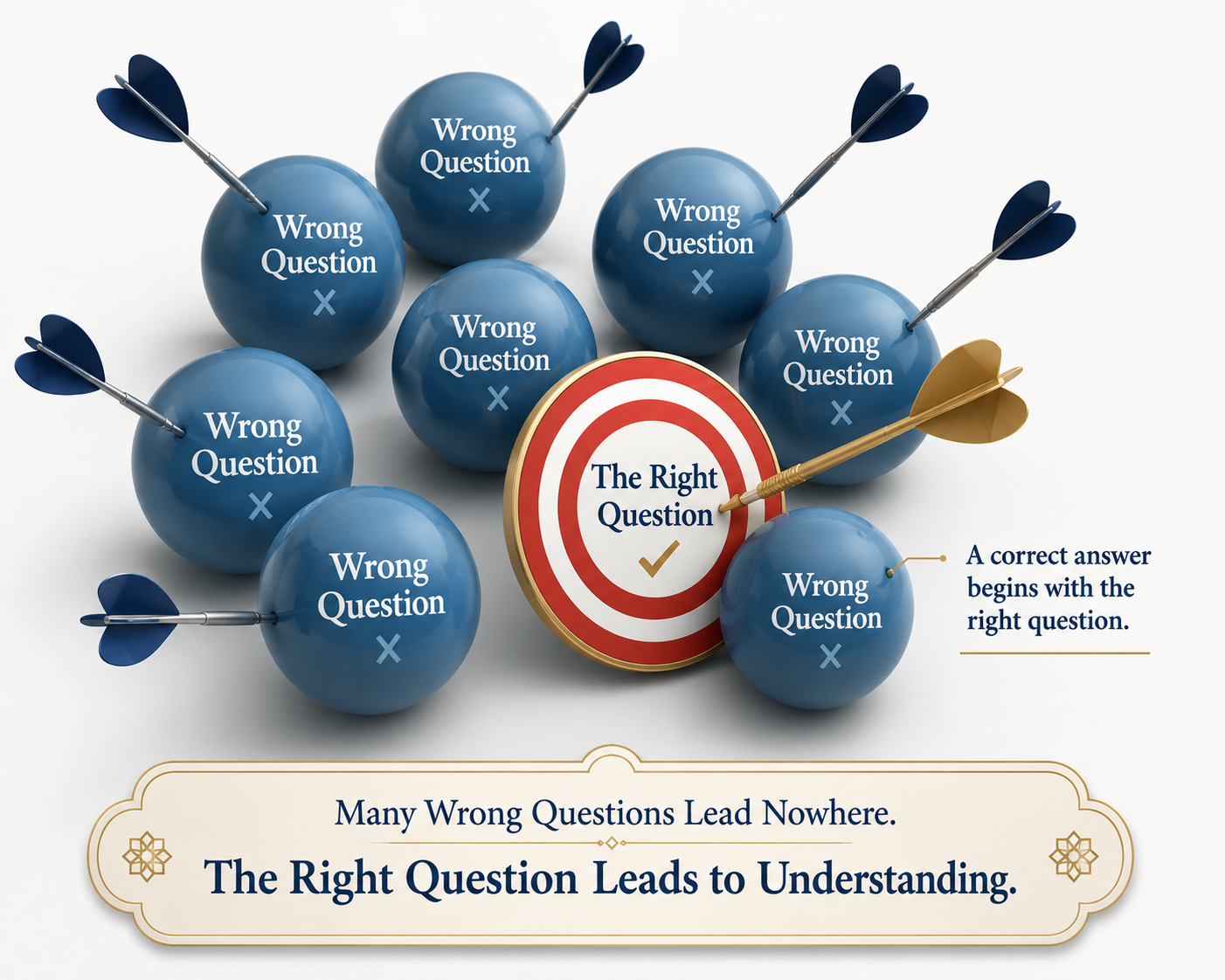
The analytical hurdles examined above force a fundamental methodological reassessment: Is the question “Who represents Islam?” fundamentally valid in the first place?
The core difficulty lies in confusing definition with representation. A broad conceptual definition of Islam can be formulated, just as broad definitions can be formulated for capitalism, democracy, or liberalism. Identifying a single concrete entity that can represent a global religious tradition across centuries, however, is a very different—and analytically far more difficult—task.
Belief systems are internalized and practiced by billions of individuals whose perspectives are shaped by geography, culture, historical eras, and personal experiences. Because human divergence in thought and behavior is an intrinsic feature of social reality, no single entity can serve as a universal representative for how a faith is lived.
- Broad Analytical Consensus: In abstract, high-level terms, one could state that Islamic societies share foundational reference points: belief in One God (tawhid), reverence for the Qur’an, and recognition of Muhammad as the final Prophet. Historically, one can observe broad trends—such as the flourishing of scientific inquiry across the Islamic world from the 8th to the 15th centuries, followed by periods of institutional stagnation from the 16th century onward.
- The Hazard of Negative Generalization: When the inquiry is deployed to impose essentialist moral or cognitive judgments—particularly within discourses on political violence, terrorism, or sectarian hatred—it ceases to function as a genuine analytical tool. Instead, it becomes a rhetorical device designed to enforce pre-determined conclusions.
Questions such as “Is a Muslim inherently a potential terrorist?” or “Do non-Muslims intrinsically harbor hostility toward Muslims?” transform a complex sociological phenomenon into a rigid, reductive trope. Applying this reductive framing to any major world religion, political philosophy, or secular ideology yields the same analytical impasse.
Ultimately, asking “Who represents Islam?” in an absolute, concrete sense—especially when tied to contemporary debates on terrorism and extremism—is methodologically flawed.
7. Reformulating the Question: “Who Represents the Broader Vision of Islam?”
To escape the epistemological stalemate, the question itself must be reformulated. Instead of asking “Who represents Islam?” in an absolute, concrete sense, the analytically valid question becomes: “Who represents the broader vision of Islam?”
By returning to core principles regarding human survival and demographic reality, a nuanced answer emerges—one that approaches the truth without claiming an absolute monopoly over it.
The broader vision of Islam is represented by the vast majority of Muslims—the billions who have lived throughout history and those living today. As human beings, their lived reality reflects the dynamic evolution, achievements, and setbacks of human civilization. Consequently, one cannot claim that hundreds of millions of Muslims are inherently violent, dogmatic, or intellectually stagnant simply because they adhere to Islam.
Acknowledging Internal Vulnerabilities
However, identifying the broad majority as the primary representative of the faith does not justify evading a troubling reality: violent and extremist groups—whether operating physical, verbal, or structural violence under the banner of Islam—are also Muslims.
These groups find within foundational texts and secondary traditional heritage (Turath) material that they deploy to justify political violence and radical agendas. They exploit ideological fractures and overlooked dark corners within historical Islamic discourse. Therefore, violent factions represent a real—albeit distinct—fragment of Islamic interpretations.
Furthermore, one cannot ignore that the dominance of rigid, textualist methodologies over rationalist critique among religious elites since at least the 15th century contributed to intellectual and scientific stagnation compared to earlier periods of Islamic history.
In the same way that historical interpretations of Christianity cannot be wholly detached from the violence and dogmatism associated with parts of medieval Christian history, and interpretations of Judaism cannot be entirely separated from the political and religious dimensions of the conflict in Palestine, historical Islamic visions cannot simply be declared immune from every action committed in their name.
8. Conclusion
The question “Who represents Islam?”—much like many debates that have proliferated in recent decades—has been heavily co-opted within global, regional, and domestic media warfare. It is frequently deployed for political, ideological, and sectarian leverage rather than objective scholarly inquiry.
Consequently, most public responses oscillate between two rigid, diametrically opposed poles:
- The Absolute Apologetic: Asserting that violence has zero connection to religious heritage.
- The Essentialist Hostile: Attributing all acts of violence directly to the core tenets of the faith.
In populist media landscapes, architects of these polar answers are often less concerned with convincing audiences of nuanced truths than with embedding pre-packaged political narratives through the framing of the question itself.
This critique does not imply that every commentator engaging with this topic acts with cynical intent. Many researchers, scholars, and members of the public approach the question seeking genuine clarity. However, in an era dominated by hyper-saturated media markets and sophisticated digital information warfare (Cyberwar), rigorous intellectual work requires evaluating not only the accuracy of our answers, but the validity and premises of the questions we ask.
9. Explanatory Notes and Glossary for International Readers
- al-Islam al-Siyasi (Political Islam): A term used to describe modern political movements, parties, or ideologies that advocate for Islam as a comprehensive political and governance system, rather than solely a personal faith.
- da‘wah: Literally meaning “invitation” or “call.” In Islamic terminology, it refers to proselytizing, religious outreach, and missionary work aimed at explaining or propagating the faith.
- Muhammad ‘Ali al-Thanawi (d. 1745 CE): An Indian Muslim scholar known for Kashshaf Istilahat al-Funun wa al-‘Ulum (The Dictionary of Technical Terms of Arts and Sciences), an authoritative classical reference encyclopedia covering Arabic, Islamic, philosophical, and scientific terminology.
- Ibn Khaldun (1332–1406 CE): A pioneering Arab Muslim historian, sociologist, and philosopher whose work, Muqaddimah (Prolegomena), established foundational frameworks for historiography, political theory, and sociology.
- ulama: Plural of ‘Alim. Scholars trained in traditional Islamic sciences, theology, jurisprudence, and Qur’anic exegesis who historically functioned as guardians of religious law and doctrine.
- fuqaha: Plural of Faqih. Jurists specializing in Fiqh (Islamic jurisprudence), responsible for deriving legal rulings (Fatwas) from foundational scriptural sources.
- ‘‘aqidah: The formal system of creed, theology, and core doctrinal beliefs in Islam.
- Salafism (al-Salafiyya): A reformist movement within Sunni Islam that advocates returning to the traditions and practices of the Salaf (the first three generations of Muslims). While many Salafis are quietist and focus on personal piety, a militant minority (Jihadist-Salafism) utilizes this framework to justify political violence.
- Ash‘arism (al-Ash‘ariyya): A major school of Sunni theology (kalam), associated with Abu al-Hasan al-Ash‘ari (d. 936 CE). It developed methods that combined scriptural argument with systematic theological reasoning and became influential in many Sunni scholarly institutions.
- Abu Hamid al-Ghazali (1058–1111 CE): A prominent polymath, jurist, philosopher, and theologian in Islamic history. Known in the West as Algazel, his works deeply influenced both Islamic thought and medieval Western scholasticism.
- Takfir: The act of declaring a Muslim an apostate or non-believer (Kafir). Historically treated with extreme caution by mainstream jurists, Takfir is frequently deployed by radical groups to justify violence against political opponents or other Muslims.
- A’mal al-Jawarih vs. A’mal al-Qulub: A fundamental distinction in classical Islamic theology (Kalam). A’mal al-Jawarih refers to physical acts of worship performed by bodily limbs (such as bowing in prayer or fasting). A’mal al-Qulub refers to spiritual acts generated within the heart (such as intention, sincerity, love, trust in God, and fear of divine judgment).
- Fitrah: The innate, primordial disposition or natural human inclination toward monotheism, goodness, and divine recognition that Islamic theology posits every human being is born with.
- tawhid: The foundational concept of strict monotheism in Islam—affirming the absolute oneness, uniqueness, and indivisibility of God.
- mu‘amalat: The branch of Islamic jurisprudence (Fiqh) that deals with civil law, social relations, commercial transactions, contracts, and interpersonal conduct, as distinguished from Ibadat (rituals of worship).
- Ihsan: Literally “excellence” or “perfection.” In prophetic traditions, it represents the highest level of faith, defined as: “Worshipping God as if you see Him; for even if you do not see Him, He surely sees you.”
- Yusuf al-Qaradawi (1926–2022): An influential Egyptian Islamic scholar, theologian, and author based in Qatar. He was a prominent figure in modern Sunni political jurisprudence (Fiqh al-Wasaṭiyya) and served as the chairman of the International Union of Muslim Scholars.
- hadith al-Iftiraq (The Tradition of Sectarian Schism): A famous and widely debated prophetic tradition found in both Sunni and Shia collections describing the division of the Muslim community into 73 sects. It has historically been deployed by rival theological schools to validate their own orthodoxy while delegitimizing opposing factions.
- al-Firqah al-Najiyah (The Saved Sect): A theological concept derived from the schism hadith, referring to the single group among the 73 factions deemed by a particular school of thought to adhere to true, uncorrupted guidance.
- ‘Ismah (Infallibility): Theological doctrine concerning divine protection from error or sin. Its scope differs among Islamic traditions. Sunni theology generally associates prophetic ‘ismah especially with the reliable transmission of revelation, while Twelver Shi‘i theology extends infallibility to the Imams.
- al-Fitnah (The Great Schism / Early Civil Wars): Refers to the foundational political and military conflicts in early Islamic history (656–661 CE), particularly the confrontation between the Caliph ‘Ali ibn Abi Talib and Mu’awiyah ibn Abi Sufyan. This conflict led to the emergence of the main sectarian divisions in Islam (Sunni, Shia, and Kharijite).
- Essentialism: A philosophical and sociological concept wherein complex human populations, cultures, or religions are reduced to a set of fixed, unchanging, and inherent characteristics, ignoring internal diversity, historical evolution, and socio-economic contexts.
- Sahabah (The Companions): The generation of Muslims who directly knew, saw, and followed the Prophet Muhammad during his lifetime. In Sunni Islam, the Sahabah are revered as primary authorities for transmitting scripture and prophetic tradition.
- Ahl al-Bayt (The Household of the Prophet): Refers to the lineage of the Prophet Muhammad through his daughter Fatima and cousin/son-in-law ‘Ali. In Shia Islam, the Ahl al-Bayt—specifically the Imams—are viewed as divinely guided, infallible spiritual and political successors.
- Hermeneutics (ta’wil / tafsir): The methodology of textual interpretation. In Islamic jurisprudence, tafsir refers to exegesis explaining the literal or historical meaning of Qur’anic verses, while ta’wil refers to allegorical or deeper esoteric interpretation.
- Historiography: The study of historical writing and methodology. The text highlights how medieval Islamic historical records were predominantly produced by religious scholars (ulama) and court historians close to state power, rather than representing the unlettered masses.
- Turath (Islamic Heritage): The vast corpus of traditional scholarly literature—comprising exegesis, jurisprudence, theology, biographical dictionaries, and historical chronicles—produced by Muslim scholars over centuries. Contemporary critical thinkers distinguish between sacred divine revelation (Qur’an) and human intellectual heritage (Turath).
- Naql and ‘Aql (Transmission and Reason): A recurring tension in Islamic intellectual history concerning the relative authority of transmitted texts and rational inquiry. Different theological and legal schools assigned different weight to each, and the balance between them changed across periods and regions.
- Information Warfare & Cyberwar: The strategic deployment of digital media, social networks, and public narratives to manipulate public perception, destabilize societal trust, and enforce political agendas during geopolitical conflicts.
10. Source Notes and References
The following references reproduce and standardize the sources cited in the original Arabic edition. Arabic book titles are transliterated and followed by an English descriptive translation where useful. Quotations from Arabic-language sources are presented in English translation unless an English-language source is specifically identified.
- Muhammad ‘Ali al-Thanawi. Kashshaf Istilahat al-Funun wa al-‘Ulum [Dictionary of the Technical Terms of the Arts and Sciences]. Beirut: Librairie du Liban, 1996, p. 483.
- ‘Abd al-Rahman ibn Khaldun. Kitab al-‘Ibar wa Diwan al-Mubtada’ wa al-Khabar [Book of Lessons and Record of Beginnings and Events], vol. 2. Beirut: al-Jamal Publishing Foundation, pp. 46–47.
- Al-Thanawi, Kashshaf Istilahat al-Funun wa al-‘Ulum, p. 507.
- Biographical identification of Abu Hamid al-Ghazali (1058–1111).
- Abu Hamid al-Ghazali. Majmu‘at Rasa’il al-Imam al-Ghazali [Collected Epistles of Imam al-Ghazali]. Cairo: al-Maktaba al-Tawfiqiyya, p. 257.
- The Economist, “Islam in Europe: Perception and Reality,” Daily Chart, 23 March 2016.
- Pew Research Center, “How the U.S. General Public Views Muslims and Islam,” 26 July 2017.
- Qur’an 3:19. The original Arabic edition also notes occurrences of the word Islam in Qur’an 3:85; 5:3; 6:125; 9:74; 39:22; 49:17; and 61:7.
- Qur’an 49:14.
- Hadith report beginning “Submit and you will be safe … What is Islam? … that you surrender your heart to God, and that Muslims are safe from your tongue and hand,” cited in the Arabic edition as narrated by Ahmad and Muhammad ibn Nasr al-Marwazi.
- Author’s explanatory note distinguishing a‘mal al-jawarih (bodily acts) from a‘mal al-qulub (acts of the heart).
- Yusuf al-Qaradawi. Al-Din wa al-Siyasa: Ta’sil wa Radd Shubuhat [Religion and Politics: Foundations and Responses to Objections]. Dublin: European Council for Fatwa and Research, 2007.
- Qur’an 1:5.
- Al-Qaradawi, Al-Din wa al-Siyasa, p. 17.
- Al-Qaradawi, Al-Din wa al-Siyasa, p. 17.
- Qur’an 3:67.
- Center for Shiite Studies, “What Is Islam?” (Arabic-language web source cited in the original edition).
- Islamweb, Fatwa Center, Fatwa no. 25251 (Arabic-language web source cited in the original edition).
- Encyclopaedia Britannica, “Islam.”
- Hadith of sectarian division, cited in the original Arabic edition to Abu Dawud, al-Tirmidhi, Ibn Majah, and al-Hakim; the original note records al-Hakim’s grading and acknowledges variant wordings.
- Shi‘i variant of the sectarian-division report, cited in the original Arabic edition through ‘Abbas al-Qummi, Safinat al-Bihar, and Muhammad Husayn al-Tabataba’i, al-Mizan.
- Ala al-Din al-Khatib, “Ihtikar al-‘Ilm wa I‘tiqal al-‘Aql bi-Ism al-Din” [Monopolizing Knowledge and Imprisoning Reason in the Name of Religion], MENA Studies Observatory, 18 August 2018.
Editorial Note on Date and Context
This English edition preserves the temporal standpoint of the original Arabic study, published on 3 July 2019. References to contemporary political debates, public attitudes, and geopolitical conditions should therefore be read in that historical context unless otherwise indicated.


