By: Alaa Al-Khatib
24/02/2026
What happens when the Caliph transforms from an absolute ruler into a mere “hostage” in his own palace? How did the empire shift from a geographic unity into fragmented states divided by ethnicity and sect? In this episode, we deconstruct the great “Structural Coup” in Islamic history: from Al-Mutawakkil, who buried the “Mu’tazilite Mind,” to the “Qadiri Decree” (The first official state creed), which set rigid boundaries for thought. We explore the ordeal of Al-Tabari, which revealed the rise of street extremism, and the works of Al-Ghazali and Al-Mawardi, who respectively shackled logic and legitimized the “ugly reality” of political decay. This is the story of the erosion of politics and the rise of sects as an alternative to the state.
Al-Mutawakkil’s Era: The Coup Against Reason
This era began with a political decision that shook the state’s foundations. Caliph Al-Mutawakkil decided to end the “Mihna” (The Inquisition regarding the createdness of the Quran) and turned completely against the Mu’tazilah (The Rationalist school). This stagnation was later codified in the “Qadiri Decree” during the reign of Caliph Al-Qadir. This official theological document imposed the “Traditionalist” view and excommunicated dissenters. This was not merely a religious victory; it was a functional shift. The authority abandoned the attempt to “rationalize religion” and embraced “popular traditionalism” to ensure the loyalty of the masses, transforming the state from a patron of science into a “Religious Police.”
Al-Mutawakkil’s coup extended beyond theology to redefine the state’s relationship with its non-Muslim citizens. In 235 AH, he issued the strictest decrees in Abbasid history, forcing Christians and Jews to wear the “Ghiyar” (Yellow distinguishing clothes), banning them from riding horses, and destroying newly built churches. This was a calculated move to court conservative forces and construct a “rigid,” closed Islamic identity—a precursor to the later policies of Al-Hakim bi-Amr Allah in Egypt.
Ghost Caliphs and the Rise of Sultans
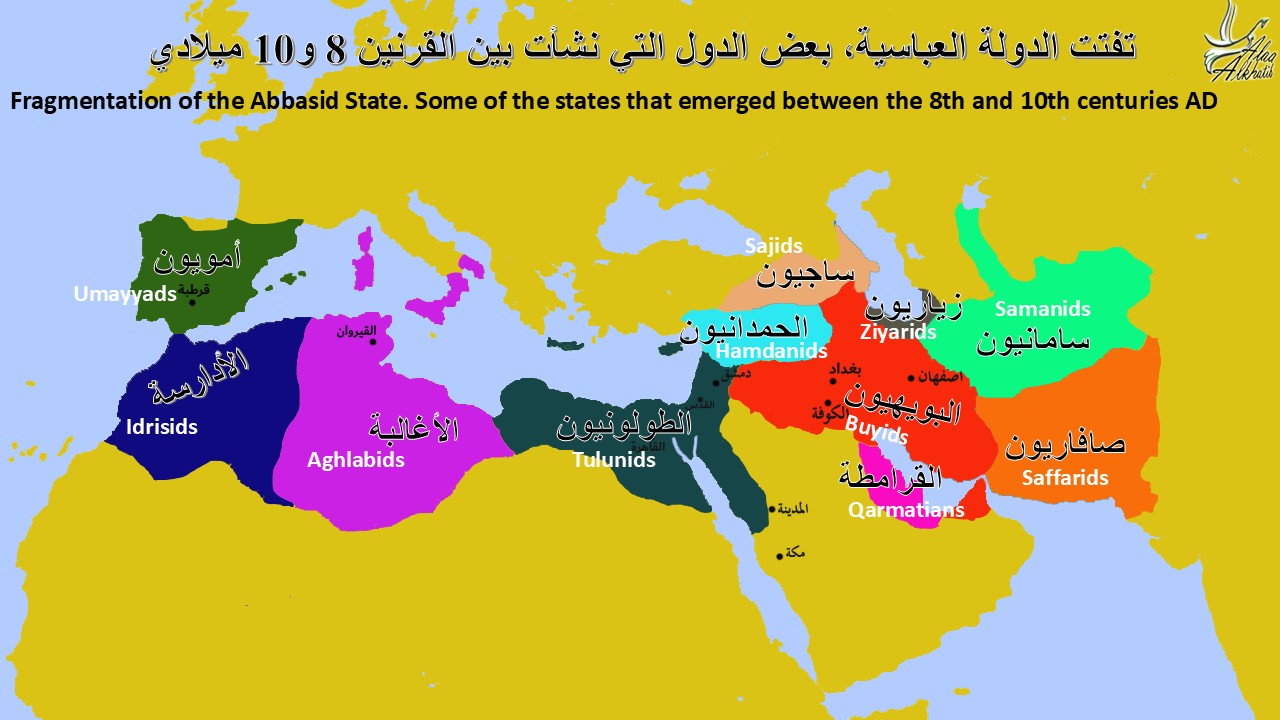
In Baghdad, the Caliph no longer held true power. The Mamluks (Turkish slave soldiers) brought in by Caliph Al-Mu’tasim became the masters of the palace, assassinating Caliphs and appointing others at will. This central weakness led to the emergence of “Independent States” based on geography and ethnicity:
- The Tulunids and Ikhshidids in Egypt.
- The Hamdanids (Arabs) in Aleppo.
- The Samanids and Ghaznavids in the East (Persia and Central Asia). The empire became a “Sick Man” ruled by military commanders (Sultans), while the Caliph remained a mere figurehead, his name mentioned in Friday prayers and struck on coins but possessing no real authority.
The Alliance of Ruler and Cleric: Al-Tabari’s Ordeal
The alliance to legitimize power, which began under the Umayyads, reached a more dangerous stage. A politically weak state required the legitimacy of hardline jurists to control the street, making persecution “populist.” The best example is Imam Al-Tabari, the author of the most significant works of history and Quranic exegesis. He died under house arrest and was buried secretly at night for fear of Hanbali mobs (extremist followers of the traditionalist school) who accused him of heresy simply for acknowledging diverse scholarly opinions. Here, the “extremist street” became the actual ruler under the Sultan’s protection.
The Duality of the Era: Natural Philosophers Under Fire
A striking paradox emerged: while jurists were stifling theological reasoning, natural scientists were reaching global heights. Avicenna (Ibn Sina), Rhazes (Al-Razi), and Alhazen (Ibn al-Haytham) achieved greatness not because of the official religious establishment, but in spite of it. They lived anxious lives between the palaces of princes who needed their medical and scientific skills, and the accusations of heresy (Zandaqa) launched from the pulpits. This created a historical gap between “Experimental Science” and “Religious Thought” that has lasted for centuries.
The Rise of Ash’arism: Institutionalizing the Division
Amidst this political noise, Abu al-Hasan al-Ash’ari emerged. A former Mu’tazilite, he built a school (Ash’arism) that attempted to reconcile “Reason” and “Text.” This was the “Middle Way” adopted by the state (especially under the Seljuks) to unify the Sunni front against the expansion of Shia dynasties (the Fatimids and Buwayhids). This solidified what we now call “Ahl al-Sunnah wa al-Jama’ah” (Sunni Orthodoxy).
This closure was physically manifested in grand mosques through the appearance of Four Mihrabs (prayer niches)—one for each of the four Sunni legal schools. Muslims no longer prayed behind any Imam, but only behind the Imam of their specific sect. Jurisprudence was transformed from a “search for truth” into a “sub-identity” that divided society.
Slave Society and the Making of Mamluks
Socially, slavery spread widely, and slave markets became a staple of the landscape. The state, having lost trust in Arabs and Persians, relied on the Turkish Mamluks. These warrior-slaves, who began as palace guards, would soon transform into kings, displacing the Caliphs and beginning the era of Mamluk Sultanates that would rule the region by the sword.
Al-Mawardi: The Jurist of the “De Facto”
How can a jurist legitimize a powerless Caliph and a Sultan who lacks religious legitimacy? Al-Mawardi, in his book “The Ordinances of Government” (Al-Ahkam al-Sultaniyya), provided the legal engineering for this “Ugly Reality.” He recognized the “Emirate of Seizure” (Imarat al-Isti’la), arguing that whoever holds power (the Sultan) is legitimate as long as he protects the community and upholds the prayer. Al-Mawardi established the pragmatic principle: “An oppressive Sultan is better than lasting strife (Fitna).”
Al-Ghazali: Shackling Philosophy
The peak of this intellectual shift came with Abu Hamid al-Ghazali. In his book “The Incoherence of the Philosophers,” he delivered a fatal blow to Greek philosophy within Islamic thought. Al-Ghazali was the “ideological engineer” for the Nizamiyya schools (the first state-sponsored university system). He rearranged the Muslim mind to prioritize “Bayan” (revelatory text) over reason, setting strict boundaries on where the mind could wander, leading to long-term intellectual stagnation.
Sectarian Strife: The Streets on Fire
Conflicts in Baghdad were not confined to books; they burned in the streets. Historians describe the bitter civil strife between Hanbalis and Ash’aris, and between Sunnis and Shia. Baghdad was periodically consumed by sectarian riots fueled by politicians to distract from their own incompetence. Religion was transformed from a “spiritual message” into a “deadly identity” used for settling political scores.
The Tragedy of Al-Hakim: Extremism as Demographics
In Fatimid Egypt, the reign of Al-Hakim bi-Amr Allah saw a dramatic shift. He demolished the Church of the Holy Sepulchre and imposed unprecedented restrictions on Egyptian Copts, forcing them to carry heavy crosses and banning them from riding horses. This persecution led to the largest wave of conversion to Islam in Egypt’s history as people fled the Sultan’s tyranny and the burden of the Jizya (tax on non-Muslims). This shows how extreme political decisions can permanently alter a nation’s demographic map.
Almohad vs. Almoravid: When Creed Breeds Genocide
In the far West (North Africa), Ibn Tumart, the founder of the Almohad movement, formulated a strict creed based on “Absolute Monotheism” as he interpreted it. For him, the ruling Almoravids were not just rivals but “Infidels” and “Anthropomorphists” (those who personify God). This theological framing was a “blank check” for atrocities.
In Marrakesh, the war was not a political battle but a “Creedal Cleansing.” The Almohads committed mass genocide based on sectarian excommunication decrees (Takfir). In just a few days, nearly 70,000 Almoravids were killed—not in a battlefield, but in “executions based on identity.” Political ambition wore the mask of creed, turning neighbors into butchers. This was the harshest scene in Islamic history before the arrival of the Mongols.
Conclusion
Episode 6 teaches us that state weakness inevitably leads to the rise of “sub-identities” and sectarian extremism. When strong law vanished, the jurist and the military commander took over. Islam entered a phase of “Intellectual Encapsulation,” attempting to preserve its identity amidst political collapse, but the price was an “open-ended leave for the mind.”
In the next episode, we will face the greatest earthquakes: the Crusaders from the West and the Mongols from the East, and witness how the Mamluk state grew from the ruins of the Caliphate.
——————-
You might want to read the full paper at this link:
History of Islam (full article): Islam Between the Sacred and the Human
Or you might be interested in reading the rest of the series:
- Sovereignty and Negotiation: An Analytical Reading of the Formation of the “Medinan Polity”
- Post-Founder Era: The Struggle for Legitimacy and the Test of Survival. The Saqifa, the Ridda, and the Conquest
- From Omar’s Assassination to the Great Fitna: The Cracking of the Center. When the State Devours its Children
- From Caliphate to Kingdom: The Birth of the Empire, The Umayyad Dynasty
- The Global Empire: The Labor of Nationalities and the Making of the Muslim Mind. The Power vs. The Jurist
- The Breaking of the Center: The Era of Sultans and the Making of Orthodoxy
- The Era of Fracture: Crusaders, Mongols, and the Fiqh of Siege
- The Tunnel of Stagnation and the Shock of Awakening
- The Crossroads: Aborted Enlightenment and the Rise of Ideology
- The Historical Trial: Toward an Islam Without Idols


