By: Alaa Al-Khatib
24/02/2026
What does a society do when faced with annihilation? In this episode, we experience the “Black Comedy” of an era where cities fell and “brothers” allied with “invaders” against one another. From the fall of a fragmented Al-Andalus (Islamic Spain) under the Taifa Kings, to the burning of Baghdad by the Mongols, and finally the rise of the Mamluks from the womb of slavery to save what remained. In the heart of this rubble, the “Fiqh (Jurisprudence) of Extremism” was born with Ibn Taymiyya as a shield for a besieged society, while Sufism spread as a spiritual escape for the soul from a hellish reality.
The Taifa Kings: The Al-Andalus That Devoured Itself
While the East was boiling, Al-Andalus provided a profound lesson in “Structural Fall.” The once-great Umayyad Caliphate fragmented into 22 “cartoonish” petty states known as the Taifa Kings (Reyes de Taifas). Political surrealism was at its peak: Muslim princes paying tribute (Parias) to Christian Castilian kings in exchange for protection against their own Muslim neighbors. Sovereignty here was not for religion or nation, but for the “survival of the throne,” even at the expense of history itself.
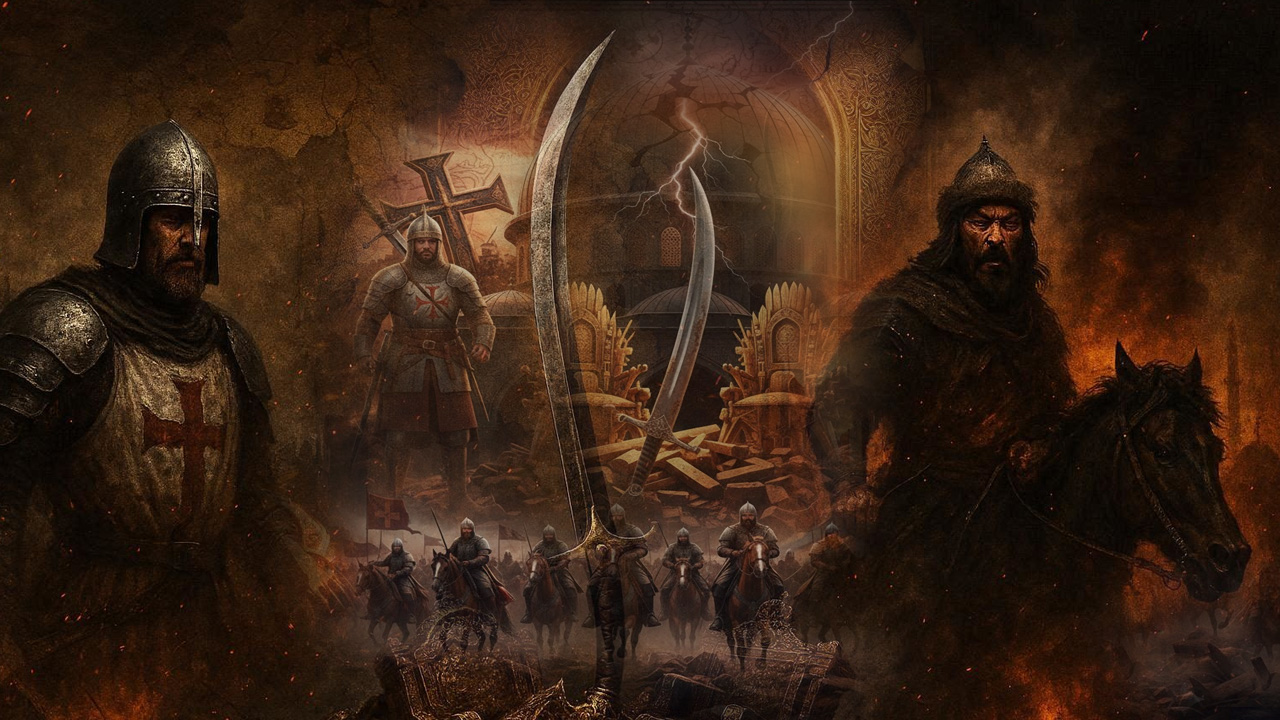
Black Comedy: When the Compass Was Lost
When the “Franks” (Crusaders) arrived, they did not find a unified nation, but rather warring “fiefdoms.” The Black Comedy lay in cross-religious alliances; you could find a Muslim prince allied with a Frankish commander to fight another alliance composed of both Muslims and Franks! The conflict was not always “Crusading” in the field as later Western narratives portrayed it; it was a struggle over feudal estates.
In the midst of this humiliation, the story of the Judge of Damascus (Abu Saad al-Harawi) stands out. He went to Baghdad to seek help, but when he found the Caliph and his entourage drowned in luxury, he sat in the Great Mosque on a Friday in Ramadan and ate publicly! When people were shocked by his action, he said: “You wonder at my eating in Ramadan, but you do not wonder at the blood of Muslims being shed?” It was a desperate cry of protest against a clinically dead authority.
The Mongol Earthquake: The End of the Ancient World
If the Crusaders were a pain in the extremities, the Mongols were a cardiac arrest. The fall of Baghdad (1258 AD) was not just the fall of a city, but the end of the “Idea of the Caliphate.” Books were dumped into the Tigris until its waters turned black with ink, and the Caliph was kicked to death. This collapse created a massive political and psychological vacuum, leaving society feeling “orphaned,” searching for a strong “savior” who possessed the legitimacy of the sword rather than the legitimacy of lineage. The age of “Qurayshi Lineage” (the traditional requirement for a Caliph) ended, and the age of the “Mamluk Sword” began.
The Rise of the Mamluks: Sovereignty to the Victor
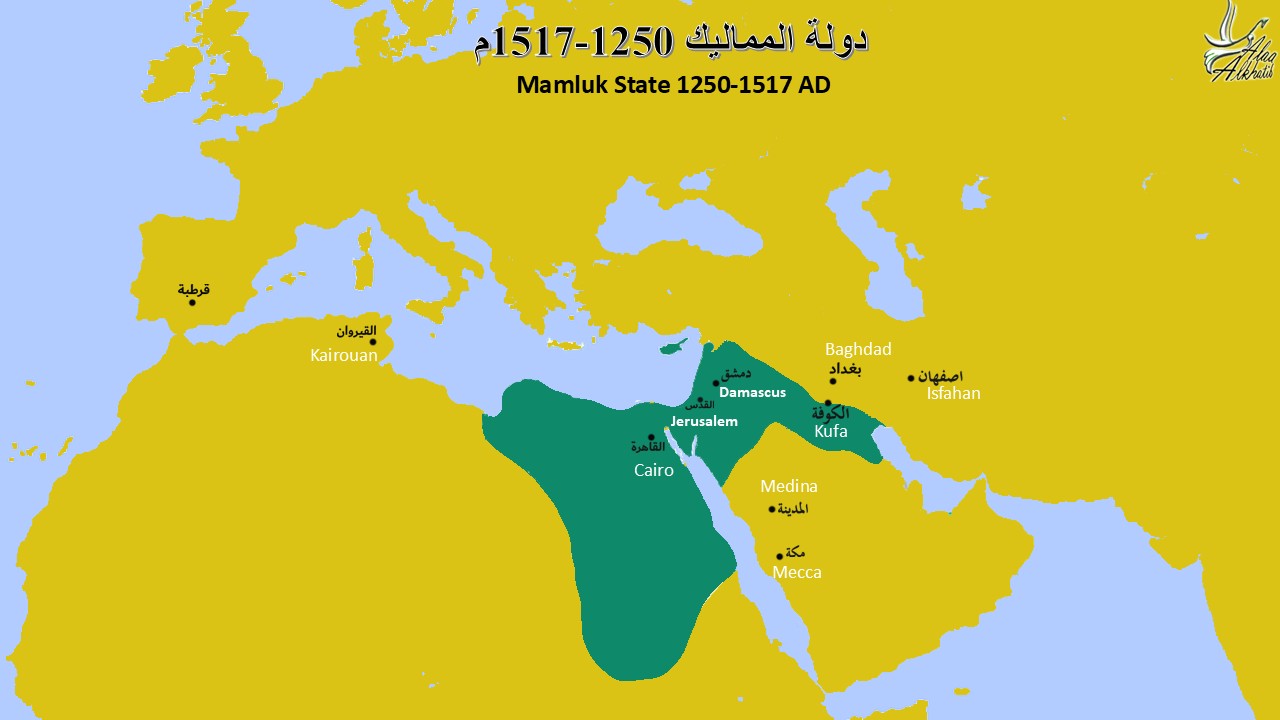
From the heart of the slave markets discussed in the previous episode, the saviors emerged. The Mamluks, who inherited the Ayyubid legacy, proved that “military competence” was the only remaining legitimacy. At the Battle of Ain Jalut, they did not just defend Islam as a creed; they defended their “existence” as a new ruling class. The Mamluk state was a “Military State” par excellence, prioritizing power over ethnic origins.
Ibn Taymiyya & Ibn Khaldun: The Farewell of Reason
In this besieged atmosphere, Ibn Taymiyya emerged to establish the “Fiqh of Resistance.” He did not come from intellectual luxury but from beneath the smoke of wars. He believed the cause of defeat was “theological dilution,” so he revived the “Ahl al-Hadith” (Traditionalist) school with unprecedented rigor, founding what would later be known as Salafism. Ibn Taymiyya established the “Fiqh of Siege”—an aggressive discourse against the Shia, Sufis, and philosophers—to unify the Sunni front behind a single, rigid theological vision against outsiders.
However, the great tragedy was in science. While Ibn Khaldun was writing his “Muqaddimah” (The Introduction) as the final gasp of the grand analytical mind, scientific production in medicine, astronomy, and physics was slowing down to a halt. The state’s preoccupation with wars and the restriction of education to religious Nizamiyya schools caused the Muslim mind to withdraw into “texts and commentaries,” entering a tunnel of civilizational darkness at the dawn of the Ottoman era.
Sufism: The Final Sanctuary for the Exhausted Soul
On the other hand, Sufism was spreading like wildfire. When political reality became ugly and bloody, people collapsed inward. The Zawiyas (Sufi lodges) became the “alternative society.” Sufism provided spiritual solace for the defeated, but it also contributed to numbing political awareness, as salvation became individual and metaphysical, far from the unbearable struggles of the Sultans.
Merchant Expansion: The Islam of Kings (Southeast Asia)
While political Islam was shrinking in Al-Andalus, “Commercial Islam” was expanding in the Indian Ocean. Islam did not enter Indonesia and Malaysia by the sword, but by the “pragmatic ethics” of merchants. History indicates that the conversion of local kings was not always purely spiritual; it was a clever political decision to join the “Global Trade Network” controlled by Muslims and to gain support against local rivals. Islam here was a “passport” into the economic elite club.
The Backlash: Persecution of the “Other”
The Crusades left a deep scar on the relationship between Muslims and Eastern Christians. Historians note that Mamluk periods of weakness saw restrictive measures and persecution that did not exist in the Umayyad or early Abbasid eras. The “Christian neighbor” was viewed by some as a potential “fifth column” for the Franks, leading to waves of social and legal tightening—a direct result of the “Fiqh of Siege” starting to dominate the collective mind.
Conclusion
When civilizations weaken, they give birth to the highest degrees of contradiction: the Mamluk’s sword alongside the Sufi’s asceticism, and Ibn Taymiyya’s strictness alongside the loss of the Taifa Kings. At this stage, the Islamic state lost its central form forever, marking the beginning of the era of “Great Military Empires.” In the next and final episode: we will see how the Ottomans inherited this diaspora and how Islam transformed into a “World State” once again, but with a completely different identity.
——————-
You might want to read the full paper at this link:
History of Islam (full article): Islam Between the Sacred and the Human
Or you might be interested in reading the rest of the series:
- Sovereignty and Negotiation: An Analytical Reading of the Formation of the “Medinan Polity”
- Post-Founder Era: The Struggle for Legitimacy and the Test of Survival. The Saqifa, the Ridda, and the Conquest
- From Omar’s Assassination to the Great Fitna: The Cracking of the Center. When the State Devours its Children
- From Caliphate to Kingdom: The Birth of the Empire, The Umayyad Dynasty
- The Global Empire: The Labor of Nationalities and the Making of the Muslim Mind. The Power vs. The Jurist
- The Breaking of the Center: The Era of Sultans and the Making of Orthodoxy
- The Era of Fracture: Crusaders, Mongols, and the Fiqh of Siege
- The Tunnel of Stagnation and the Shock of Awakening
- The Crossroads: Aborted Enlightenment and the Rise of Ideology
- The Historical Trial: Toward an Islam Without Idols


