By: Alaa Al-Khatib
23/02/2026
Imagine waking up to find that the “race” which ruled the world for a century has been completely displaced, and that other languages and ethnicities have begun to manage the levers of power. The Abbasid Revolution was not merely the replacement of one ruling family by another; it was a “Structural Coup” that transformed the state from an “Arab Club” into a Global Empire.
The Abbasid Revolution was a “Structural Explosion.” While the heads of the Umayyad dynasty fell, other minds were building intellectual systems that would endure for a thousand years. In this article, we will not only discuss palaces but the making of the “Muslim Mentality.” How were the sects (Madhahib) born from the womb of conflict with authority? How did “Usul” (The fundamental principles of jurisprudence) become the state’s secret constitution? And why did the Abbasids fail to maintain the territorial unity that the Umayyads had gathered?
The State of Blood and Shrinking Borders
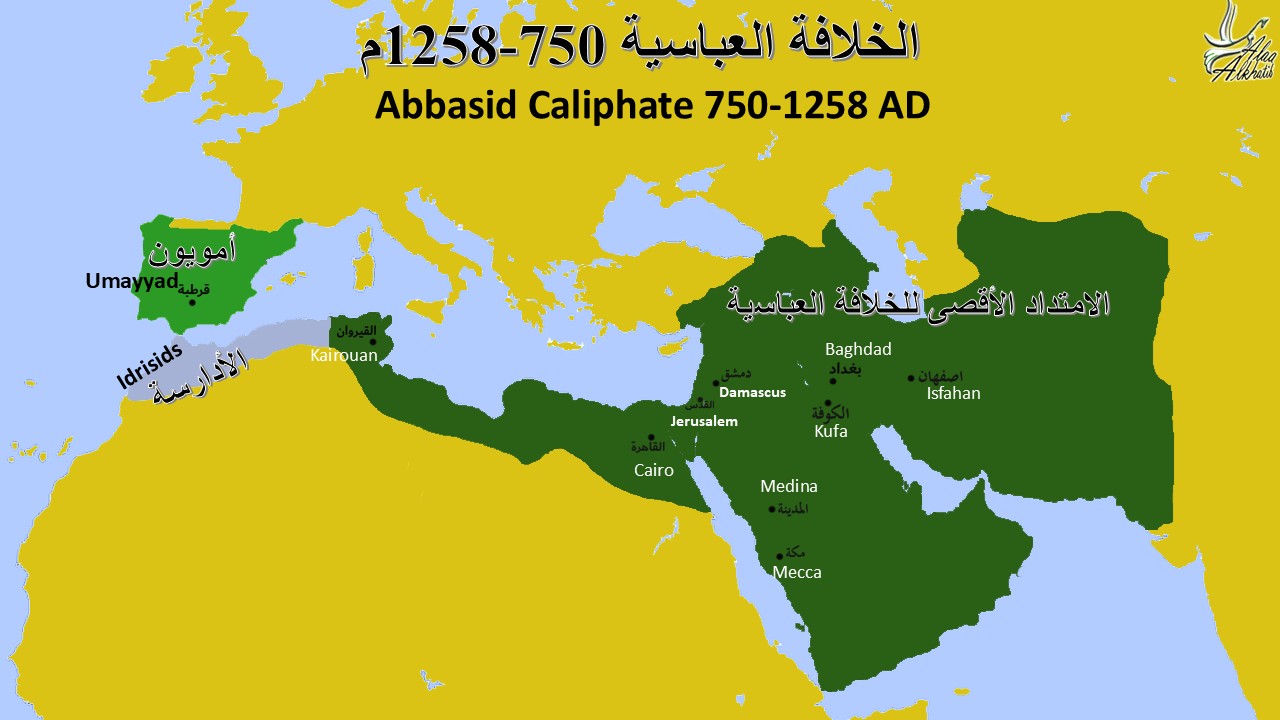
The Abbasids rose upon the ruins of the Umayyads with excessive bloodshed; Abu al-Abbas “al-Saffah” (The first Abbasid Caliph, whose nickname means “The Bloodshedder”) showed no mercy even to the dead in their graves. However, the historical paradox is that this state, born in blood, faced a harsh geographic reality: absolute centralization vanished. For the first time, vast territories exited the Caliph’s sovereignty; North Africa became independent under the Idrisids, and Al-Andalus (Spain) remained Umayyad under “The Falcon of Quraysh” (Abd al-Rahman al-Dakhil).
The Abbasid Empire, despite its Baghdadi splendor, never reached the horizontal expanse of the Umayyad state. It was an empire of “Civilization and Center” rather than an empire of “Horizontal Expansion.”
Abu Muslim al-Khurasani: The Murdered Kingmaker
Here, the role of the Persians as “Kingmakers” emerges. Abu Muslim al-Khurasani (The Persian military leader of the revolution) was not just a commander; he was the “National Engine” who mobilized the Eastern armies. However, al-Mansur (The second Abbasid Caliph and the real founder of the state) realized early on that the kingmaker is the greatest threat to the king. Thus, Abu Muslim’s treacherous assassination was the political tool used to balance the scales of power. The Abbasid state was built on Persian shoulders but feared their growing influence, creating a national “struggle of wings” between the “Persian Wing” managing the administration and the “Arab Wing” clinging to legitimacy.
National Solidarity (Asabiyyah): Replacement, Not Exclusion
With the construction of Baghdad, the center of gravity shifted from Damascus to the heart of the old Sassanid (Ancient Persian) civilization. The rise of the Barmakids (A powerful Persian family of viziers) and other Persians within the state’s apparatus was not “pluralism” in the modern sense, but rather the replacement of one ethnic solidarity (Asabiyyah) with another. The Barmakids monopolized the bureaucracy and administration, marginalizing not only the Arabs but even other ethnicities that participated in the revolution. At its peak, the empire suffered from this ethnic rivalry, which eventually led to the “Fall of the Barmakids”—a sovereign act by Caliph Harun al-Rashid to regain absolute control.
The Mind and the Mihrab (The Prayer Niche)
The Crystallization of Shiism: From Revolution to Creed
After the Abbasids betrayed their Alid allies (descendants of Ali ibn Abi Talib), the Shia movement began to transform from a “political opposition movement” into a comprehensive “creedal entity.” This path crystallized with Imam Ja’far al-Sadiq (The sixth Imam and the founding father of Shia jurisprudence). He made a strategic decision to move away from armed confrontation to build an independent “theological and legal school.” Here, the concepts of “Imamate” (Divine leadership) and divine authority were born as alternatives to the authority of the Caliph, whom the Shia viewed as a usurper. Shiism thus became the “intellectual refuge” for those resentful of the new regime.
Abu Hanifa and the Four Imams: Politics Over the Pulpit
In Baghdad and Kufa, the “Sunni Juridical Mind” began to take shape in the face of authority:
- Abu Hanifa al-Nu’man: Represented the “rationality of the merchant-jurist.” He relied on analogy (Qiyas) and personal opinion (Ra’y). He refused to be a “tailor” for the Sultan’s laws and died in prison after refusing to serve as a judge for al-Mansur.
- Malik and al-Shafi’i: Malik (Founder of the Maliki school) suffered from al-Mansur’s brutality, while al-Shafi’i (Founder of the Shafi’i school) was brought in chains to Caliph al-Rashid on charges of pro-Shia sympathies.
- The Architect of the Sunni Mind: The greatest shift came with al-Shafi’i. Through his book “Al-Risala,” he established “Usul al-Fiqh” (Principles of Jurisprudence) to regulate the religious mind within a framework of (The Quran, Sunnah, Consensus, and Analogy). Al-Shafi’i formulated the “logic” that later stabilized the state and society, transforming jurisprudence from open independent reasoning (Ijtihad) into a “disciplined institution.” In effect, al-Shafi’i built the “prison of the mind” for the Sunni school, a restriction that later migrated to the Shia school as well.
- Ahl al-Hadith (The Traditionalists): Emerged under the leadership of Ahmad ibn Hanbal as a “religious conservative” movement. They rejected the introduction of philosophy and Greek logic—championed by the Mu’tazilah—into the creed. The conflict between the “People of Opinion,” supported by the authorities (like Caliph al-Ma’mun), and the “People of Hadith,” supported by the public, was a struggle over: Who owns the right to interpret the truth? The State or Society?
The Mu’tazilah: The Dream of Coerced Rationality
While the jurists were building the sects, the Mu’tazilah (A rationalist school of theology) were building a “State of Reason.” Caliph al-Ma’mun adopted this school as the official state ideology. However, al-Ma’mun committed a structural error: he tried to impose “Reason” by the “Sword” through the Mihna (The Inquisition regarding the createdness of the Quran). Here, the “State’s Reason” clashed with the “Society’s Text,” represented by Ahmad ibn Hanbal. The Mu’tazilite rationalist dream collapsed under the weight of the clash with the street, and the “Ahl al-Hadith” school triumphed—especially with Caliph al-Mutawakkil’s ascension—as the expression of the people’s conscience against palace philosophy.

Gold and Paper: The Sovereignty of Knowledge
During the era of Harun al-Rashid and al-Ma’mun, the state reached the peak of “Knowledge Sovereignty.” The translation movement was not a luxury; it was a desire to possess the “Technology of the Mind” (Greek logic) and Persian administration. The state became a patron of science because knowledge was the “Soft Power” that supported military hegemony. Golden Age Baghdad did not rule by swords alone, but by logic, gold, and bureaucracy.
Conclusion
The Abbasid era was the “Great Laboratory” of Islamic identity. Within it, Islam transformed from “Fighting Arabism” into a civilization of sects, nationalities, and intellectual currents. The state no longer ruled by the holy text alone, but through “Political Jurisprudence.” However, the division that began in Damascus was solidified in Baghdad as a structural conflict between race, sect, and mind.
In the next article, we will witness the entry of the “Turkish Element” and see how the Caliphs were transformed into mere ghosts in their palaces, while military commanders ruled a torn empire.
——————-
You might want to read the full paper at this link:
History of Islam (full article): Islam Between the Sacred and the Human
Or you might be interested in reading the rest of the series:
- Sovereignty and Negotiation: An Analytical Reading of the Formation of the “Medinan Polity”
- Post-Founder Era: The Struggle for Legitimacy and the Test of Survival. The Saqifa, the Ridda, and the Conquest
- From Omar’s Assassination to the Great Fitna: The Cracking of the Center. When the State Devours its Children
- From Caliphate to Kingdom: The Birth of the Empire, The Umayyad Dynasty
- The Global Empire: The Labor of Nationalities and the Making of the Muslim Mind. The Power vs. The Jurist
- The Breaking of the Center: The Era of Sultans and the Making of Orthodoxy
- The Era of Fracture: Crusaders, Mongols, and the Fiqh of Siege
- The Tunnel of Stagnation and the Shock of Awakening
- The Crossroads: Aborted Enlightenment and the Rise of Ideology
- The Historical Trial: Toward an Islam Without Idols


