By: Alaa Al-Khatib
21/02/2026
After two decades of civil wars and political fluidity, society reached a point of “inertia before explosion.” The central question was no longer: “Who is the most pious?” but rather: “Who is most capable of containing this massive expansion?” Here, the Umayyad state was born—not as a religious choice, but as a structural necessity to end the chaos. In this episode, we dismantle the transformation from “Contractual Allegiance” (Bay’ah) to “Hereditary Monarchy,” and how theology (Kalam) was transformed into a tool to serve the authority or to ignite a revolution against it.
The End of Civil War and the Beginning of Forced Stability
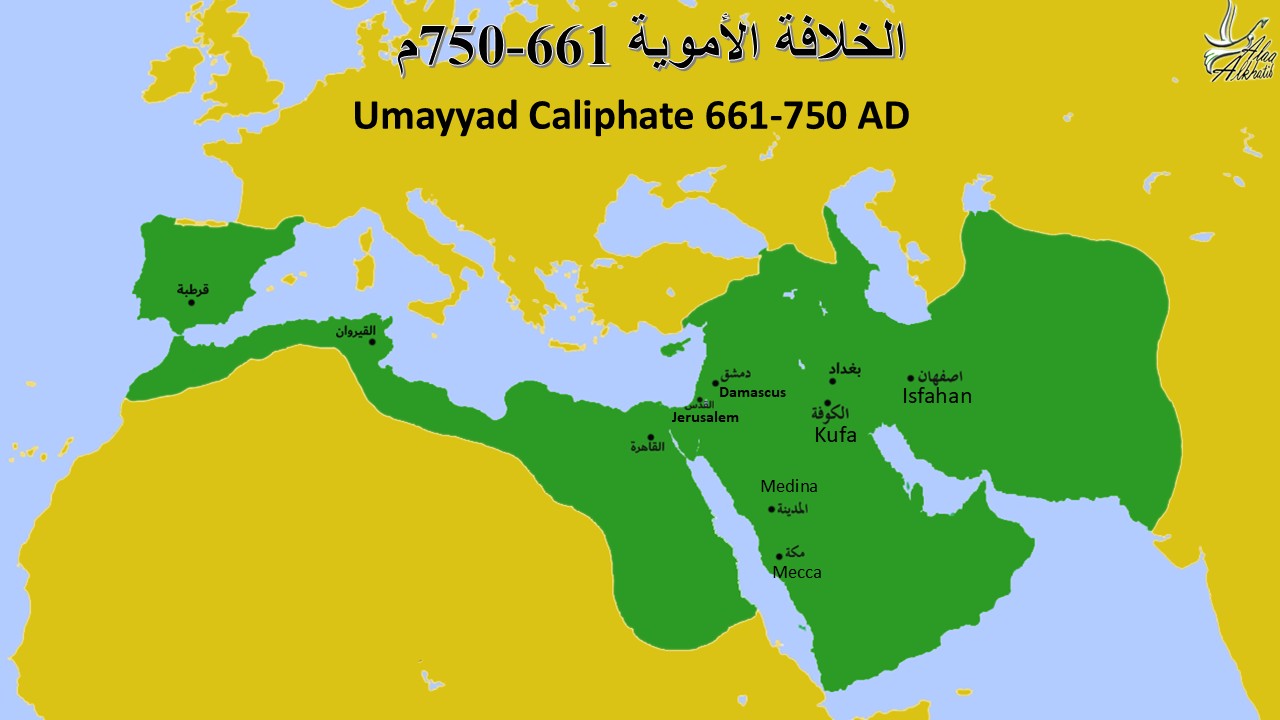
The relocation of the capital to Damascus was not merely a geographic change; it was a functional transition. The Umayyad state offered “Security” in exchange for “Political Participation.” This model was accepted by the public, not out of a love for autocracy, but as an escape from the nightmare of civil war. Here we observe a constant political law: societies exhausted by insecurity prefer a “Strong State” over “Chaotic Democracy.” The Umayyads did not rule by divine revelation, but through the “Pragmatism of Control.” It was a governance that provided stability in exchange for the old form of legitimacy. This is where the Umayyad state truly began.
The Transition to the Hereditary Pattern
The appointment of a Crown Prince (the Yazid model) was the shock that ended the “Utopia” of the Rightly Guided Caliphate. From the perspective of “Critique of Modernity,” this shift represented the institutionalization of the state. Instead of elite struggles upon the death of every ruler, the “Family Inheritance” model was adopted to ensure the stability of the empire’s infrastructure. The state chose “Dynastic Stability” as a sovereign tool to avoid the collapse of the center.
This return to the traditional hereditary form was due to the absence of an institutional model for power transition. This is not an attacking description, but an institutional one: the state chose a model of family continuity over open competition.
Tribal and Ethnic Solidarity (Asabiyyah)
The Umayyads did not rule from Damascus solely by the power of administrative bureaus (Diwans), but through the “Balance of Tribes.” Muawiya ibn Abi Sufyan was the “Architect of Balances”; he married into the powerful Yamani tribes in the Levant to create a shield for his throne. However, this policy was a dangerous gamble, as it linked the state’s fate to ancient Pre-Islamic conflicts. The struggle between the “Qaysites and the Yemenites” eventually eroded the state’s stability.
Furthermore, the Umayyad state did not view the “Mawali” (Non-Arab converts such as Persians, Berbers, and others) as equal partners in the nation, but as subjects of the Quraysh Empire. This ethnic superiority was the “time bomb” that dismantled the state from within. The concept of “Imams are from Quraysh” evolved from a religious discourse into an “Exclusive Sovereign Right,” leading to the emergence of two classes: the Arabs (The Masters) and the Mawali (Second-class citizens). Consequently, the Umayyad state was an “Arab Empire” more than a “Comprehensive Islamic State.” Administration, leadership, and land were exclusive to the Arabs, fueling the resentment that eventually led to the Abbasid Revolution.
The Ideology of “Jabr” and “Qadar” (The Politicization of Creed)
Theology (Kalam) was not born in mosques, but in the palaces of rulers and the corridors of the opposition. Theological disputes did not emerge in a vacuum, but in an environment of authoritarian political conflict and interaction with other cultures and religions.
The Umayyad authority supported “Jabriyyah” (Predestinarianism) as political propaganda, claiming: “We are only the decree of God over His servants.” If the ruler is destiny, then revolting against him is heresy. In contrast, the opposition (Qadariyyah and Mu’tazilah) raised the banner of “Free Will” to justify political responsibility and accountability. Here, we see how “religious information” is transformed into a coercive tool for social control or incitement:
- Jabriyyah: Justifies authority through destiny. It posits that humans are “compelled” in their actions, with no independent will. It told the people: “Be patient, for this is God’s judgment” (to maintain stability).
- Qadariyyah: Emphasizes human responsibility. It emerged as a reactive movement, asserting that humans are “free” and have an independent “power” and will to choose their actions. It told the people: “Take action, for the ruler is responsible for his injustice” (to legitimize change).
- The Early Mu’tazilah: Linked divine justice to the responsibility of the ruler.
During this period, the execution of Ma’bad al-Juhani occurred—the first martyr of opinion. He was killed and crucified by the state because he was the first to speak of the Qadariyyah doctrine. He was followed by the killing of Ghaylan al-Dimashqi and Ja’d ibn Dirham. Thus, the policy of persecuting intellectual dissent became established. The political struggle posed a creedal question: Is the unjust ruler a divine decree or a human responsibility? This was not a theoretical question, but a “State Question.” It marked the point where the alliance between the ruler and the cleric took a different turn.
Revolutions and Early Opposition
The Umayyad state was not accepted without resistance. Political revolutions, opposition movements, regional rebellions, and movements with religious-political rhetoric emerged. No Umayyad Caliph was spared from clashes with revolutions against the center in Damascus, except for Hisham ibn Abd al-Malik. Crucially, the opposition began to produce an alternative discourse of legitimacy, marking the beginning of the formation of oppositional Islamic political thought.
Imported Bureaucracy (Tools of the Empire)
The Umayyad state was not built upon sacred texts alone, but upon the experiences of cities. The Umayyads borrowed Byzantine Diwans, the Persian postal system, and Roman tax records. The later Arabization of the bureaus and the minting of coins were declarations of “Administrative Sovereignty.” Islam was no longer just a “Call” (Dawah); it became an “Ideological Framework” for an empire managed by a bureaucratic machine inherited from previous civilizations. The Islamic state was not built as a model isolated from history, but through the tools of great powers. It was built through Administration, not just through “Text.”
Conclusion
The era of “Political Innocence” ended, and the era of the “Imperial State” began. The Umayyads did not create a unique system; they followed the traditions of the great states of their time: monarchy, inheritance, and bureaucracy. However, this “forced stability” hid a national and intellectual boiling point that would soon explode in the “Abbasid Coup.” In the next article, we will see how the revolution devoured its children and how non-Arab nationalities entered to change the face of the state completely, following the first comprehensive coup against this model via the Abbasid Revolution.
——————-
You might want to read the full paper at this link:
History of Islam (full article): Islam Between the Sacred and the Human
Or you might be interested in reading the rest of the series:
- Sovereignty and Negotiation: An Analytical Reading of the Formation of the “Medinan Polity”
- Post-Founder Era: The Struggle for Legitimacy and the Test of Survival. The Saqifa, the Ridda, and the Conquest
- From Omar’s Assassination to the Great Fitna: The Cracking of the Center. When the State Devours its Children
- From Caliphate to Kingdom: The Birth of the Empire, The Umayyad Dynasty
- The Global Empire: The Labor of Nationalities and the Making of the Muslim Mind. The Power vs. The Jurist
- The Breaking of the Center: The Era of Sultans and the Making of Orthodoxy
- The Era of Fracture: Crusaders, Mongols, and the Fiqh of Siege
- The Tunnel of Stagnation and the Shock of Awakening
- The Crossroads: Aborted Enlightenment and the Rise of Ideology
- The Historical Trial: Toward an Islam Without Idols


