
Alaa al-Khatib
14/04/2026
In the midst of one of the fiercest confrontations the region has witnessed, and amid escalating strikes targeting multiple levels of Iranian leadership, the old question seemed to resurface: is the Iranian regime approaching the moment of collapse? Yet what actually happened was the opposite. Despite the targeting of first-, second-, and even third-tier figures, the regime did not fragment, nor did it display the disarray one would expect from a system viewed as a traditional pyramid that could be toppled by a single concentrated blow.
This paradox forces a reconsideration of the very nature of this regime. The Islamic Republic of Iran is not merely a religious system built on wilayat al-faqih, nor is it a nation-state in the classical sense, nor even a conventional political republic. It is a hybrid structure, formed since 1979 at the intersection of religion, politics, security, and economy, and it has evolved within a highly turbulent regional and international environment—to the point that its behaviour and resilience can no longer be understood through any single, simple model.
Within this structure, religion functions not merely as spiritual reference but as an instrument for producing legitimacy, and political institutions operate less as mechanisms of free representation than as tools for internal organization and the distribution of power. At the same time, despite the trans-national Islamic discourse that accompanied the revolution, the Iranian state rests on a deeper and more complex identity: an inclusive Iranian identity carrying clear historical and cultural layers of Persian origin, without ever fully transforming into a declared nationalism. This interplay between Islam as ideology, Iran as an inclusive framework, and Persia as cultural depth is what gives the regime its distinctive capacity to reproduce itself in the face of crises.
From here, the real question is not only about the regime’s ability to survive despite the strikes, but about how it was built from the outset as a system capable of absorbing shocks. How did wilayat al-faqih evolve from a revolutionary idea into a node within a complex network of power centers? How do elections function within this system, and what are their limits? How was its legitimacy constructed among religion, revolution, and external hostility? And why do its regional relationships appear to rest as much on conflict as on pragmatism? Finally, how can a regime whose leadership is repeatedly targeted continue without collapsing?
These questions do not lead merely to a historical reading, but to an attempt to understand the logic of a system that may appear contradictory from the outside, yet internally operates according to a precise balance among multiple elements—making its persistence a product of its structure, not merely political chance.
From Revolution to State: The Birth of an Unconventional Regime
The Iranian revolution of 1979 was not simply an event that toppled a monarchy and replaced it with a religious one; it was a moment of comprehensive redefinition of the very idea of the state in Iran. The Shah’s fall did not just create a political vacuum—it exposed a deeper crisis concerning the source of legitimacy, the limits of authority, and the nature of the relationship between society and state.
In this context, Ruhollah Khomeini did not present religion merely as a system of moral values, but proposed it as a governing framework capable of filling the political vacuum and reproducing authority in a different form. This is where the theory of wilayat al-faqih emerged—as articulated in his book Islamic Government—not as a traditional continuation of Shiite jurisprudence, but as its radical transformation from an advisory role into direct sovereign authority held by the jurist.
This intellectual shift, however, was not the only factor shaping the regime; it intertwined with two decisive processes: internal conflict and external war.
Domestically, the Iranian revolution was not a purely Islamic event—it involved multiple forces: nationalists, leftists, liberals, and Islamists. With the collapse of the Shah’s regime, this diversity turned into a struggle over the shape of the new state. Amid this struggle, the Khomeinist current gradually worked to exclude the other forces—not only to consolidate its own power, but to entrench a deeper conviction: that the regime’s survival depended on monopolizing religious authority over power, while maintaining an institutional political façade that gave the system a republican form without threatening its core.
In this context too, the development of Khomeini’s political thought cannot be separated from the broader climate of rising political Islam across the Muslim world during that period. The writings of thinkers such as Sayyid Qutb were circulated and translated in Iran, contributing to the formation of a revolutionary discourse opposed to Western hegemony and grounded in redefining authority from an Islamic perspective. Yet Khomeini’s project was not a direct repetition of Sunni Islamist movements—it was a distinct reformulation within the Shiite context, transferring political authority to the jurist himself rather than merely seeking to influence the state from outside it.
The second decisive factor was the Iran-Iraq War (1980–1988), which played a central role in reshaping the regime’s structure. The war was not merely a military confrontation; it was a founding moment for the new state, one that entrenched the leadership’s conviction that survival was achieved not only through religious legitimacy, but through possessing independent, reliably loyal instruments of power.
In this context, the security and military institutions were reinforced, foremost among them the Islamic Revolutionary Guard Corps (IRGC), conceived not as a force tied to the political state but as one directly bound to protecting the regime itself. Meanwhile, the traditional military structure inherited from the Shah’s era was weakened, including the dismissal of a large number of experienced officers, in favor of building new institutions more loyal to the revolution and its ideology.
Thus, the Islamic Republic was formed neither as a purely religious system nor as a conventional nation-state, but as a complex composite bringing together revolution and state, ideology and institution, religious legitimacy and the demands of practical governance. The Iranian regime was not built on a single idea, but as the outcome of a complex interaction between religious theory, internal political struggle, a complex social structure, and a bitter wartime experience—accumulated over a long period during which the regime drew experience from both its internal and external trials. The result was a dual structure of power: religious in its legitimacy, security-based in its instruments, and political in its form. Since then, the regime has ceased to be merely a product of revolution and has become an integrated system, designed not only to govern, but to survive.
The Networked Structure of Iran’s Power Pyramid
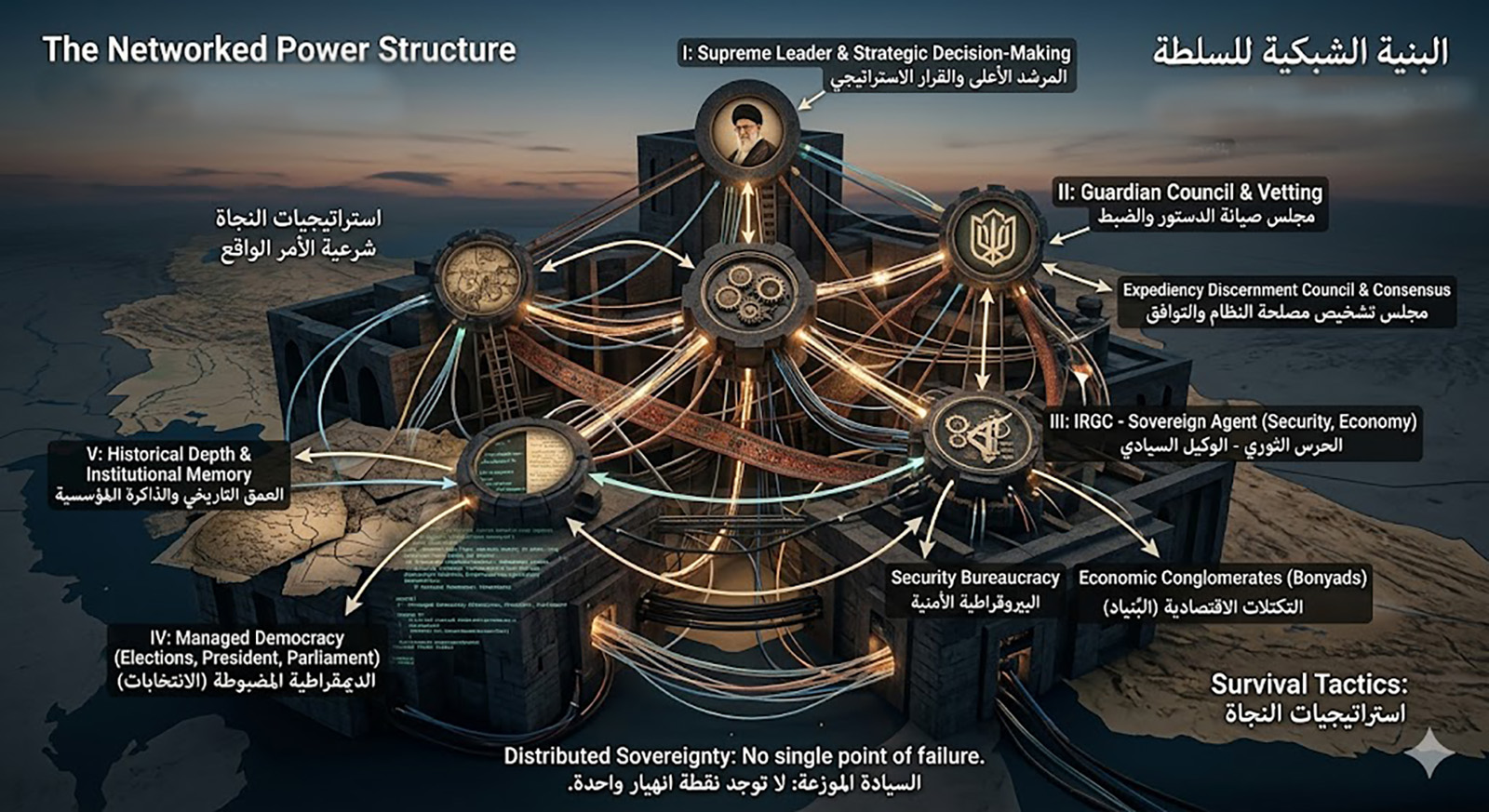
If the Iranian regime appears from the outside as a traditional pyramid topped by the Supreme Leader, this impression—while formally accurate—conceals a far more complex structure beneath the surface. The Islamic Republic was not built as a simple centralized system that could be toppled by removing its head, but as a distributed, multi-centered system, in which authorities overlap and power is continuously redistributed.
At the apex of this structure sits the office of the Supreme Leader, combining religious legitimacy with political authority and holding final say on major issues. But this apex does not operate in a vacuum, nor does its authority translate through a traditional hierarchical chain of command—rather, it works through an interwoven network of institutions, each playing a role in stabilizing the regime, not merely in administering the state.
At the political level, there exist institutions that appear, at first glance, closer to the model of a modern state: an elected president, a parliament, a government. Yet these institutions operate within pre-drawn boundaries, their decisions subject to oversight by higher bodies—chief among them the Guardian Council, which holds the authority to determine who is eligible to run for office, thereby controlling the outputs of the political process before it even begins.
Alongside this, other institutions exist, such as the Expediency Discernment Council, which plays a role in resolving contradictions within the regime itself—reflecting that the system does not seek to eliminate plurality within its institutions, but to organize and manage it. This constrained pluralism creates an internal balance that prevents power from concentrating entirely in one hand, while at the same time not permitting the emergence of any real alternative outside the system.
But the most important dimension of this network appears in the security and military structure, foremost among them the IRGC, which represents not merely a military institution but one of the regime’s central pillars. The IRGC combines multiple functions: military, security, intelligence, economic, and even social. Unlike a conventional army, it is organically bound to the regime’s doctrine and functions as a guarantor of its survival, not merely a tool for defending the state.
This overlap between political, religious, and security institutions produces what might be described as a “state within a state,” or more precisely, a “multi-layered state,” where no single authority controls everything, but rather a multi-centered structure of authorities that monitor one another, converging at a single point: the regime’s survival.
Alongside this, the economy plays a decisive role in anchoring this structure. A large portion of Iran’s economic activity falls under neither free-market logic nor conventional state control, but under quasi-official networks such as charitable foundations (bonyads) and companies linked to the IRGC. This economic structure creates a class of interests directly tied to the regime’s survival, making stability not merely a political matter but a material interest for vast networks within both state and society.
The Iranian regime relies on organizing plurality through constrained pluralism as a tool of survival and continuity; the structure of power does not prevent conflict within it, but contains that conflict within its institutions and corridors—preventing the emergence of total “political inertia,” as elites and crises are rotated within the network rather than escaping it.
In light of this composition, targeting leaders—even at multiple levels—proves insufficient to trigger decisive collapse. Each center of power within the regime possesses a degree of autonomy and capacity for continuity, while remaining linked to the other centers within a network that makes the collapse of any one of them a threat to all, rather than an opportunity for internal conflict.
Here, the Iranian regime is no longer a pyramid that can be toppled by a single strike, but a network in which power is distributed in a way that makes it more capable of absorbing shocks. The problem does not lie in the strength of the head alone, but in the nature of the body that carries it.
Regulated Democracy: Why Do Elections Exist?
On the surface, elections appear to be a core part of the Iranian regime’s political structure: an elected president, an elected parliament, announced turnout figures, competing campaigns. This image, at first glance, suggests a democratic system operating through mechanisms of popular representation. But this impression quickly dissolves upon examining the framework within which these elections are actually held.
In Iran, elections are not used as a means of changing the regime, but as a tool for organizing it. From the outset, the electoral process is subject to oversight by the Guardian Council, which holds decisive authority over who may run for office—thereby drawing the boundaries of political competition in advance. Elections are thus not an open arena, but a limited field of competition among currents that all belong, to varying degrees, within the system itself. The Guardian Council carries out a pre-emptive “filtering” process aimed at steering outcomes; it does not leave results to chance, but practices a form of “social engineering” that ensures whoever wins remains a “gear” compatible with the overall machine.
This does not mean elections are entirely symbolic or without effect. On the contrary, they serve multiple functions within the regime’s structure. First, they grant the regime periodic legitimacy, used both internally and externally to demonstrate popular support and political continuity. Second, they allow a degree of competition within the ruling elite, helping redistribute power and ease tension among different power centers. Third, they function as a mechanism for absorbing social tension, as part of society finds in the electoral process a limited space for expression—even if that space is pre-calibrated. This electoral system thus allows elites (reformists, conservatives, radicals) to compete over “administration” rather than “sovereignty.” This regulated conflict prevents “institutional inertia,” as it regularly renews the blood within the state’s bureaucratic apparatus.
In this sense, politics in Iran is not abolished but redefined. The political struggle does not revolve around the form of the regime or its legitimacy, but around how it is administered and the limits of its policies. Here, elections become a means of regulating this struggle, not of opening it to uncalculated possibilities.
Ironically, this limited electoral structure contributes to the regime’s stability more than it weakens it. It prevents the absolute concentration of power in one hand by creating internal balances, while simultaneously preventing the emergence of any real political alternative that could pose an existential threat to the regime.
Within this framework, what is sometimes called “reformism” inside the Iranian system can be understood not as a movement seeking radical change, but as a current operating within the system’s boundaries, renegotiating certain policies without touching its foundations. This explains how the regime can undergo shifts in discourse or policy without any change occurring in its fundamental structure.
In the political science literature, Iran is not classified as a liberal democracy but as a hybrid regime, or “electoral authoritarianism”—or more precisely, an “elite religious system with electoral instruments,” where elections are used as a tool for organizing competition within the system, not for changing it. The Iranian citizen does not choose between open political projects, but between options pre-determined within a framework that preserves the existing power structure.
The question, then, is not: why do elections exist in a system that is not fully democratic? It becomes: how are elections used as a tool of both control and continuity at once?
Here, democracy is not absent—it is reshaped, so that it serves the regime’s survival rather than threatening it.
Legitimacy: How Does the Regime Live Off Crises?
If the structure of the Iranian regime explains how it functions, understanding its legitimacy explains why it endures. The Islamic Republic did not build its legitimacy on stable economic achievement or broad political consensus, but on a complex mix of multiple sources—foremost among them its ability to reinterpret crises as proof of its necessity rather than evidence of its failure.
In this context, four main sources of legitimacy can be identified within the Iranian regime, overlapping and being reformulated with each new phase.
The first source is revolutionary legitimacy, rooted in the overthrow of the Shah’s regime as a founding moment that remains present in official discourse. The regime presents itself not merely as a ruling authority, but as the extension of an ongoing revolution—granting it the ability to transcend conventional performance evaluation and tie its existence to a larger historical idea.
The second source is religious legitimacy, tied to the theory of wilayat al-faqih, which grants the regime a dimension extending beyond politics into something resembling divine mandate. This legitimacy is used not only to justify authority but also to define its limits, such that opposing it in certain contexts becomes closer to challenging the religious framework itself than mere political objection.
The third source is sovereign or national legitimacy, built on a discourse of resisting external hegemony, particularly toward the United States and Israel. Here, the regime presents itself not merely as ruler but as guardian of the state against threats, allowing it to convert external pressure into a factor of internal mobilization. Within this framework, Islamic identity intersects with a broader Iranian identity, activated especially at moments of danger to reinforce internal cohesion despite national diversity.
The fourth source, perhaps the most important, is the legitimacy of endurance. From the war with Iraq, through sanctions, to direct military strikes, the regime has succeeded in reframing its own survival as an achievement in itself. Rather than crises undermining its legitimacy, they are presented as proof of its capacity to endure—and even as validation of its chosen path.
In this sense, the Iranian regime does not merely survive despite crises—it lives through them. Each crisis is reformulated within a discourse linking external threat to the necessity of internal cohesion, creating a closed loop in which pressure becomes a factor of stability rather than collapse.
This does not mean this legitimacy is immune to erosion, or accepted by all segments of society. The tension between these different sources, and between them and economic and social realities, constitutes one of the most significant challenges the regime faces. Yet the regime’s ability to move between these sources, reordering its priorities according to circumstance, grants it high flexibility in crisis management.
Like many dictatorial states, the Iranian regime has managed to make “survival” its final product. In neoliberal systems, the achievement is “growth”; in the Iranian Republic, whose model of statehood rests on survival as an end in itself, the achievement is “not falling.” This explains why sanctions do not lead to collapse—they simply feed the third and fourth sources of legitimacy (sovereign and endurance-based).
In light of this, the question is no longer why the regime persists despite pressure, but how it succeeded in converting that pressure into part of the very logic of its survival. A regime whose legitimacy is built on stability may collapse with its first crisis; a regime whose legitimacy is built on conflict finds in crisis a natural environment for its continuation.
The Outside as Internal Necessity: Why Does the Hostility Persist?
Iran’s regional behavior, and the tense nature of its relations with its surroundings, cannot be understood apart from its internal structure. In Iran’s case, hostility is not merely a reversible policy choice but a structural component of the regime’s very composition, born with the revolution and entrenched over time until it became part of the state’s operating mechanism.
From the earliest days after 1979, the Islamic Republic did not define itself as a new state within the existing international order, but as a revolutionary power seeking to redefine that order. The seizure of the American embassy in Tehran and the hostage crisis was a pivotal moment in this trajectory—not merely a diplomatic crisis, but a declaration of Iran’s shift from ally to adversary, from a state within the international balance of power to a state defining itself in opposition to that balance.
In this context, labeling the United States the “Great Satan” was not merely propaganda, but an intellectual framework redefining foreign policy as an extension of ideological struggle. The same applies to the relationship with Israel, which became a fixed element in the regime’s discourse—not only for geopolitical reasons, but as part of constructing a political identity built on resistance and confrontation.
Yet this hostility does not function only externally—it performs a crucial internal function. It provides the regime with an interpretive framework for crises, allowing economic or political pressures to be attributed to external factors, easing internal pressure and redirecting anger toward “the other.” It also reinforces cohesion within the ruling elite, as internal disagreements become less significant in the face of a permanent external threat.
This does not mean, however, that Iranian foreign policy is entirely governed by ideology. Despite its revolutionary discourse, the regime has shown a high capacity for pragmatism, whether in its relations with major powers such as Russia and China, or in managing its regional balances. This interplay between ideology and interest does not weaken the regime—it grants it additional flexibility, allowing it to maneuver within a complex environment without abandoning its core discourse.
At the same time, this framework allows the regime to expand its regional presence—not only through conventional politics, but by building networks of influence extending into a number of regional states. Here, expansion is not merely geopolitical ambition, but part of a defensive strategy that pushes conflict beyond its borders, tying Iranian security to a broader regional depth. The regime has converted “influence” into “security sensors.” Iran does not expand merely to spread revolution, but to build an “infrastructure for confrontation” far from the state’s core, granting it a “strategic depth” that shields its hard core from any direct strike.
This dimension, however, is incomplete without understanding an equally important aspect: the pragmatism of Iranian behavior, which often coexists with—and sometimes contradicts—ideological discourse. This contradiction appeared clearly in the early years after the revolution in what became known as the Iran-Contra affair, when Iran entered into communication and arms-exchange channels with the United States—officially described as the “Great Satan”—in the context of its war with Iraq. This was not an isolated exception, but an early indication that regime survival could take precedence over the consistency of its discourse.
This pragmatism, however, did not remain confined to wartime conditions—it developed more clearly in the post-Khomeini era under Ali Khamenei, who inherited a more stable system and redirected its foreign policy within a wider margin of flexibility. Whereas Ruhollah Khomeini viewed both the Western and Soviet blocs through a rejectionist ideological lens, as extensions of non-Islamic systems, Iranian leadership in the 1990s—under Khamenei’s tenure as Supreme Leader after Khomeini—moved toward building more pragmatic relations with its regional surroundings, particularly Central Asia, leveraging religious and cultural ties to reinforce its influence.
In this context, Iran did not hesitate to play roles that went beyond its revolutionary discourse, at times supporting regional arrangements aimed at stability, and its interests intersected with Russia’s in managing the crises following the Soviet collapse, whether in Central Asia or its broader surroundings, including the Caucasus. This shift does not mean the regime abandoned its ideology, but reflects its ability to deploy that ideology within more complex calculations—where discourse is not discarded, but reinterpreted to serve continuity.
In this sense, the contradiction between declared hostility and pragmatic behavior does not appear as a flaw in Iranian policy, but as part of its structure. The regime does not operate according to a single fixed logic, but within a mix of ideology and interest that allows it to preserve its identity on one hand while adapting to reality on the other.
In light of this, the question is no longer why Iran continues to adopt a foreign policy built on hostility, but how that hostility became part of the logic of its internal stability. A regime that defines itself through conflict cannot easily abandon it, because doing so would mean abandoning one of the most important sources of its cohesion.
The Phase of Fortification: How Did the Regime Learn From Revolutions?
The Iranian regime was not shaped by revolution and war alone—it reshaped itself more profoundly over the past decade, under the impact of the wave of unrest that swept the region, from internal protests to the “Arab Spring” revolutions.
The events of 2009, known as the “Green Movement,” were a pivotal moment within Iran. They were not merely an electoral protest, but the first real test of the regime’s ability to confront a wide-scale internal challenge led by segments from within society, not from outside it. These events revealed a relative fragility in the regime’s structure at the time, but they simultaneously triggered a deep internal review aimed at recalibrating instruments of control and strengthening its capacity to contain crises.
With the outbreak of the Arab revolutions after 2011, the Iranian regime received an even clearer message: that waves of change could reach any state, regardless of its regime type. Iran’s stance toward these revolutions was not consistent with its traditional revolutionary discourse, but was marked by considerable selectivity. While it supported certain movements, it stood decisively by the Syrian regime—not merely as a political ally, but as a strategic line of defense for a regional structure it viewed as an extension of its own internal security.
Iran also expanded its presence in other arenas, such as Yemen, taking advantage of the vacuums left by political transformations—reflecting its shift from a phase of “defending the revolution” to one of “managing influence” within a fragmented regional environment.
Domestically, these shifts were accompanied by clear social changes, particularly the rise of a younger, more open and aspirational generation, especially prominent during Hassan Rouhani’s presidency. This tension between a changing society and a regime seeking stability did not lead to internal disintegration, but pushed the regime to develop more precise tools for managing the balance between openness and control.
In this sense, the past decade was not merely a period of pressure on the regime, but a period of learning and fortification. It shifted from reaction to action, from crisis management to crisis anticipation, and from relying solely on revolutionary legitimacy to building a more complex system combining security, politics, economy, and discourse.
From this, one could argue that today’s Iranian regime is not the same regime it was fifteen years ago. Had Iran faced pressures similar to today’s in the mid-2000s, the outcome might have been different. Today, what we are facing is not a regime still in formation, but one that has repeatedly tested itself and restructured itself in light of those tests.
This transformation cannot be separated from the broader international context, where the decline of global governance and the intensifying competition among major powers—especially after the Ukraine crisis—created a wider margin for states like Iran to maneuver. The regime benefited not only from its internal structure but also from a less stable international environment that allowed it room to maneuver and build interest-based relationships with major powers such as Russia and China, within what resembles a more fluid, less disciplined international system.
Why Has the Regime Not Fallen?
Having traced the formation of the Iranian regime—from revolution to state, through its development and reconstruction over the past decade, from structure to legitimacy, from the internal to the external—the central question returns with even greater urgency: how can a regime whose leadership is targeted at multiple levels continue without collapsing?
The answer lies not in a single factor, but in the layering of a set of elements that make this regime a case distinct from conventional models of statehood. The Islamic Republic was not built as a hierarchical system dependent on a single head that could be toppled, but as a complex network of power centers, with authority distributed among religious, political, security, and economic institutions—such that the absence of any one center does not lead to the collapse of the whole.
In this structure, the leader alone does not constitute the center of the regime, but represents part of a broader system capable of reproducing itself even amid the loss of pivotal figures. The IRGC, the religious institutions, and the economic networks do not function merely as subordinate tools, but as pillars in their own right, converging on a single objective: the regime’s survival.
Alongside this, the nature of legitimacy plays a decisive role in explaining this resilience. A regime that derives its legitimacy from stability may collapse at its first crisis, whereas a regime that defines itself through conflict finds in crises a natural environment for its operation. Here, strikes are not interpreted as a sign of weakness, but are reframed as evidence of being targeted, and thus as an additional cause for internal cohesion.
The existence of electoral institutions, despite their limits, adds another layer of stability, creating internal channels for redistributing power and absorbing tension without opening the door to radical change in the regime’s structure. At the same time, the economic structure tied to the regime binds broad segments of the elite to a direct interest in its continuation, making its preservation not merely a political choice, but a material necessity.
At the level of foreign policy, persistent hostility, despite its cost, performs an internal function no less important than its external one—reinforcing the regime’s identity and redirecting pressures—while practical pragmatism allows it to avoid total isolation, through building interest-based relationships with international and regional powers.
In light of this, targeting leaders, however painful, proves insufficient to trigger comprehensive collapse. The Iranian regime is not a body that can be dismantled from the top, but a distributed system that renews itself from within and rebuilds its balance with every shock.
Herein lies the fundamental paradox: the problem is not merely the regime’s strength, but the nature of how it is perceived. Treating it as a conventional regime leads to flawed conclusions, based on the assumption that removing the leadership means the end of the structure—while reality suggests the opposite.
What the Iranian experience reveals is not only the limits of military power, but the limits of understanding as well. A regime built to operate under tension does not easily collapse under pressure—it may instead reorganize itself through it.
In the end, the question is not: why has the Iranian regime not fallen?
Because regimes built on stability need peace in order to live… while regimes built on conflict have mastered how to live inside the storm.
The question, instead, becomes: was it ever capable of falling at all, given the tools that were used against it?


