
Alaa Alkhatib | Senior Energy & Geoeconomics Strategist, Policy Researcher |
May 18, 2026
Originally published in Arabic On the Jamhara platform, 2026/06/12,
EXECUTIVE SUMMARY
This study challenges the pervasive, essentialist reductionism that frames the Syrian conflict primarily as an inevitable, ancient sectarian feud between primordial religious communities. It argues that sectarianism in Syria is not an independent variable or a fixed socio-cultural trait, but a manufactured secondary structure—engineered and continuously weaponized by the totalitarian Assad regime as an instrument of social control, divide-and-rule governance, and balance-of-terror management through a cross-sectarian alliance network encompassing security elites, business oligarchs, and traditional religious establishments.
The paper introduces a four-tiered dynamic spectrum mapping how sectarianism escalates from latent psychological beliefs to hate speech, dehumanization, and organized physical violence. Furthermore, it explains that the flare-up of sub-national identities in the post-Assad transitional period (following December 2024) is not driven by an inherent desire for tribal warfare, but is the direct byproduct of an acute institutional vacuum and the collapse of state apparatuses. Finally, the study outlines strategic pathways to re-politicize the Syrian conflict and secure durable civil peace through three structural pillars: comprehensive transitional justice, equitable state institution building, and a cohesive national narrative rooted in equal citizenship and a renewed social contract.
Keywords: Sectarianism; Essentialist Fallacy; Hate Speech; Totalitarianism; Syria Transition; Transitional Justice; Dehumanization; Re-politicization.
1. Introduction: The Essentialist Fallacy and Analytical Limitations
Mainstream Western media coverage and analytical literature on Syria frequently fall into an essentialist trap: reducing a complex, multi-layered socio-political crisis into a narrow, primordial sectarian conflict. This framework depicts the Syrian tragedy as an unavoidable, timeless clash between fixed ethnoreligious blocs. Methodologically, this perspective suffers from severe reductionism. It treats sectarianism as an independent variable—an primary cause—rather than an outcome shaped by deliberate political engineering, socio-economic marginalization, and institutional decay.
Treating religious or confessional communities as monolithic units with unified political interests ignores deep internal socio-economic, regional, and ideological divisions within every single group. The true danger of this essentialist lens is that it alters the self-perception of local actors. When a conflict is redefined around primordial pre-state identities, its core political dimensions—authoritarian repression, institutional corruption, economic injustice, and demands for democratic governance—are completely erased. Consequently, a negotiable political dispute over governance and state resources is transformed into an existential zero-sum struggle for survival.
Following the collapse of the Assad regime in December 2024, Syria entered a delicate transitional phase marked by visible societal fractures. Essentialist observers interpreted this post-collapse turbulence as proof that sectarianism was the primary driver of Syrian society all along. In reality, these fractures were the inevitable result of decades during which sectarian fears were state-managed and frozen under coercive authoritarian control. Once the regime’s repressive machinery collapsed, an acute institutional vacuum emerged, unleashing sub-national identities in the absence of neutral state structures. Sectarianism in Syria is not an inherent cultural constant, but a secondary, manufactured structure that must be deconstructed through systemic political analysis rather than cultural determinism.
2. Sectarianism as a Dynamic, Multi-Tiered Spectrum
Far from being static or homogenous state of mind, sectarianism operates as a dynamic, multi-tiered spectrum. It ranges from subtle cultural affiliations to overt, organized physical violence. Dissecting this spectrum is essential to understanding how societies transition from fragile co-existence into armed polarization.
Level 1: Latent Beliefs & Cultural Identity (Passive Sectarianism)
Religious or confessional affiliation functions primarily as an innocent source of psychological comfort, social belonging, and ritual continuity. Common in traditional societies, this level rarely triggers conflict; interactions in market trade, workplace, and neighborhood life remain stable and cooperative despite social boundaries like endogamy.
Level 2: Social Distrust & Discriminatory Behavior
Latent beliefs translate into tangible socio-economic behaviors. Individuals favor co-religionists in employment, business partnerships, or local appointments—driven either by ‘organic trust’ or ambient suspicion of the ‘Other.’ This level expands rapidly during economic hardship and state retreat, signaling diminishing faith in equal citizenship.
Level 3: Sectarian Discourse & Dehumanization
Sectarianism enters the public realm through explicit hate speech, weaponized historical grievances, and systemic dehumanization. The ‘Other’ is portrayed as an existential threat to the community’s survival. This psychological conditioning lowers the moral barrier to violence and erases empathy across group lines.
Level 4: Physical Violence & Systematic Conflict
The ultimate escalation into physical destruction, identity-based killings, and forced displacement. Sociological analysis proves this stage is never a spontaneous popular reaction; it requires structured armed militias, sustained financial funding, and strategic manipulation by political or regional actors.
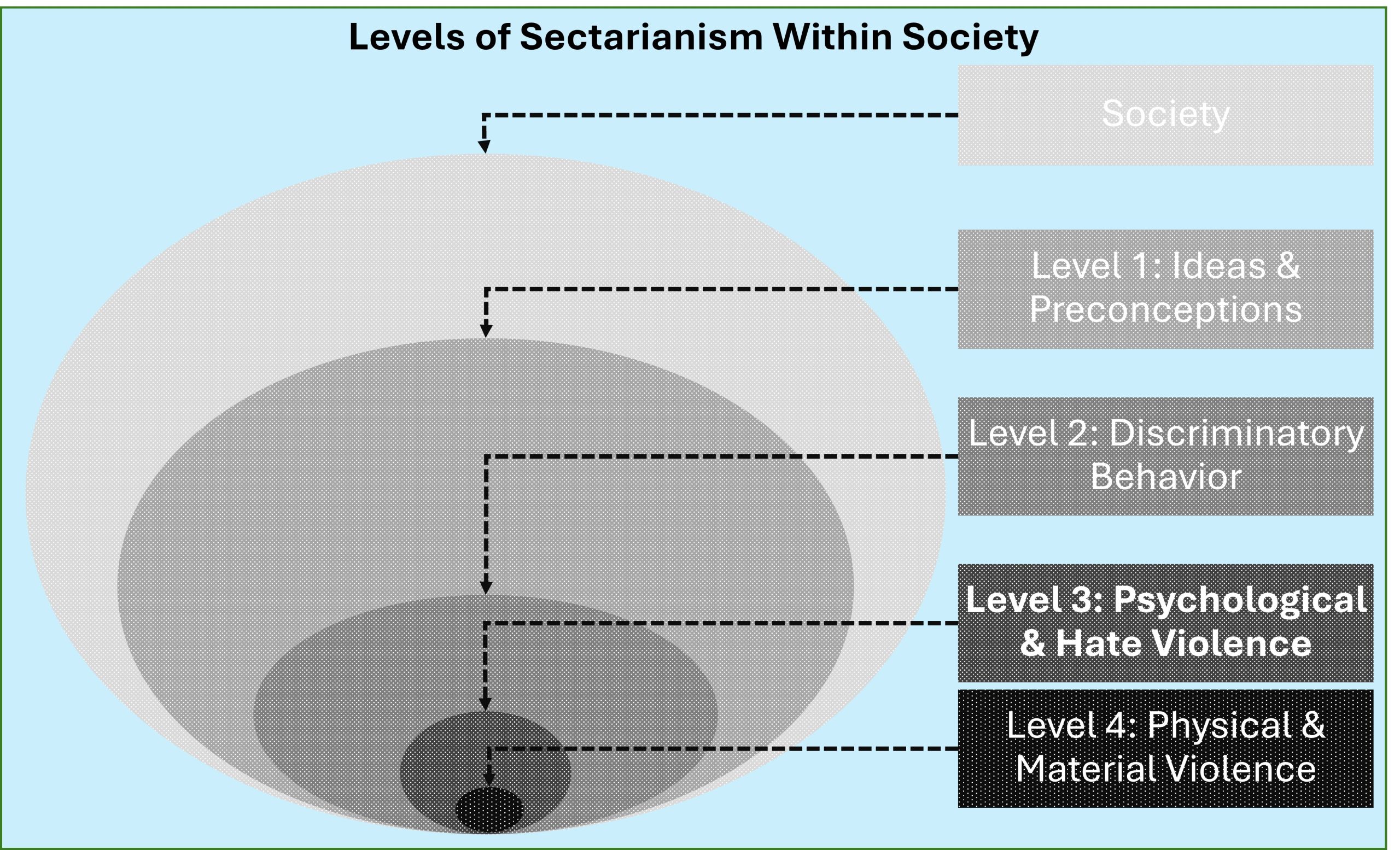
Analytical Rules:
• Inverse Proportion: Popular participation decreases as severity rises; the vast majority of citizens reside in Levels 1 and 2, whereas a small minority drives Levels 3 and 4.
• Sequential Dependency: Mass physical violence (Level 4) cannot erupt without the psychological groundwork laid by Level 3 hate speech. De-escalating public discourse and enforcing anti-hate policies early can effectively prevent armed violence.
3. Authoritarian Engineering: The Assad Regime’s Governance Model
The totalitarian regime of Hafez al-Assad, followed by Bashar al-Assad, played a decisive role in shaping modern Syrian sectarian dynamics—not by creating sectarianism from scratch, but by systematically engineering it as an instrument of political survival. Authoritarian regimes maintain power by fracturing civil society and monopolizing arbitration between social groups.
The Assad governance model operated on a dual mechanism: total suppression of independent political space on one hand, and the covert cultivation of cross-sectarian fear on the other. By banning autonomous civil society, political parties, and independent labor unions, the regime prevented the formation of broad, cross-sectarian national movements (such as democratic, leftist, or civil rights coalitions). Concurrently, the state security machinery fostered an atmosphere of mutual suspicion, presenting the regime locally and internationally as a ‘secular protector of minorities’ against a radicalized majority.
Deconstructing the ‘Alawite Regime’ Myth
The regime actively nurtured the narrative that it represented ‘Alawite rule,’ achieving two conflicting strategic objectives:
1. To Minorities (and Alawites in particular): It bound their survival directly to the regime’s existence, weaponizing the fear of sectarian retribution to transform an entire community into political hostages and human shields.
2. To the Sunnis: It projected an image of an impenetrable, mono-sectarian security apparatus, signaling that any attempt at political reform would inevitably trigger a catastrophic civil war.
A structural analysis of the regime’s power base exposes the fallacy of this narrative. Rural Alawite regions suffered severe economic neglect and poverty alongside other Syrian provinces. In truth, the regime was not a sectarian state, but a cross-sectarian mafia-like family oligarchy resting on three structural pillars:
• The Military-Security Apparatus: Driven by personal loyalty and family networks. While top commands were disproportionately assigned to Alawite loyalists for regime survival, high-ranking Sunni and minority officers were deeply integrated into senior operational levels to guarantee total control.
• The Business Oligarchy (The Urban Bourgeoisie): A crucial strategic alliance with traditional merchant elites in Damascus and Aleppo (predominantly Sunni and Christian families). The regime granted lucrative monopolies and commercial privileges in exchange for absolute political compliance.
• The Traditional & Religious Establishment: Co-opting Sunni state clergy, official muftis, and tribal Sheikhs to legitimize authoritarian rule and pacify rural and conservative populations.
Under Bashar al-Assad, this system transitioned from state-mediated patronage to an aggressive kleptocracy where security power fused directly with economic monopolies (exemplified by Rami Makhlouf). The subsequent internal purging of Makhlouf by new financial networks centered around Asma al-Assad highlighted the true nature of the system: a predatory family cartel driven purely by enrichment and power retention, rather than communal or sectarian solidarity.
4. Post-2024 Dynamics: From Latent Sectarianism to Institutional Vacuum
When the Syrian uprising began in March 2011, it emerged as an inclusive, pro-democracy national movement. To derail this threat, the regime deliberately militarized the conflict, employed extreme violence, and released radical jihadist figures from prisons. The strategy was clear: transform a popular uprising against authoritarian rule into a sectarian civil war, forcing international observers to choose between tyranny and extremism. This dynamic was further compounded by regional interventions (Iran, Russia, Hezbollah) and the rise of transnational extremist groups.
Following the fall of the regime in December 2024, Syria entered a period defined by an acute institutional vacuum. The sudden collapse of central security apparatuses occurred before credible, democratic state institutions could take root. In this void, sectarian tensions escalated—not because Syrians possess an inherent drive for sectarian conflict, but because all established mechanisms of social regulation collapsed overnight.
The flare-up of sub-national identities in the post-Assad era demonstrates that decades of totalitarian rule did not resolve sectarianism; it merely repressed and deepened its fault lines. The resolution of these tensions depends entirely on establishing a just state, impartial rule of law, and competent public institutions.
5. Hate Speech and the Construction of a Dominant Narrative
Hate speech serves as the primary engine translating latent prejudice into active social conflict. It provides the cognitive frame and moral justification required for individuals to participate in or tolerate exclusion and violence.
In contemporary Syria, digital media and social platforms have decentralized the generation of hate speech. Unchecked algorithms accelerate misinformation within a ‘post-truth’ ecosystem, where primordial fear overrides empirical facts. This toxic discourse relies on three cognitive mechanisms:
• Over-reductionism: Attributing complex political, economic, or criminal events entirely to the sectarian identity of the perpetrator.
• Blanket Generalization: Erasing individual responsibility and assigning collective guilt to an entire religious group for the actions of a political regime or warlord.
• Dehumanization & Historic Alignment: Employing loaded religious terminology to equate present-day political opponents with historical enemies, framing political compromise as treason.
This environment transforms the ‘Sectarian Narrative’ into a Dominant Cognitive Frame. When every crime, policy dispute, or local conflict is filtered through this lens, citizens lose the capacity for objective legal accountability. Opponents are no longer seen as political actors with negotiable interests, but as existential threats.
- Strategic Framework: Re-Politicizing the Conflict & Rebuilding National Identity
Dismantling sectarianism requires a structural pivot away from confessional balancing toward the re-politicization of the Syrian struggle. The conflict must be reframed around state building, institutional accountability, social justice, and constitutional rights. This transformation rests on three core strategic pillars:
1. Comprehensive Transitional Justice: Universal legal accountability is the only mechanism that can prevent grievance from mutating into endless revenge cycles. Prosecuting perpetrators based strictly on individual criminal responsibility—regardless of their religious background—redefines the relationship between victim and offender as a legal matter rather than a communal feud.
2. Building Inclusive State Institutions: Sub-national identities recede only when citizens trust that their rights, safety, and economic prospects are protected by an impartial state. Syria requires an independent judiciary, professional non-sectarian security forces, and democratic governance anchored in international human rights standards.
3. Formulating an Inclusive National Narrative: Syria must construct a new, critical national narrative that acknowledges historical grievances without falling into sectarian reductionism. This narrative must celebrate cultural diversity while establishing an overarching civic identity based on equal citizenship and a new constitutional contract.
7. Conclusion: Beyond the Sectarian Mirage
Sectarianism in Syria is neither an illusion nor is it the ultimate structural truth of Syrian society. It is the functional symptom of a deeply distorted political system and the absence of a shared civic space. The greatest threat to Syria’s future is not the existence of social diversity, but the continued reliance on ‘sectarian lenses’ by political actors, media platforms, and international policymakers.
Syria stands at a critical historical juncture. Beyond physical reconstruction, the ultimate challenge lies in reconstructing national meaning and collective consciousness. The battle for Syria’s future will not be decided solely by governance structures, but by how Syrians interpret their shared tragedy and whether they can forge an inclusive, civic identity capable of transcending the fractures of the past.


