
Alaa Alkhatib
An edited English edition based on the original Arabic study
Updated and adapted for an international readership • 25 August 2026
Editorial Note to the English Edition
This English edition is not a literal translation. It preserves the argument, structure and policy concerns of the Arabic original while adapting terminology, examples and explanatory context for readers who may not be familiar with Syria’s political economy.
Several categorical formulations in the original have been moderated where the available evidence supports a more qualified conclusion. In particular, the paper distinguishes between neoliberalism as a broad and contested policy label and specific policies—rapid privatization, fiscal austerity, deregulation and capital-account liberalization—whose effects vary with institutional capacity, sequencing and sector.
Time-sensitive Syrian data and policy examples have also been checked against later public sources. The purpose is not to replace the author’s thesis, but to make the argument more precise: Syria’s central risk is not private investment itself. It is the premature transfer of strategic assets and policy capacity in a state whose institutions, regulatory systems and social contract remain exceptionally fragile.
Contents
- Syria at a Crossroads
- Neoliberal Economics: The Seductive Promise
- Syria: Why Rapid Privatization Risks Becoming a Fire Sale
1. Syria at a Crossroads
Even before the 2011 uprising, Syria faced serious economic and institutional weaknesses: corruption and patronage were widespread, public institutions were fragile, unemployment and poverty were persistent, and the business environment was difficult. The World Bank’s Doing Business 2009 profile ranked Syria 137th out of 181 economies—an indicator that should not be treated as a complete measure of institutional quality, but which nevertheless reflected substantial obstacles to enterprise and investment.[1]
Fourteen years of war then transformed structural weakness into devastation. Later World Bank assessments estimated direct physical damage to infrastructure, housing and non-residential buildings at about US$108 billion and reconstruction needs at roughly US$216 billion. The same assessment estimated that nearly one-third of Syria’s pre-conflict gross capital stock had been damaged.[2] UNDP has likewise described an economy marked by pervasive poverty, severely disrupted public services and institutional fragility.[3]
Against this background, the post-Assad transitional authorities have sought to revive economic activity rapidly through private investment, restructuring of state enterprises, foreign partnerships and a reduced role for the old public-sector apparatus. These measures are understandable in a country with extremely limited fiscal capacity. The danger lies not in opening the economy as such, but in doing so before the state has rebuilt the institutions capable of valuing public assets, regulating monopolies, enforcing contracts and protecting strategic interests.
This paper argues that a rapid, poorly regulated transfer of strategic assets under present Syrian conditions could become a fire sale rather than a reconstruction strategy. The alternative proposed here is neither a return to Assad-era state capitalism nor a rejection of markets. It is a developmental model in which markets and private capital operate within a strong institutional framework, while the state retains strategic direction over infrastructure, natural resources, human development and long-term economic resilience.
2. Neoliberal Economics: The Seductive Promise
“Neoliberalism” is a contested term, used more often by critics than by the architects of the policies grouped under it. In economic debate, it commonly refers to an agenda emphasizing market competition, deregulation, privatization, trade and financial openness, fiscal restraint and a smaller direct role for the state in production.[4]
It should not be confused with every form of market capitalism. A market economy can coexist with strong competition law, public infrastructure, social insurance, industrial policy and public ownership of selected strategic assets. The central issue is therefore not a binary choice between “capitalism” and “socialism,” but the scope, capacity and strategic role of the state.
A useful simplified analogy is this: in classical market capitalism, the state may act as referee—protecting property, enforcing contracts, policing monopoly and providing essential public goods. In a strongly neoliberal version, the referee is deliberately given a narrower mandate, on the assumption that competition and private allocation will usually outperform public direction. That assumption can work tolerably well in some sectors and institutional settings; in others, especially where markets are concentrated or institutions are weak, it can create serious vulnerabilities.
Milton Friedman became one of the most influential advocates of economic liberalization in the twentieth century, and reforms associated with Ronald Reagan and Margaret Thatcher helped move privatization, deregulation and fiscal restraint into the mainstream of Western policy. From the 1980s onward, similar prescriptions also became central to many structural-adjustment programs in developing economies.
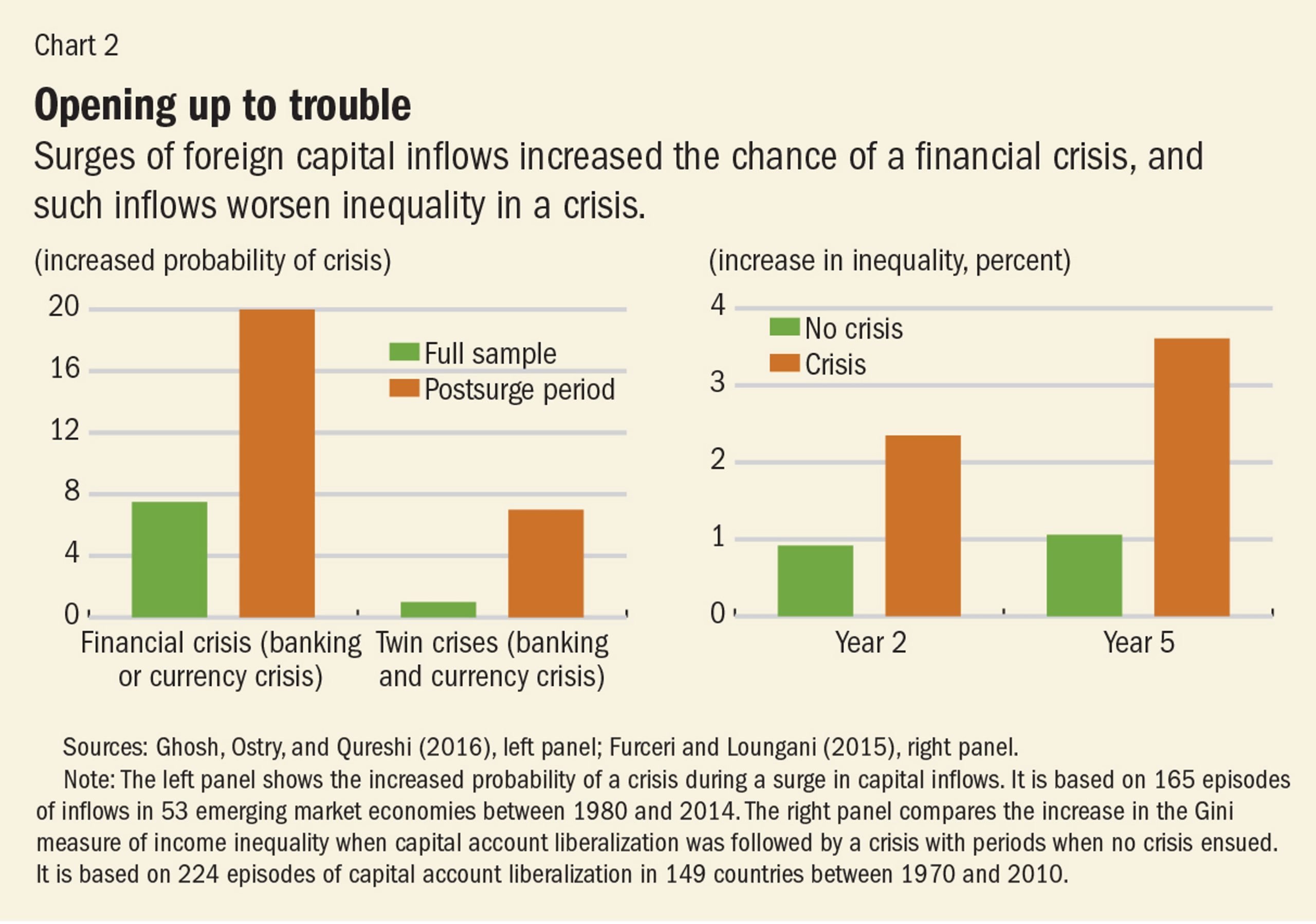
Yet the record is mixed. Joseph Stiglitz, David Harvey, Ha-Joon Chang and many other economists and political economists have criticized rapid liberalization and poorly sequenced privatization, particularly where institutions are weak. Importantly, even IMF economists Jonathan Ostry, Prakash Loungani and Davide Furceri concluded in 2016 that some prominent elements of the neoliberal agenda had been “oversold”: growth benefits were difficult to establish across broad groups of countries, while increased inequality and financial volatility were more evident.[4]
2.1 Between Success and Failure
Whether an economic model has “succeeded” depends on what is being measured: aggregate GDP, inflation control, productivity, employment, resilience, inequality, public services or household welfare. Policies associated with liberalization have produced gains in some circumstances, but those gains cannot automatically be attributed to a single ideological model.
Inflation and macroeconomic stabilization. Fiscal restraint and monetary stabilization have helped some countries control severe inflation, although austerity can impose substantial social and employment costs when applied too aggressively or during weak demand.
Foreign investment. Trade and investment liberalization can attract capital, technology and market access. Foreign direct investment is particularly different from short-term speculative flows and can support development when embedded in domestic supply chains and governed by effective regulation.
Export-led growth. China and Vietnam opened extensively to global trade and investment, but their growth models were never examples of a state withdrawing from economic strategy. Both retained powerful public institutions, state-owned enterprises, industrial policy and active direction of investment.
Chile. Chile’s reforms produced periods of strong growth and macroeconomic stability, but the country also retained or later developed forms of regulation and social policy that complicate the claim that its success resulted from pure laissez-faire liberalization.
The more defensible conclusion is therefore not that market liberalization always fails, but that sequencing, institutions and distribution matter. Capital-account liberalization, for example, has been associated with greater exposure to boom-and-bust cycles in emerging economies, while fiscal consolidation can increase unemployment and inequality. The IMF’s own research stresses that there is no fixed agenda that produces good outcomes in all countries and at all times.[4]
2.2 The European Lesson: Markets, Resilience and Strategic Infrastructure
The limits of a market-only logic are not confined to developing economies. Europe’s energy crisis after Russia’s invasion of Ukraine illustrated a broader problem: economic efficiency and strategic resilience are not always the same objective.
France provides a useful example. EDF had been partially listed, but the French state remained its dominant shareholder. In 2022 the government announced that it would acquire the remaining shares, and by June 2023 the state had returned to 100 percent ownership. The official rationale emphasized energy sovereignty and the strategic importance of nuclear electricity.[5] The lesson is not that privatization itself caused France’s energy problems; rather, strategic infrastructure can carry national-security and long-horizon investment obligations that ordinary market incentives do not fully capture.
The European Union’s dependence on Russian gas revealed the same tension at a continental scale. According to the International Energy Agency, Russian gas accounted for around 45 percent of EU gas imports in 2021.[6] That dependence was the result of many political, commercial and geopolitical choices—not simply private-company behavior. But it demonstrated how a supply structure that appears economically efficient in normal times can become a strategic vulnerability under geopolitical shock.
For Syria, the implication is straightforward: electricity grids, ports, water systems, telecommunications and hydrocarbon resources cannot be evaluated solely through the question of which bidder offers the fastest capital injection. The state must also ask what ownership structure protects continuity, resilience, pricing power, technological learning and national sovereignty over decades.
2.3 Lessons from Developing and Post-Conflict Economies
Iraq after 2003: The post-invasion restructuring of Iraq combined sweeping institutional change, trade opening and attempts to transform state-owned sectors under conditions of occupation, insecurity and weak institutions. The subsequent economic and political failures cannot be attributed to neoliberal policy alone; war, sectarian conflict, corruption and institutional collapse were central. Nevertheless, Iraq is a warning against attempting radical market restructuring before basic state capacity and political legitimacy are secured.[7]
Lebanon: Lebanon’s post-war model relied heavily on services, finance, capital inflows, real estate and a politically mediated reconstruction process. The 2019 financial collapse had multiple causes, including fiscal and monetary mismanagement, a dysfunctional political system and deep corruption. It nevertheless demonstrates the danger of an economy that produces impressive urban and financial expansion without building a sufficiently productive, accountable and resilient economic base.[8]
Turkey: Turkey’s experience is similarly complex. Liberalization, foreign capital and construction helped generate strong growth for years, but vulnerabilities accumulated through external financing, currency exposure, institutional deterioration and a development model increasingly tied to politically connected construction and credit. Turkey should therefore be read not as proof that “neoliberalism causes collapse,” but as a warning about growth models that become dependent on capital inflows and weak institutional checks.[9]
2.4 Why the Risks Are Greater in Developing States
Developing and post-conflict states often begin from conditions that make premature liberalization especially risky: high poverty, weak regulatory institutions, patronage networks, limited competition, shallow capital markets and severe infrastructure deficits.
First, domestic demand matters. A productive national economy requires citizens who can participate not only as workers but as consumers. Where purchasing power collapses, private investment may rationally orient itself toward export markets, luxury consumption or protected rents rather than toward broad-based domestic development. Social protection and wage recovery are therefore not merely welfare questions; they can be components of economic reconstruction.
Second, infrastructure requires long horizons. Electricity generation and transmission, railways, roads, water networks, schools and hospitals require enormous upfront investment and often produce returns over decades. Private capital can play a major role, but its incentives must be aligned through regulation, concession design and public planning with universal service, maintenance, resilience and affordability.
Third, weak states are vulnerable to regulatory capture. Privatization conducted before competition authorities, procurement systems, independent courts and transparent asset-valuation mechanisms exist can replace an inefficient public monopoly with a politically connected private monopoly.
Fourth, heavy dependence on volatile external capital can amplify international shocks. Ostry, Loungani and Furceri note that surges in capital inflows have repeatedly ended in financial crises in emerging markets, and that financial openness can worsen inequality when crises occur.[4]
Criticism of these risks is not inherently left-wing and does not require opposition to private property or markets. The central question is institutional: what combination of market incentives, public authority and social protection is most likely to create a productive, competitive and resilient economy?
3. Syria: Why Rapid Privatization Risks Becoming a Fire Sale
A fire sale occurs when valuable assets are sold under conditions of acute distress, so that the seller’s weakness becomes part of the price. Syria today possesses precisely the conditions that can produce such a distortion: enormous reconstruction needs, weak public finances, damaged institutions, limited access to capital, urgent demand for services and an understandable political desire to show rapid improvement.
Under these conditions, privatization may generate immediate cash and visible projects while transferring long-term strategic value at depressed prices. The problem becomes especially acute when public assets cannot be valued transparently, tender processes are opaque, competition is weak, or investors possess far greater bargaining power than the state.
David Harvey’s concept of “accumulation by dispossession” is useful here as a warning rather than a predetermined diagnosis: moments of crisis can enable the transfer of public or communal assets into concentrated private ownership under highly unequal bargaining conditions.[10]
For Syria, two risks deserve particular attention. The first is the formation of a new domestic oligarchy built around access to political authority, licenses, land and public contracts. The second is excessive dependence on foreign investors whose commercial or geopolitical priorities may not coincide with Syria’s long-term development needs.
Neither outcome is inevitable. Foreign capital will be indispensable to reconstruction, and private enterprise must be a major engine of recovery. The policy challenge is to attract investment without surrendering the state’s ability to regulate strategic assets, protect competition and preserve future public revenue.
3.1 The Emerging Economic Direction of the Transitional Authorities
The transitional authorities have not published a single comprehensive document defining Syria’s long-term economic model. It would therefore be premature to label the entire program definitively “neoliberal.” Yet several early policies display characteristics commonly associated with market-oriented restructuring: plans to privatize or restructure state firms, large reductions in public employment, simplified taxation, extensive reliance on foreign investment and the opening of infrastructure sectors to private capital.
Reuters reported in January 2025 that the new authorities were planning to privatize many state-run companies while reducing the public payroll, although officials also described strategic assets as exceptions and spoke of measures to protect vulnerable groups.[11] This distinction matters: reforming a bloated and patronage-ridden public sector is necessary, but reform is not synonymous with indiscriminate sale.
The energy sector illustrates both Syria’s need and the scale of the decisions now being made. In May 2025, the government signed a memorandum with an international consortium led by Qatar’s UCC for projects valued at about US$7 billion and intended to add 5,000 MW of generating capacity. The package included gas-fired combined-cycle plants and solar generation.[12] Later agreements moved toward implementation. For a country suffering severe electricity shortages, such investment can be transformative. Precisely because it is so important, the concession terms, risk allocation, pricing mechanisms, ownership structure and long-term fiscal obligations deserve maximum transparency.
Ports and hydrocarbons raise similar questions. Foreign operators can provide capital, logistics networks and technical expertise that Syria urgently lacks. But ports, oil and gas are also strategic assets. Contract design must therefore protect public revenue, competition, supply security, environmental standards and the state’s capacity to revise policy as conditions change.
The correct debate is consequently not “investment versus no investment.” It is whether Syria is negotiating from a coherent national strategy, with competent institutions and transparent rules, or whether urgency is allowing individual projects to determine the strategy by default.
3.2 Improvisation and the Absence of Long-Term Strategic Planning
Sustainable development rests on three interconnected foundations: political stability, economic sustainability and human development. Economic sustainability in turn depends on infrastructure that is reliable, adaptable, inclusive and capable of supporting productive activity.
The scale of Syria’s destruction makes strategic planning indispensable. The World Bank’s 2025 physical-damage assessment estimated US$52 billion in direct infrastructure damage alone, with total reconstruction costs across physical assets estimated at US$216 billion.[2] Such a challenge cannot be managed as a collection of disconnected investment announcements.
Syria needs a reconstruction road map that distinguishes emergency needs from medium-term recovery and long-term national development. Infrastructure built today may remain in service for forty or fifty years. Decisions about power generation, transport corridors, ports, water networks, telecommunications and urban form will therefore shape the geography of opportunity and inequality for generations.
Large towers, luxury developments and headline investment figures may create a powerful visual impression of recovery. They are not, by themselves, evidence of development. A reconstruction strategy should be judged by productivity, employment, affordable services, regional balance, human capital, fiscal sustainability and the capacity of Syrian firms and workers to move into higher-value activities.
The central danger is a recovery that looks spectacular in selected districts while leaving the majority of Syrians poorer, public services weaker and the national economy dependent on imported capital, imported technology and external political relationships.
4. The Alternative: A Twenty-First-Century Developmental State
Syria does not need another economic shock. A more appropriate starting point is the developmental-state tradition associated most clearly with post-war Japan, South Korea and Taiwan: market economies in which capable public institutions actively shaped industrial transformation, directed credit and investment, supported selected sectors and disciplined firms through performance requirements.
This should not be copied mechanically. The historical East Asian model emerged under very different geopolitical conditions, often under authoritarian governments and within a Cold War international order that offered unusual market access and strategic support. Syria in the twenty-first century needs a more open, accountable and socially inclusive version.
The objective is not state ownership of everything. It is a state capable of setting direction: building institutions, coordinating infrastructure, protecting competition, investing in human capital, retaining strategic leverage and creating incentives for private firms to invest in productive sectors rather than rents.
4.1 What Is a Developmental State?
A developmental state is one in which government assumes a deliberate leadership role in structural economic transformation. It goes beyond correcting isolated market failures and instead coordinates public and private resources toward long-term national objectives. It is neither a command economy nor a laissez-faire state.
4.2 Core Characteristics
4.2.1 A Competent Technocratic Bureaucracy
- A professional administrative apparatus relatively insulated from narrow political and private interests.
- Recruitment and promotion based primarily on competence and merit, particularly in economic, infrastructure and regulatory institutions.
- Specialized agencies capable of designing, evaluating and implementing long-term development policy.
4.2.2 State Autonomy
- The state must be able to take long-term decisions that may conflict with the short-term interests of powerful business groups, landowners, monopolies or political networks.
- Autonomy does not mean authoritarianism. In a democratic developmental model it should be combined with legal accountability, parliamentary oversight, independent courts and public transparency.
4.2.3 A Clear Development Vision
- A national strategy should identify the structural transformation Syria seeks over twenty to forty years.
- Industrialization remains important, but modern industrial policy should include digital services, pharmaceuticals, advanced agriculture, logistics, energy technologies and other tradable sectors.
4.2.4 A Strategic Alliance with Business
- The relationship should be neither total state control nor unconditional business freedom.
- The state can provide infrastructure, credit support, research capacity, export assistance and temporary protection, while requiring measurable performance in productivity, exports, employment, technology transfer and local value creation.
- Alice Amsden famously described part of the East Asian approach as “getting prices wrong”: deliberately altering market incentives to channel capital toward strategic activities rather than assuming that current market prices always produce the socially optimal allocation.[13]
4.2.5 Export Orientation
- Support for infant industries should not become permanent protection for inefficient firms.
- Exposure to international markets can provide a performance test. Export capability, quality standards and productivity growth should become central measures of whether supported sectors are actually becoming competitive.
4.3 Difficulties of Applying the Model in the Twenty-First Century
The classic developmental state operated in a world of greater national policy space. Today, World Trade Organization rules, global value chains, digital markets, climate constraints and mobile capital limit some traditional instruments of protection and subsidy.
Moreover, the East Asian successes depended on unusually capable bureaucracies. In Syria, this is the central constraint. Intervention by a weak or corrupt state can be as destructive as unregulated privatization: it can generate clientelism, politically allocated credit, artificial exchange rates, protected monopolies and waste.
The lesson is therefore not simply “more state.” It is better state capacity.
4.4 A More Flexible Syrian Development Model
4.4.1 From Traditional Industrialization to Smart Specialization
- Pharmaceuticals and biotechnology: rebuild on Syria’s pre-war scientific and manufacturing base while integrating international quality standards.
- Software and information technology: a relatively capital-light sector that can draw on Syrian human capital and diaspora networks.
- Renewable-energy supply chains: use the electricity crisis not only to import generating capacity but to build local installation, maintenance, engineering and selected manufacturing capabilities.
- Agri-food processing: connect agriculture to higher-value packaging, cold chains, food processing and export logistics.
4.4.2 Smart Partnership Instead of Closed Protection
- Use public-private research institutes and competitive innovation grants to support research and development.
- Employ quality, health, environmental and safety standards to raise domestic capabilities rather than merely block imports.
- Support exporters through logistics, market intelligence, certification and trade finance rather than relying only on cash subsidies.
- Integrate Syrian firms into global value chains. Syria does not need to manufacture an entire automobile to participate in advanced industry; it can specialize in components, engineering services, pharmaceuticals, software or other niches where skills and location provide an advantage.
4.4.3 The Absolute Priority: Institutions First
This is the most important condition in the Syrian context. A developmental strategy requires a competent and honest bureaucracy. Interventionist policies implemented through weak institutions can quickly become mechanisms for patronage and corruption.
The first economic reform is therefore institutional: independent and functioning courts, transparent procurement, public disclosure of major concessions, credible auditing, competition law, professional regulators and anti-corruption enforcement. Without these foundations, both neoliberal and developmental models can fail.
4.4.4 Social Justice as a Condition of Stability
Classic developmental states sometimes subordinated social equality to rapid growth. That would be dangerous in post-conflict Syria, where poverty, displacement and regional grievances are already profound.
Social protection, healthcare and education must therefore be part of the development strategy rather than residual spending added after growth occurs. Rebuilding people is more important than rebuilding concrete.
4.5 A Road Map for Syrian Economic Policy
The immediate objective should be rebuilding state capacity and social trust, not maximizing short-term asset-sale proceeds.
Planning should operate on three horizons: an emergency horizon of roughly one to three years; a medium-term horizon of five to ten years; and a long-term infrastructure and structural-transformation horizon extending several decades. These horizons must be connected: an emergency electricity contract, for example, should not foreclose the energy strategy Syria may need twenty years later.
A national reconstruction authority or equivalent coordinating mechanism could publish sectoral plans, standardized concession principles, procurement rules, debt and contingent-liability disclosures, and measurable development targets. Major strategic contracts should be evaluated not only for headline investment value but for lifetime fiscal cost, ownership, tariffs, technology transfer, local employment and resilience.
4.6 Phases of Administrative and Economic Recovery
Phase One: Emergency and Relief (approximately years 1–2)
- Restore basic services and administrative functionality, using international grants and concessional finance where possible.
- Support small and medium-sized Syrian enterprises in agriculture, food production, repair, construction services and local manufacturing through transparent credit and guarantee programs.
- Reform essential public institutions rather than selling them under distress. Hospitals, schools, municipal services and core infrastructure require immediate rehabilitation.
- Create transparent registries of state assets, public liabilities and major concessions before any large privatization program.
Phase Two: Reconstruction and Stabilization (approximately years 3–5)
- Build a fairer and administratively realistic tax system capable of financing public services.
- Prioritize productive investment in manufacturing, agriculture, logistics and tradable services—not only import, consumption and real estate.
- Use public-private partnerships selectively for infrastructure where risks can be allocated transparently and the state retains regulatory control.
- Keep ownership or decisive strategic control over finite natural resources such as oil and gas while contracting private firms for technology, management, construction or operation where appropriate.
- Design tariffs and concessions to protect affordability, competition and public revenue.
Phase Three: Growth and Development (after approximately five years)
- Only after regulators, courts, competition institutions and transparent capital markets have become credible should Syria consider broader privatization of non-strategic assets.
- Privatization should then proceed from a position of institutional strength rather than fiscal desperation, through transparent valuation, competitive bidding and safeguards against concentration.
- Industrial and innovation policy should increasingly shift from reconstruction toward productivity, exports, technology and human-capital upgrading.
5. Conclusion: Syria Cannot Gamble with Its Future
In Syria, the economic and the political cannot be separated. Social divisions remain deep, public trust is weak and the distribution of property is inseparable from questions of justice, displacement, regional balance and political legitimacy. A badly designed privatization process could therefore become more than an economic error; it could create new social and political grievances.
Syria is not a bankrupt company whose assets can simply be broken up and sold. It is a country attempting to rebuild a state, an economy and a social contract at the same time.
The central warning of this paper is not against markets, foreign investors or private enterprise. Syria needs all three. It is against irreversible decisions made before the institutions required to govern them exist.
A successful reconstruction strategy must combine investment with sovereignty, competition with regulation, private initiative with public capacity, and growth with social justice. The state should not attempt to produce everything. But it must be capable of deciding what cannot safely be surrendered, what must be regulated, what should be temporarily supported, and what kind of economy Syria wants to possess when the emergency has passed.
The choice is therefore not between an Assad-era public sector and an unrestricted market. Syria can choose a third path: a capable, accountable developmental state that builds markets rather than abandoning them, mobilizes private capital without becoming subordinate to it, and treats human development as the foundation of reconstruction.
Reconstruction should not be a sale of Syria’s weakness. It should be the construction of Syria’s future.
References
[1] World Bank, Doing Business 2009: Syria country profile.
[8] Fabrice Balanche, “The Reconstruction of Lebanon or the Racketeering Rule,” 2024.
[14] Joseph E. Stiglitz, Globalization and Its Discontents, W.W. Norton, 2002.
[15] Thomas Piketty, Capital in the Twenty-First Century, Harvard University Press, 2014.
Prepared as an English publication edition.


