
By: Alaa Al-Khatib
18/02/2026
If the state of Medina was formed around the persona of the Founder, the most critical question was not how it emerged, but rather: What happens when the Founder is gone? Was there a complete governance mechanism? A constitution for the transition of power? A pre-defined system of succession? Or did politics, in its rawest form, immediately resurface?
Traditional discourse promotes the idea of the “Rashidun Caliphate” (The Rightly Guided Caliphate) as a solid block of spiritual consensus. However, a political reading of history reveals a major moment of rupture. The question raised was not “Who is the most pious?” but rather: “Who holds the right to decide?” and “How is a state managed without a written text for the transition of power?”
In this stage, we face three moments that redefined politics in early Islam: The Saqifa, the Ridda, and the Conquests. Here, the imagined ideal model collapsed, and the model of the “State of Dominance and De Facto Reality” was born.

The Saqifa: A Political Meeting Before the Burial
Before the Prophet was buried, the Ansar (The “Helpers”—the local inhabitants of Medina who supported the Prophet) gathered in Saqifat Bani Sa’idah (A roofed gathering place belonging to the tribe of Bani Sa’idah). This was not a meeting for preaching or a council of jurisprudence; it was an urgent political meeting titled: Who Rules?
The Ansar put forward their candidate, Sa’d ibn Ubadah, the leader of the Khazraj tribe and the master of the Ansar. The Muhajirun (The “Emigrants”—those who migrated from Mecca to Medina) arrived quickly, represented by Abu Bakr al-Siddiq and Omar ibn al-Khattab. A heated debate ensued, and proposals were exchanged.
It was suggested: “An amir (leader) from us and an amir from you,” proposing a power-sharing formula. However, the argument that ultimately prevailed was not a Quranic text nor a Prophetic Hadith (Record of the traditions or sayings of the Prophet), but rather a socio-political argument. As Omar ibn al-Khattab stated: “The Arabs will only submit to Quraysh” (The Prophet’s tribe and the most powerful tribe in Mecca). Quraysh’s tribal status in the peninsula was incomparable to that of the Aws and Khazraj (The two main tribes of the Ansar). The logic of Asabiyyah (Social solidarity with an emphasis on tribalism or clanism) and the centrality of Quraysh settled the debate.
In a decisive moment, Omar initiated the Bay’ah (An oath of allegiance) to Abu Bakr, others followed, and Abu Bakr became the first Khalifa (Caliph—the successor and leader of the Muslim community).
Analytically, we are looking at elite negotiation, a race for decision-making, swift resolution, a balance of power, and the absence of a prior constitutional text. No binding text was used to define the mechanism of power transition. No decisive verse or definitive Hadith was invoked. It was a political negotiation in every sense. The transition of power occurred through an emergency decision in a limited meeting, not through a previously codified system. Thus, the first sovereign decision after the Founder was made in an emergency meeting, not in a written text.
The Ridda Wars: A Crisis of Loyalty or a Crisis of Faith?
As soon as the Saqifa was settled, the Arabian Peninsula erupted. Many tribes refused to pay Zakat (The mandatory alms-giving in Islam, treated here as a state tax), rejected central authority, declared independence, and followed local leaders. Some actually apostatized in a creedal sense, such as the followers of Musaylimah ibn Habib (often called Musaylimah the Liar) among the Bani Hanifa, the followers of Tulayha al-Asadi, and the followers of Al-Aswad al-Ansi in Yemen.
Tribes like Tamim, Hanifa, Sulaym, and Hawazin were not saying “No to God,” but rather “No to Quraysh as a permanent center for decision-making and wealth.” To them, Zakat was being read as a political tribute to a new center.
Asabiyyah (Tribal loyalty) was the primary driver of the tribal rebellion. Perhaps the saying: “The liar of Rabia (Musaylimah) is dearer to us than the truthful one of Mudar (The Prophet),” summarizes the core of the scene. This is not a theological statement, but a purely political one. The struggle was not only over divine truth but over sovereignty, leadership, and the center of power.
The new authority viewed this as a political rebellion and dispatched armies. The Ridda Wars (The Wars of Apostasy) broke out—bitter and fateful wars. Abu Bakr’s victory was a victory for the organized Asabiyyah of Quraysh and its allies over the fragmented loyalties of other tribes.
This rebellion against the central authority of Quraysh was, in a theological reading, an apostasy from religion (Ridda). However, in a sociological reading, it was a rebellion against the center and a refusal of the redistribution of power. The nascent state could not survive without a monopoly on decision-making and taxation. Thus, the first war the state fought after the Founder was a war to establish Centralization.
The Dialogue Between Abu Bakr and Omar: The Monopoly on Force
A famous narration recounts the dialogue between Omar and Abu Bakr regarding fighting those who refused to pay Zakat. Omar asked: “How can we fight them (when they still profess faith)?” Abu Bakr replied: “By Allah, if they withhold even a camel-tether (a small piece of rope) which they used to give to the Messenger of Allah, I will fight them for withholding it.” Omar later stated that he realized God had opened Abu Bakr’s heart to the fight and knew it was the truth.
This dialogue is usually read as an example of creedal firmness. However, politically, it is the first explicit application of the principle of the State’s monopoly on the use of force and the monopoly on taxation. The issue was not just worship; it was Financial Sovereignty. The state needed resources to survive and prepare for its expansion project. It either had to be a coercive central power or return to being a transient tribal alliance. Therefore, the Ridda Wars were wars to establish sovereignty, not just a theological debate.
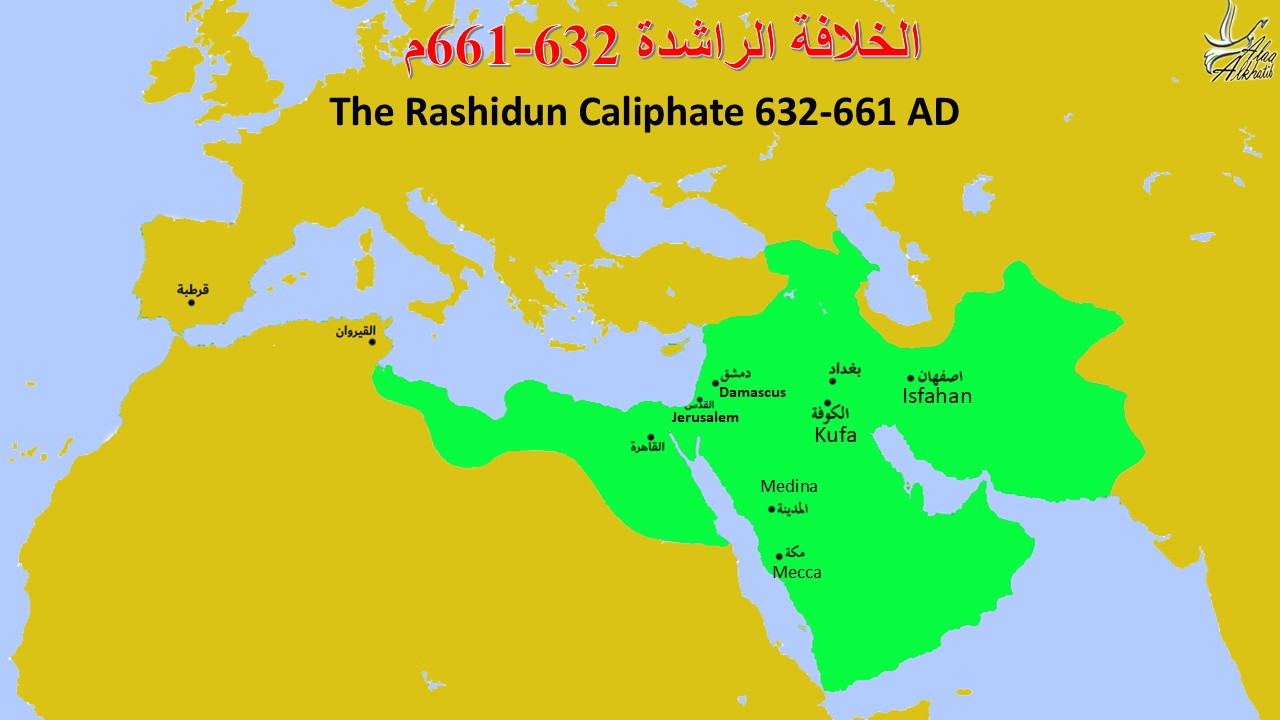
The Conquests: State Expansion, Not Just a Religious Call
After securing the interior, the armies headed outward. We are no longer facing a missionary group, but an organized military machine. The Conquests were not merely a spiritual impulse; they were a response to economic necessities (need for resources), tribal dynamics (directing the energy of raiding outward), and political needs (expanding the “Lebensraum” or vital space).
The tribes, having stopped internal fighting, needed a new arena. Ghanima (Spoils of war) was not a minor detail in the wars of expansion; it was a material engine that ensured tribal loyalty to the center. The nascent state realized its survival depended on the flow of resources from abroad. The Persian and Byzantine empires were relatively weak, opening the way for rapid expansion. The matter was no longer just a “spreading call,” but an expanding state.
Omar’s Diwan: The Birth of Bureaucracy and Hierarchy
During the era of Omar ibn al-Khattab, the “Diwan al-Ata” (The Department of Distribution/Stipends) was born. For the first time, the names of fighters and early converts to Islam were recorded, and the distribution of salaries from the Bayt al-Mal (The State Treasury) was organized.
However, the distribution was not equal. Clear criteria were set for distributing wealth among Muslims, including: seniority in Islam, kinship to the Prophet, and performance in battles. Thus, the distribution order was graded from the Muhajirun to the Ansar and the veterans of the Battle of Badr, followed by other categories. Consequently, a financial-political hierarchy emerged. Society was no longer just an equal community of believers; it became financial classes linked to their proximity to the center and the “Sword of the State.”
Al-Ata and Asabiyyah: The Nationalization of the Tribe
The Ata (Stipend) was not paid only to individuals, but through the tribal gateway. The tribal leader would distribute it within his tribe. In this way, Asabiyyah (Tribal solidarity) was not abolished but “nationalized.” The state linked tribal loyalty to salaries, transforming it from a potential threat into a tool of control. Therefore, “citizenship” did not pass through the individual, but through the tribe. This model merged the state with tribalism instead of dismantling it.
The Machinery of Wealth and Sovereignty
When Omar established the Diwans (Administrative departments/registers), he was not practicing preaching; he was building resource management. Every Muslim became a financial entry in the state’s records. The fighter transformed from a volunteer raider into a professional soldier receiving a regular stipend.
However, the system carried the seed of internal tension: the closer you were to the center of Quraysh and the earlier you were in the struggle, the higher your stipend. Here, a financial-political elite was born, which would play a major role in future conflicts.
Conclusion: From Spiritual Legitimacy to the Legitimacy of Dominance
We have seen that the Saqifa was a negotiation over power, the Ridda Wars were a war over the centralization of the state, the Conquests were wars of state expansion, and the Diwan al-Ata was the foundation of the ruling class and socio-economic stratifications.
Power did not transition smoothly through a written text, but through the sharpness of decision and the speed of resolution. The state was not born from a ready-made “catalog,” but was shaped through a conflict of wills and the necessities of survival.
In the next article, we reach the most dangerous moment: when the conflict moves from the peripheries to the heart of the house of governance. From the assassination of Omar to the Great Fitna (The first civil war in Islam), when Muslim blood was shed in abundance and politics within Islam was redefined once again.
——————-
You might want to read the full paper at this link:
History of Islam (full article): Islam Between the Sacred and the Human
Or you might be interested in reading the rest of the series:
- Sovereignty and Negotiation: An Analytical Reading of the Formation of the “Medinan Polity”
- Post-Founder Era: The Struggle for Legitimacy and the Test of Survival. The Saqifa, the Ridda, and the Conquest
- From Omar’s Assassination to the Great Fitna: The Cracking of the Center. When the State Devours its Children
- From Caliphate to Kingdom: The Birth of the Empire, The Umayyad Dynasty
- The Global Empire: The Labor of Nationalities and the Making of the Muslim Mind. The Power vs. The Jurist
- The Breaking of the Center: The Era of Sultans and the Making of Orthodoxy
- The Era of Fracture: Crusaders, Mongols, and the Fiqh of Siege
- The Tunnel of Stagnation and the Shock of Awakening
- The Crossroads: Aborted Enlightenment and the Rise of Ideology
- The Historical Trial: Toward an Islam Without Idols


