By: Alaa Al-Khatib
26/02/2026
The Shock of Awakening: Al-Afghani’s Surgery and Muhammad Abdu’s Rationalism
Napoleon’s campaign in Egypt was not merely a military invasion; it was a “cognitive earthquake” that woke the East from centuries of slumber. In this atmosphere charged with defeat, Jamal al-Din al-Afghani appeared. A man who traversed capitals from Kabul to Paris, he cried out to the Islamic world: “Wake up!” Al-Afghani was not interested in traditional jurisprudence; he was a “political revolutionary” who saw Islam as a tool for liberation from colonialism.
However, the project took a deeper and more serious turn with his disciple, Muhammad Abdu. Abdu realized that the ailment lay not just in Western cannons but in the “calcified Muslim mind.” He called for liberating thought from the shackles of tradition (stagnant clericalism) and believed that reason and revelation do not collide. He sought a “Civil Religion” that respects women, sanctifies science, and reconciles with the constitution. Yet, this “Enlightenment” project was fragile, colliding with the stagnation of Al-Azhar (the traditional clerical institution) on one hand and political ambitions on the other.
Rashid Rida: The Shift Toward Reformist Salafism
After Muhammad Abdu’s death, his legacy passed to his student, Rashid Rida. However, Rida lacked his mentor’s flexibility. With the collapse of the Ottoman Caliphate in 1924, the “Reformist Mind” suffered an identity panic. Rashid Rida gradually shifted from “Rational Enlightenment” to “Introverted Salafism.” Through his influential magazine, Al-Manar, he began pumping ideas that saw returning to the past and adhering to the “Salaf” (the ancestors) as the only way to save the Muslim identity from melting before the West. Rida was the “bridge” over which Islamic movements later crossed from the shore of “Reform” to the shore of “Ideology.”
The Birth of “Activism”: Hassan al-Banna and the Nationalization of Religion
In 1928, in the city of Ismailia—then under British occupation—Hassan al-Banna picked up Rashid Rida’s threads and turned them into an “organizational machine.” Al-Banna was not a philosopher like Abdu; he was an “Organizational Engineer.” He moved Islam from being an “individual faith or philosophical inquiry” to becoming “Comprehensive” (The slogan: Islam is the Solution for everything: politics, sports, economy).
Here, “Activist Islamism” was born. Religion gained a “secret apparatus,” a pledge of allegiance (Bay’ah), and the principle of “Hearing and Obedience.” Al-Banna replaced the “Critical Mind” with “Organizational Emotion.” At this moment, religion began to lose its function as a “moral compass” and became a “political identity card” aimed at reaching power and restoring an “imagined Caliphate.”
Mawdudi and Sayyid Qutb: Inventing “Hakimiyya” and Jahiliyya
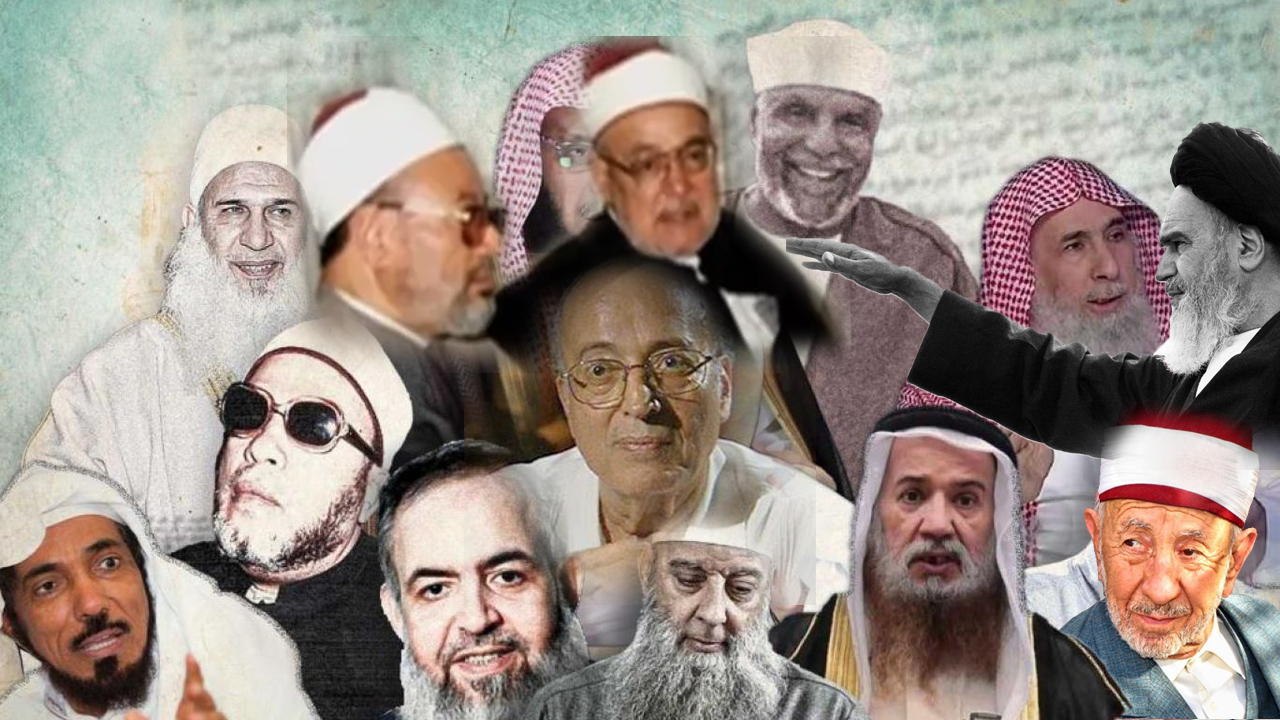
While Al-Banna was building the organization in Egypt, Abul A’la al-Mawdudi in India was founding “Emotional Separation.” Mawdudi invented the term “Hakimiyya” (God’s absolute sovereignty), the idea that any human legislation is “Shirk” (polytheism). This intellectual contagion moved to Sayyid Qutb in Nasser’s prisons in Egypt.
Qutb went to the extreme, dividing the world into two camps: “Islam” and “Jahiliyya” (Pre-Islamic state of ignorance). For Qutb, the contemporary Muslim society was no longer Muslim, but a pagan society from which one must separate “organically and emotionally.” This “Qutbist” thought removed the sense of security within societies and transformed the concept of “Jihad” from a defense of borders into a struggle against the “Infidel Interior.” This gave birth to the first seeds of Takfiri (excommunicating) groups and the bloody clashes of the 20th century.
The Duality of the “Activist” and the “Cleric”: The Struggle for Sovereignty
In the 20th century, the Muslim lived lost between two distorted models:
- Clerical (Official) Islam: Prestigious institutions (like Al-Azhar) fell into the trap of “Functionalism.” The cleric became a “state employee” blessing the ruler’s decisions and using jurisprudence to numb the masses or suppress opponents. This “Domesticated Islam” cost the religious institution its moral prestige.
- Activist (Oppositional) Islam: Movements using religion as “fuel” to reach power. They raise bright slogans but lack any real project for development or freedom and possess no viable theory of state.
The clash between the “Cleric” and the “Activist” was not a struggle over values, but over “who has the right to speak on behalf of God.” The ruler uses the cleric, the organization uses victimhood, and the citizen sees their religion reduced to a “beard,” a “veil,” or a “political slogan,” while nations advance in science and technology.
Sectarianizing the Gulf: When the Sect Became a Nuclear Weapon
The rise of “Clerical and Political Islam” cannot be understood without looking at the 1979 Iranian Revolution. It was not just a regime change but the birth of a transnational “Shia Radicalism.” The regimes on the opposite shore felt an existential threat.
Instead of facing this challenge with development or democratic projects, the authorities (through their political-clerical alliance) summoned the “Sectarian Boogeyman.” Billions were pumped into traditional clerical institutions to reproduce a Wahhabi-Salafi discourse that views the “Shia Other” as an eternal enemy. Conversely, Iran did the same by exporting “Shia Victimhood.” The sect became a “Social Nuclear Weapon.” This aimed at one purpose: consolidating power and delaying any political or rights-based demands. The Muslim citizen became fuel in an ideological war where reason was absent, leading to the destruction of social fabrics in Iraq, Syria, Yemen, and Lebanon.
Sadat’s Deal: When Religion Became a Taming Tool
Regional politics alone were not the driver; “local deals” changed history. In Egypt, President Anwar Sadat made a dangerous gamble: his famous deal with the Muslim Brotherhood. The trade-off was clear: Sadat gave them a free hand in society—controlling universities, syndicates, and the streets—and opened media and mosques for them to strike his leftist and Nasserist rivals. In return, they were to provide “religious legitimacy” or neutralize opposition to his political projects, specifically the Camp David Accords.
This deal was the “catastrophe” that legalized the presence of Activist Islamism in the heart of the state, turning it from an opposition thought into a parallel “Social Authority.” This moment solidified the “Clerical-Political Authority” where religious discourse was used to tame the masses.
The End of the Tunnel: From Afghanistan to the Arab Spring
This ideology peaked in the “Afghan Jihad,” where Gulf money met American weapons and Qutbist thought to produce Al-Qaeda and later ISIS. These distorted entities were the logical result of turning religion into a combatant ideology.
With the explosion of the “Arab Spring,” political Islam (like the Brotherhood in Egypt) reached power, but the shock was horrific. People discovered that slogans do not provide bread, and the concept of “Hakimiyya” knows nothing about managing an economy or respecting pluralism. The failure of this experiment has led to what we see today: a state of “fluidity,” atheism, or abandoning activist religiosity, and an anxious search for a “New Islam” that returns us to the lost values of Muhammad Abdu—an Islam of reason and human dignity, not of a “Supreme Leader” or a “Sultan’s Cleric.”
Conclusion
In this episode, we have toured over the corpses of grand ideas; we saw how “Reform” turned into an “Explosion.” But is there a way out? After all this sectarian and ideological destruction, can the Muslim mind reconcile with modernity without losing its soul? In the tenth and final episode, we will summarize the results of our journey and map the path toward the future.
——————-
You might want to read the full paper at this link:
History of Islam (full article): Islam Between the Sacred and the Human
Or you might be interested in reading the rest of the series:
- Sovereignty and Negotiation: An Analytical Reading of the Formation of the “Medinan Polity”
- Post-Founder Era: The Struggle for Legitimacy and the Test of Survival. The Saqifa, the Ridda, and the Conquest
- From Omar’s Assassination to the Great Fitna: The Cracking of the Center. When the State Devours its Children
- From Caliphate to Kingdom: The Birth of the Empire, The Umayyad Dynasty
- The Global Empire: The Labor of Nationalities and the Making of the Muslim Mind. The Power vs. The Jurist
- The Breaking of the Center: The Era of Sultans and the Making of Orthodoxy
- The Era of Fracture: Crusaders, Mongols, and the Fiqh of Siege
- The Tunnel of Stagnation and the Shock of Awakening
- The Crossroads: Aborted Enlightenment and the Rise of Ideology
- The Historical Trial: Toward an Islam Without Idols


