By: Alaa Al-Khatib
25/02/2026
How did scientific creativity fall silent for 500 years after Ibn Khaldun? How did the Ottoman Caliphate transform into the “Sick Man of Europe”? In this final episode of the season, we observe the rise of the Ottomans as a formidable military power and the violent sectarian transformation in Iran under the Safavids. We explore how the prohibition of the “Printing Press” isolated an entire nation from its era, and how Wahhabism emerged to revive the “Fiqh of Siege,” leading to the moment of truth before Napoleon’s cannons and the final collapse of the Sultanate.
Sovereignty of the Sword: The Ottoman Military Machine
While the East was drowning in the chaos of the Mamluks and fragmented emirates, the Ottomans emerged as a force unprecedented in history for its military organization. They did not just inherit the land; they inherited the “Legitimacy of the Sword.”
Under Selim I, the Sultanate transformed from a frontier principality in Anatolia into a global empire that swallowed the old capitals of the Caliphate in Egypt, the Levant, and the Hejaz. The Ottomans introduced the concept of the “Central Military Sultanate,” where the army was the pillar of the state and the “Janissaries” were the invincible strike force. They halted European expansion in the heart of the continent, but this colossal military might came at a heavy price: it lacked the philosophical and spiritual depth that characterized Baghdad or Cordoba. The state became a “fortified castle” protecting Islam, but it was no longer a “lighthouse” producing science.
Engineering Identity: How Iran Became Shia
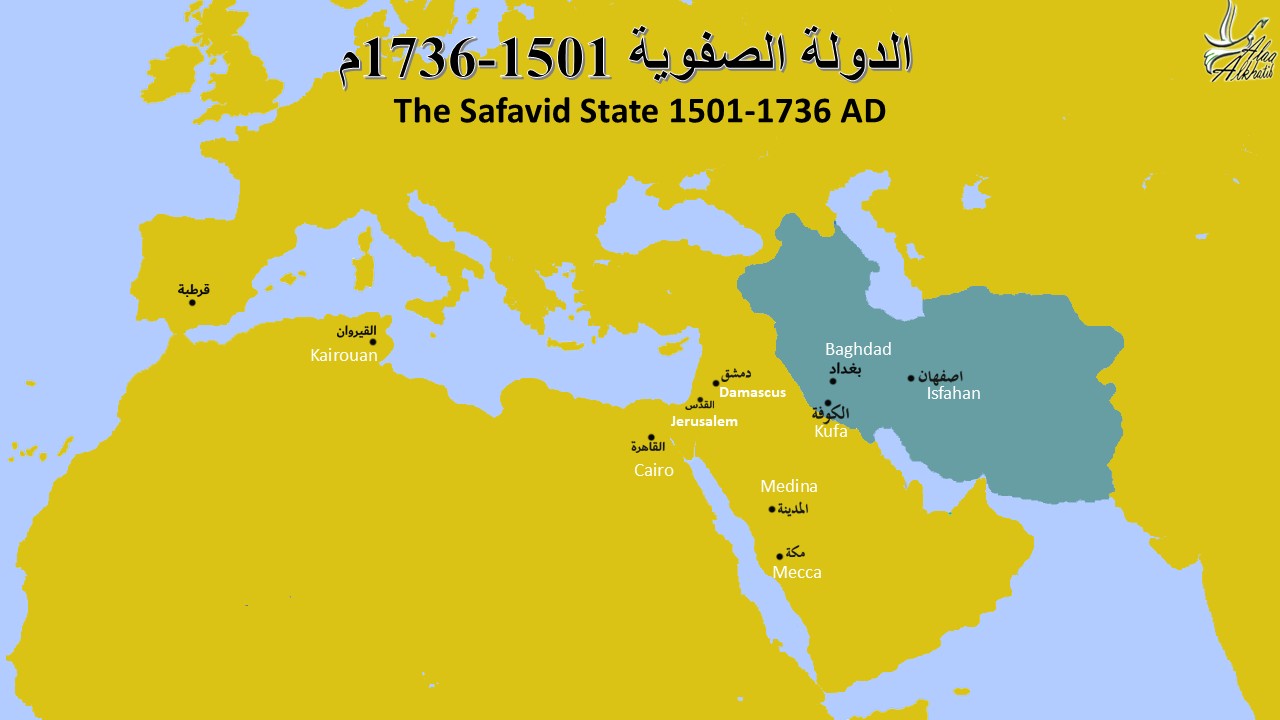
Before the Safavids, Iran was a country with a clear Sunni majority. However, Ismail I (the Safavid Shah) was not just looking for a kingdom, but for a “distinct nation.” By a decisive political decree, he declared Twelver Shi’ism as the official state religion.
This was not merely a religious calling; it was “Forced Identity Engineering.” The Safavids gave the people two choices: “The Sect or the Sword.” Historians describe how oratory in mosques and street surveillance were used to impose the new sect. Those who aligned with the ruler survived; those who clung to their heritage faced persecution. This moment proves how absolute power can flip the “people’s religion” in a single generation—not necessarily out of spiritual conviction initially, but as a mechanism for political survival and distinction from the neighboring Ottoman environment.
The War of a Million Victims: The Ottoman-Safavid Clash
While Europe was waking up, the East was burning in the fiercest sectarian-national conflict. The clash between the Ottomans (protectors of Sunnism) and the Safavids (protectors of Shi’ism) was not a mere military excursion; it was a “War of Continuous Annihilation.”
The Battle of Chaldiran (1514) and the conflicts that followed for two centuries were not just army confrontations; they involved the pillaging of cities and villages. Shocking historical estimates suggest that the victims of this extended conflict, between battle casualties and mutual sectarian cleansing in border cities, reached nearly one million. This “Million-Victim War” drew the bloody borders between the two neighbors and caused the East to bleed its energies internally rather than facing the coming Western rise.
The Tunnel of Stagnation: When the Mind Stopped
Between the 15th century and the modern era, the Islamic world entered a terrifying intellectual silence. Figures like Avicenna or Ibn Khaldun vanished. Even in religion, no scholars emerged with the weight of the great Imams or Al-Ghazali. Science turned into “Glosses on the Texts” (marginalia) and commentaries on commentaries.
The greatest symbol of this closure was the Prohibition of the Printing Press for over 200 years. While Europe was printing millions of books and entering the Renaissance, the Islamic world was still copying manuscripts by hand, creating a knowledge gap that has not been bridged to this day.
Wahhabism: The Return to Radicalism
In the heart of the Arabian Peninsula, the Wahhabi movement emerged. Inspired by Ibn Taymiyya’s thought from eras of “siege,” the first Saudi state was founded on the alliance of “The Sheikh and the Sword.” Wahhabism revived the concept of Takfir (excommunication) against other Muslims under the guise of fighting “innovations and polytheism,” launching bloody wars that shook the Ottoman Sultanate and reproduced the “Fiqh of Closure” in its harshest forms.
The Millet System: Stability Under a Ceiling of Discrimination
Under the Ottoman Sultanate, religious minorities lived under what was called the “Millet System.” The Ottomans granted them autonomy in their worship and personal status laws, but this “administrative tolerance” did not prevent a strict social hierarchy. Christians and Jews remained confined behind the inherited “Ghiyar” system; they were forced to wear distinguishing clothes and were forbidden from riding horses or wearing luxury turbans—a constant signal of the subordination of “Dhimmis” to the state. Meanwhile, sectarian minorities (Alawites, Druze, Shias) fared worse, viewed with political suspicion as a “fifth column” in the conflict with the Safavids.
Muhammad Ali and His Son: The Aborted Modernization
Muhammad Ali Pasha emerged in Egypt as a modern force that nearly swallowed the Ottoman Sultanate itself. His son, Ibrahim Pasha, reached the walls of Istanbul (The Sublime Porte) with his army. Here, the great irony occurred: Britain and European powers intervened to save the “Ottoman Caliph” from the ambitious Muslim commander! It was not love for the Ottomans, but a desire to keep the center weak until the time came to partition it.
The Shock and Collapse: From Napoleon to the Great War
Contact with the West began as an “electric shock”: Napoleon’s campaign in Egypt, and interventions in Lebanon and North Africa. Muslims suddenly discovered they were living in the Middle Ages while the enemy possessed cannons and printing presses. The Ottomans attempted reform (The Tanzimat), but it was too late. World War I was the final bullet to the “Sick Man,” as the Sultanate fragmented and the Caliphate became a memory of the past.
Ibrahim Pasha’s Earthquake: When the Christian Rode a Horse
In 1831, an earthquake shook these ancient structures. Ibrahim Pasha entered Damascus as a conqueror, bringing with him not just cannons, but shocking concepts of “Citizenship.” In a historic moment that broke centuries of tradition, he issued a bold decree: abolishing restrictions on clothing and riding.
Imagine the scene in the alleys of old Damascus: Christians wearing colorful turbans and luxury clothes, riding purebred Arabian horses amidst the shock of traditionalist groups. This was not a change in “fashion”; it was the announcement of the fall of the “System of Discrimination.” By including minorities in consultative councils, Ibrahim Pasha planted the seeds of the “Modern State” where people are equal before the law, not the sect—a shock that paved the way for the Arab Renaissance (Nahda).
Conclusion
With the departure of Ibrahim Pasha and the fragmentation of the “Sick Man,” the history of Islam did not end; it entered a new, more complex phase. The political institution (the Caliphate) fell, but the big questions remained: How do we face Western modernity? Can religion be reconciled with the modern state?
While European cannons were drawing the Sykes-Picot borders, there was an intellectual movement under the ashes trying to answer—led by men like Al-Afghani and Muhammad Abdu, opening an era of “Anxious Enlightenment” before political slogans swallowed the spark of reform.
——————-
You might want to read the full paper at this link:
History of Islam (full article): Islam Between the Sacred and the Human
Or you might be interested in reading the rest of the series:
- Sovereignty and Negotiation: An Analytical Reading of the Formation of the “Medinan Polity”
- Post-Founder Era: The Struggle for Legitimacy and the Test of Survival. The Saqifa, the Ridda, and the Conquest
- From Omar’s Assassination to the Great Fitna: The Cracking of the Center. When the State Devours its Children
- From Caliphate to Kingdom: The Birth of the Empire, The Umayyad Dynasty
- The Global Empire: The Labor of Nationalities and the Making of the Muslim Mind. The Power vs. The Jurist
- The Breaking of the Center: The Era of Sultans and the Making of Orthodoxy
- The Era of Fracture: Crusaders, Mongols, and the Fiqh of Siege
- The Tunnel of Stagnation and the Shock of Awakening
- The Crossroads: Aborted Enlightenment and the Rise of Ideology
- The Historical Trial: Toward an Islam Without Idols


